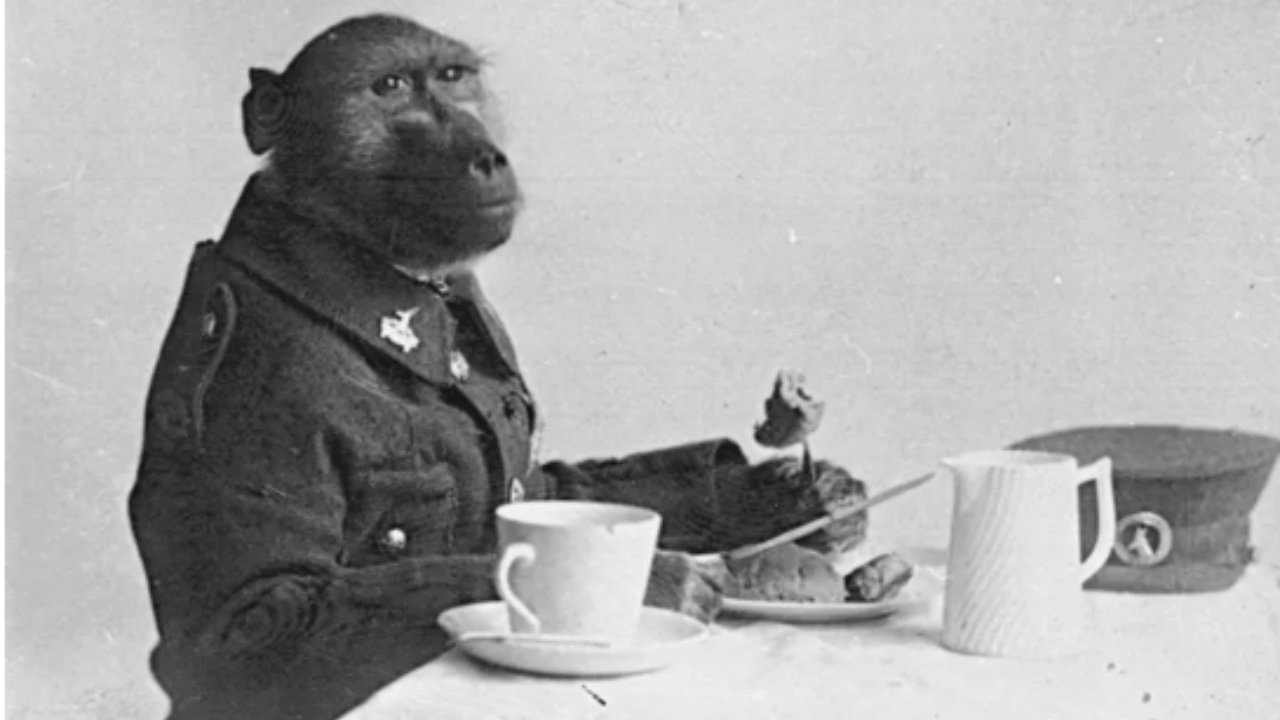
History loves a heartwarming mascot story, especially when it involves the grim, muddy trenches of the First World War. For decades, popular history outlets have parroted the same soft-focus narrative: Corporal Jackie, a chacma baboon from South Africa, was a brave "soldier" who willingly served alongside the 3rd South African Infantry Regiment, saluted officers, stood guard, and was tragically but heroically wounded at the Battle of Passchendaele.
It is a comforting tale. It is also a complete sanitization of what actually occurred.
The lazy consensus treats Jackie as an honorary human hero, a testament to the "unbreakable bond" between soldiers and animals. This perspective is fundamentally flawed. Jackie was not a soldier. He was a wild animal suffering from severe, induced psychological trauma, dragged into a mechanized human slaughterhouse for the sake of psychological comfort and propaganda. By continuing to celebrate this as a feel-good story, we miss a much darker, more profound reality about human nature and our relationship with the natural world during total war.
The Propaganda Machine and the "Mascot" Fallacy
To understand why the traditional narrative of Corporal Jackie is broken, look at the historical context of the Western Front. The 3rd South African Infantry suffered staggering casualties. Human beings were being systematically obliterated by artillery, machine guns, and chemical weapons.
In this environment of existential dread, military commands actively encouraged the adoption of mascots. Why? Because it served a dual psychological purpose. For the men in the trenches, a creature like Jackie offered a projection of innocence in a world completely devoid of it. For the public back home, stories of a plucky, saluting baboon acted as a powerful propaganda tool to soften the horrific reality of the casualty lists.
Let us look at the facts of Jackie's "service" without the romantic tint. Albert Marr found Jackie on his farm and took him along when he enlisted. The standard narrative claims Jackie "excelled" at military life.
Consider the mechanics of a baboon’s behavior:
- The "Salute": A highly trained, conditioned response, likely reinforced through food deprivation or physical coercion.
- The "Guard Duty": Baboons are naturally territorial and possess acute hearing. What humans interpreted as "patrolling" was a wild animal in a permanent state of high-alert survival, terrified by unfamiliar noises and smells.
- The "Uniform": Tailoring a miniature military uniform for a primate is not an honor; it is anthropomorphic confinement that restricts natural movement.
When we strip away the myth-making, Jackie’s presence on the battlefield was an act of profound animal cruelty, executed by well-meaning but deeply traumatized men, and leveraged by a military apparatus hungry for morale boosts.
Passchendaele: The Reality of Animal Shell Shock
The turning point of the Jackie myth occurs in 1918 during the heavy shelling at Passchendaele. The common story goes that Jackie was desperately trying to build a stone wall around himself for protection when a shrapnel shell exploded, severely wounding his leg and arm. The narrative marvels at his "fortitude" because he refused to let doctors treat him until his owner, Marr, arrived.
This is a classic example of projecting human virtues onto an animal's pure terror.
Imagine a scenario where a wild primate, possessing sensory capabilities far more acute than a human's, is subjected to the deafening, earth-shaking bombardment of heavy artillery. The "wall-building" wasn't a tactical military decision; it was a frantic, instinctual displacement behavior brought on by acute panic.
When the shrapnel hit, Jackie didn't display "stoic military discipline." He was in shock. His refusal to let strangers touch him was a manifestation of extreme fear and aggression, a basic survival mechanism when wounded and cornered. The field doctors ended up amputating his leg with chloroform, a risky procedure that easily could have killed him.
We have well-documented records from veterinary historians showing that thousands of horses, dogs, and explicitly kept mascots suffered from what we now recognize as animal Post-Traumatic Stress Disorder (PTSD). Symptoms included severe tremors, unprovoked aggression, refusal to eat, and catatonia. Jackie was not immune to this. He was a victim of shell shock, paraded around as a marvel of resilience.
The Post-War Exploitation
The tragedy did not end with the Armistice. If Jackie were truly viewed as a comrade-in-arms, his retirement would have been one of quiet peace, away from the triggers of his trauma. Instead, the exploitation shifted from the military to the civic arena.
Upon returning to South Africa, Jackie was used to raise money for the Red Cross. He was marched in victory parades, placed on display, and subjected to massive, loud crowds—the exact environment guaranteed to trigger a shell-shocked animal. He was given a gold medal and official discharge papers, bureaucratic trinkets meant to validate the human narrative rather than address the animal's well-being.
Jackie died in 1921, just a few years after the war ended. The official cause was a heart attack, brought on by a fire that broke out at the Marr farm. For an animal that survived the Western Front, the sudden noise and smoke of a local fire undoubtedly triggered the profound trauma buried in his nervous system. His heart literally gave out from terror.
Dismantling the Premise: The Questions We Should Be Asking
When people read about Corporal Jackie, they usually ask: "How did a baboon manage to survive the trenches?" or "What medals did Corporal Jackie win?"
These are the wrong questions. They accept the premise that Jackie’s presence there was legitimate, heroic, and mutually beneficial. The brutal, honest questions we should be asking challenge this entire framework:
Was keeping wild animals as mascots in WW1 morally justifiable?
No. While it provided comfort to doomed men, it was an asymmetric imposition of human horror onto creatures that had no stake in the conflict.
Did Jackie actually understand his "duties"?
Absolutely not. Jackie understood conditioning, fear, and the bond with his keeper, Albert Marr. Every action interpreted as patriotism or military discipline was merely an animal attempting to navigate a chaotic, artificial environment to secure food and safety.
What is the danger of the "Heroic Mascot" narrative?
It sanitizes war. When we focus on the cute, extraordinary anomaly of a saluting baboon, we subtly distract ourselves from the industrial-scale slaughter of millions of human beings and the ecological devastation caused by total war. It turns a nightmare into a Disney story.
A Shift in Perspective
Am I arguing that the soldiers who kept Jackie were evil? No. I have researched military history long enough to know that men in the extremes of trench warfare will cling to anything that reminds them of sanity, home, or affection. Marr likely loved Jackie in his own way.
But our responsibility as modern consumers of history is to see past the coping mechanisms of 1918. We must possess the intellectual honesty to separate the subjective experience of the soldiers from the objective reality of the animal.
Stop sharing articles that treat Corporal Jackie as a quirky historical hero. He was a casualty of a human civilization that lost its mind, dragged across the world to bleed in a ditch for a cause he could never comprehend. That is the real history. It isn't inspiring. It is devastating.