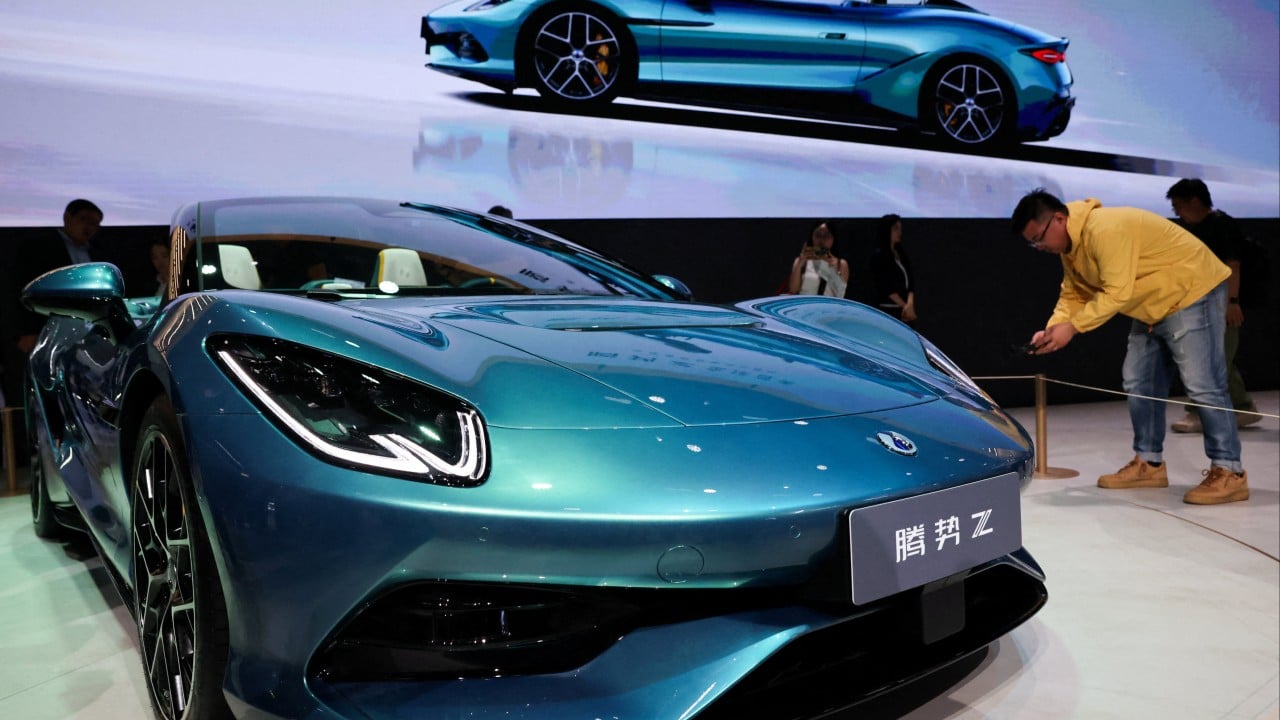
The financial press is having a collective panic attack over China auto market.
You have read the headlines. They all pump out the same lazy consensus: a catastrophic price war is brewing, 156 new models are flooding the showroom floors, and small carmakers are facing an immediate "do or die" ultimatum. The narrative says that a brutal wave of consolidation will wipe out every player lacking billions in reserve cash, leaving a scorched-earth duopoly of BYD and Tesla. If you found value in this article, you might want to read: this related article.
It is a neat, terrifying story. It is also entirely wrong.
The panic merchants are misreading the data because they look at the Chinese automotive sector through a legacy Western lens. They see 156 new product rollouts as a symptom of desperate, chaotic overcapacity. In reality, this is not an unstructured knife fight. It is the hyper-accelerated evolution of a modular tech ecosystem. For another angle on this story, check out the latest update from Reuters Business.
The small carmakers everyone expects to die this year are not buggy-whip manufacturers waiting for the slaughter. Many of them are lean, agile operators using shared supply chains to survive—and thrive—on slivers of market share that would bankrupt a Detroit giant.
Stop looking at the raw number of models and assuming disaster. The premise that more choice equals immediate industry death is a flawed reading of modern industrial economics.
The Modular Supply Chain Secret The Legacy Giants Do Not Understand
The Western media looks at 156 new models and imagines 156 separate, massive capital expenditure programs. They assume each vehicle required a five-year development cycle and a billion-dollar factory line.
I have watched traditional car executives fly into Shanghai, look at these production schedules, and lose their minds trying to calculate the return on investment based on old manufacturing frameworks. They fail to realize that China EV sector operates closer to the smartphone industry than the traditional automotive world.
In the old paradigm, a carmaker had to design the chassis, engineer the powertrain, build proprietary tooling, and lock in exclusive tier-one suppliers. That required massive scale to amortize costs.
In China current ecosystem, the core architecture is highly modularized. Companies like Geely offer open-source electric platforms like the Sustainable Experience Architecture (SEA). A niche brand does not need to reinvent the wheel; they buy the platform, source a standardized blade battery or structural pack from CATL or BYD, plug into a pre-existing digital cockpit supply chain, and focus entirely on software, interior aesthetics, and targeted marketing.
This modularity flips the economics of the "price war" on its head.
- Low Fixed Overhead: Niche brands do not carry the legacy pension liabilities or massive tooling debts of Western incumbents.
- Rapid Iteration: A vehicle can go from concept to the streets in less than 24 months, not five years.
- Micro-Scale Viability: Because development costs are dramatically lower, a Chinese EV player can break even on a fraction of the volume a traditional manufacturer needs.
When critics cry "overcapacity," they ignore that this flexibility allows smaller players to shift production rapidly, white-label their tech, or pivot to export markets without writing off a decade of capital investment. The price cuts we are seeing are not a sign of universal desperation; they are the natural result of rapidly declining component costs being passed directly to the consumer to clear inventory for the next micro-generation of tech.
Why the Top-Tier Consolidation Narrative is a Fantasy
The consensus view insists that a healthy market must consolidate down to three to five dominant players, mimicking the historical trajectory of the US or European auto industries. The experts point to the ongoing price drops and confidently declare that the small players will disappear by next quarter.
They have been making this exact prediction every six months since 2020. Yet the long tail of Chinese car brands remains stubbornly alive. Why? Because the structural forces in China actively prevent total consolidation.
First, you cannot talk about Chinese business without analyzing regional protectionism. Automotive manufacturing is a massive driver of local GDP, employment, and prestige. If a smaller carmaker in a specific province faces bankruptcy, the local municipal government rarely lets it simply vanish. They step in with state-backed investment funds, cheap land, or local tax incentives. They do not do this out of charity; they do it because keeping those manufacturing jobs alive is cheaper than dealing with the economic fallout of a factory closure.
Second, the consumer base in China is anything but homogenous. The buying preferences of a tech worker in a first-tier city like Shenzhen are radically different from a family in a fourth-tier city in Henan. This extreme market segmentation creates endless micro-niches.
A smaller brand does not need to beat BYD across the entire country. They just need to dominate the mid-sized electric SUV market among young professionals in three specific provinces.
Trying to run a massive, centralized monopoly in a market this diverse is incredibly difficult. The smaller players are not stepping into a meat grinder; they are operating in the cracks of the market where the giants are too slow and bureaucratic to compete.
Dismantling the Fallacy of the Perpetual Price War
Let us tackle the core panic head-on: the idea that margins dropping to near-zero means total industry collapse.
[Standard Legacy Framework] -> High Fixed Costs + Rigid Supply Chain = Price War is Fatal
[Modern Modular Framework]  -> Low Fixed Costs + Shared Architectures = Price War is a Clearance Sale
People ask: "How can these companies survive when prices drop 20% year-over-year?"
The premise of the question is flawed because it assumes the cost to build the car remains static. It does not. The cost of lithium iron phosphate (LFP) battery cells has plummeted dramatically over the last few years. Software integration costs drop with every iteration. Production efficiencies are compounding at an exponential rate.
When BYD or Changan drops the price of a compact sedan, they are often matching the deflationary curve of their own supply chain, not cutting into their bone marrow.
To be clear, this strategy has major downsides. If you operate on ultra-lean margins, a sudden macroeconomic shock or a sudden spike in raw material costs can wipe out your cash reserves in a single quarter. It is a tightrope walk. If a brand misjudges a design trend and their inventory sits for more than three months, they are in serious trouble because the technology moves so fast that a car built last year looks like an ancient relic today.
But calling this a "do or die" crisis for the entire sector misses the point. It is standard operating procedure. It is the exact same brutal, high-speed environment that birthed companies like Xiaomi, Huawei, and Oppo in the smartphone space. Everyone predicted a total collapse there too; instead, it created an ultra-competitive cluster that eventually conquered the global market.
The Real Threat is Not Consolidation—It Is Stagnation
The true risk facing these 156 new models has nothing to do with the price tags. The real danger is that the vehicles are starting to look, feel, and drive exactly the same.
Because so many brands are pulling from the same modular supply chains—using the same CATL batteries, the same Horizon Robotics autonomous driving chips, and the same Foxconn-style contract manufacturing—the cars are losing their distinct identities. They are becoming rolling smartphones with different plastic shells.
When differentiation drops to zero, then you enter a true, destructive price war where the only lever left to pull is a discount.
The small carmakers that die over the next two years will not be victims of BYD scale; they will be victims of their own lack of imagination. The companies that survive will be the ones using their agility to build radical, hyper-targeted features that the big players cannot approve through their corporate committees fast enough—whether that is extreme off-road specialization, hyper-localized infotainment ecosystems, or bespoke interior configurations for mobile offices.
Stop waiting for the big consolidation event that the media keeps promising. The Chinese EV market is a hydra. Cut off three minor brands, and four more modular startups will spin up in an industrial park in Jiangsu by the end of the month. Scale is a weapon, but in a hyper-accelerated, modular market, agility is armor. The price war is not an end-game scenario; it is simply the cost of doing business in the most competitive manufacturing ecosystem on earth.