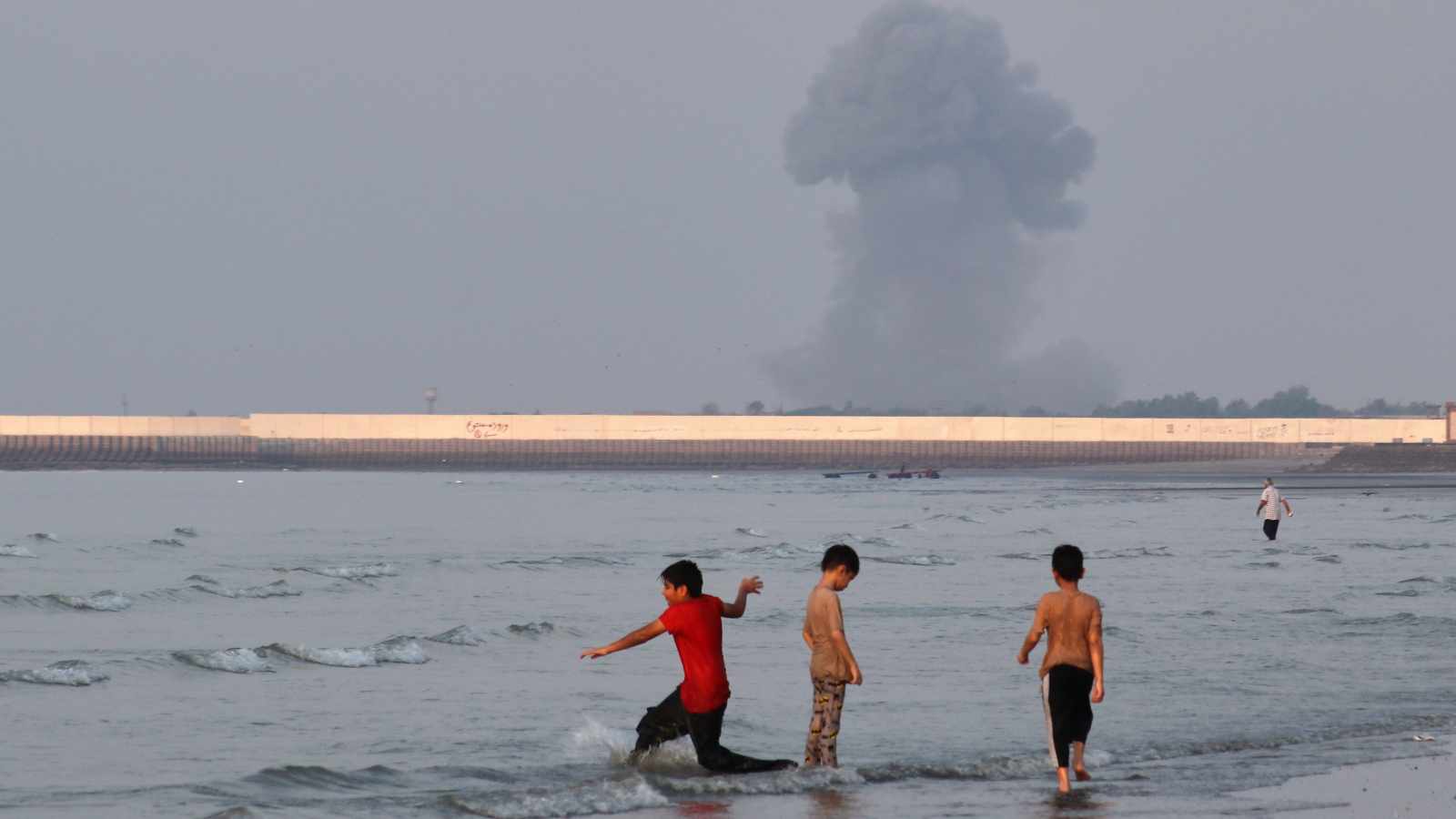
Salt gets into everything when you live near the southern edge of the Gulf. It cakes on the windshields of trucks idling at the docks, clings to the coarse wool of fishermen's sweaters, and settles on the tongue like an old coin. For generations, the rhythm of life here was dictated not by clocks, but by the water. You wake, you cast your net, you watch the horizon for tankers moving like slow-moving mountains against the brassy glare of the midday sun.
Those mountains carry the blood of modern civilization.
Consider a hypothetical ship captain named Tariq, standing on the bridge of a quarter-mile-long container vessel at three in the morning. He is navigating a corridor of water so narrow that a single misplaced decimal point in navigation software could turn a multi-million-dollar cargo into a fiery headline. That corridor is the Strait of Hormuz. Twenty-one miles wide at its absolute skinniest point, with shipping lanes barely two miles wide in either direction. Through this watery bottleneck passes roughly a fifth of the world’s petroleum consumption.
Tariq does not think about geopolitics when he stares into the dark. He thinks about clearance, wind shear, and whether the electronic signals jamming the horizon are going to spoof his radar again.
Lately, the radar has been lying more often.
The Distance Between a Word and a Valve
News reports out of Tehran this week carry a specific, frustrating brand of ambiguity. Iranian officials whisper that an agreement concerning the Strait is close. They use diplomatic phrasing, measured and heavy with conditions. But closeness in diplomacy is like seeing land through a fog bank; you can smell the damp earth, you can hear the faint barking of dogs, but your hull can still smash into an invisible reef.
The deal, whatever its contours in the smoke-filled rooms of negotiators, is not enough to open the waterway.
Why? Because a handshake in a European capital does not turn a valve in Bandar Abbas. It does not lift the electronic fog, nor does it clear the mines that exist only as a theoretical threat until they are not.
To understand the chasm between a diplomatic breakthrough and an open sea, you have to look at how fragile modern infrastructure actually is. We treat the global economy like a massive, indestructible steel bridge. In reality, it is a house of cards balanced on a greasy coin.
When talks stall over minor clauses, the cost is not measured in abstract percentages on a stock ticker. It is measured in the fuel surcharge paid by a farmer in Nebraska whose tractor needs diesel to harvest corn. It is measured in the heating oil for a tenement in Seoul. The Strait of Hormuz is a narrow gate, and right now, someone is holding a heavy boot against the bottom of the door.
The Geography of Anxiety
I remember standing on the concrete pier at Khasab years ago, watching the oil tankers line up like patient beasts waiting to be fed. The air hummed with a low, bone-shaking frequency from massive marine diesel engines. Back then, tension was a background radiation. You knew the flags changed—sometimes British, sometimes Liberian, sometimes Panamanian—while the crews remained a multinational mosaic of exhaustion and low pay.
Today, that background radiation has spiked.
When Iran signals that a deal is "close," they are speaking the language of leverage. In the high-stakes poker of international sanctions and regional security, an open waterway is a valuable asset. Why give it away for a promise when you can keep your hand on the latch?
The sticking points are rarely cinematic. They involve banking clearances, the tracking of ghost fleets carrying sanctioned crude, and the uneasy presence of foreign navies patrolling waters that Tehran views as its front porch. To an official in Tehran, keeping the gate partially bolted is a matter of sovereignty. To Tariq, bobbing on the dark water fifty miles offshore, it is an agonizing holding pattern that burns fuel, spikes insurance rates, and keeps his family wondering when he will finally dock.
The Weight of an Unmoved Anchor
There is a terrifying inertia to blockades and near-blockades. Once the rhythm of trade stutters, it does not restart with the snap of a finger.
If the diplomatic breakthrough finally arrives tomorrow, the ships will not simply surge forward. Crews must be reassessed. Insurance syndicates in London must recalculate risk premiums that cost hundreds of thousands of dollars per voyage. Minesweepers must verify corridors. The logistical machine is heavy, rusted by months of suspicion, and slow to turn.
We live in an era that worships speed. We expect data to travel across oceans in milliseconds, stock trades to execute in microseconds, and news to update before the event has even finished unfolding. Yet the physical reality of the world remains stubbornly heavy. Oil still has to be pumped from the sand, loaded into steel hulls, and driven through narrow ditches of water by men who haven't slept properly in three days.
The water outside Bandar Abbas remains choppy under the desert wind. The negotiators are still talking. And Tariq is still watching his radar screen, waiting for the blips to clear.