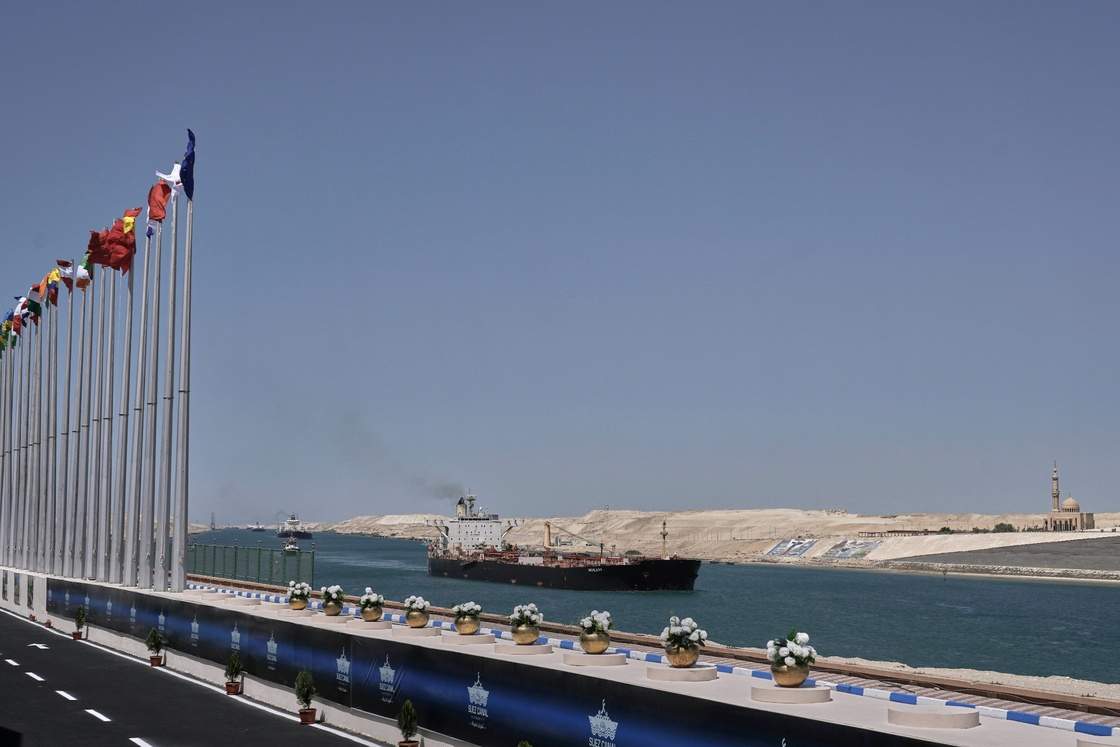
The salt air in Port Said tastes of old coal and anticipation. Standing at the northern gate of the Suez Canal, you can feel the quiet rhythm of global commerce ticking over like an ancient engine. Giant steel leviathans—containers stacked twenty high, tankers carrying the lifeblood of modern nations—crawl through the desert channel. They move with an almost hypnotic deliberation, connecting the factories of Asia to the breakfast tables of Europe and the fuel tanks of the Americas.
For decades, we treated this thin blue scratch in the Egyptian sand as a permanent fixture of geography. A highway that never closes. A given.
Then a flash splits the night near the southern mouth, and the illusion shatters.
A drone, small, anonymous, and terrifyingly precise, drops out of the dark sky. It slams into a gas vessel cruising the Red Sea approach. The explosion blooms orange against the black water, a sudden violent punctuation mark written in fire and steel. No one dies in the initial blast, which feels like a statistical miracle, but the shockwave travels far beyond the hull. It hits the fragile architecture of international trade, sending tremors through boardrooms in London, Tokyo, and Houston.
We are watching the map redraw itself in real-time.
To understand why a single drone strike near these historic choke points matters to someone sitting thousands of miles away, you have to look past the dry maritime safety notices. You have to look at the geometry of our supply chains.
Consider the modern economy as a fragile, sprawling ecosystem built entirely on convenience. We have optimized every mile, every hour, and every dollar out of shipping costs. Goods do not sit in warehouses; they ride on waves, timed to arrive at distribution centers with clockwork precision. The Suez Canal is the critical artery of this circulatory system. Roughly twelve percent of global trade passes through its narrow waters. When a ship carrying liquefied natural gas or crude oil has to alter course because the skies overhead have become hostile, the delay is not measured in hours. It is measured in weeks, millions of dollars in extra fuel, and cascading shortages that eventually reach the corner grocery store and the local utility bill.
When the conflict in the Middle East begins to bleed outward—jumping from localized land skirmishes into the maritime commons—the theater of war expands from a regional tragedy into a global anxiety.
Let us be honest about the fear here. It is not just about economics. It is about vulnerability.
We live in an era where cheap technology has democratized destruction. A drone built with off-the-shelf components, guided by simple satellite coordinates, can disrupt a vessel that cost half a billion dollars to build. This asymmetry haunts military planners and commercial captains alike. How do you protect a slow-moving, high-value target against an enemy that strikes from the shadows with minimal investment?
History offers grim echoes. Whenever great powers clash or proxy wars threaten critical maritime straits, the cost is invariably paid by the anonymous sailors working the engine rooms and the ordinary citizens downstream who watch inflation tick upward on essential goods. We saw it during the oil crises of the 1970s. We saw it during the pandemic-era bottlenecks. Each crisis teaches us the same painful lesson: our world is far more interconnected, and far more fragile, than we care to admit on a quiet Tuesday afternoon.
The strike near the canal is not an isolated incident. It is a symptom of a widening aperture.
Iran and its regional network operate in the spaces between total war and uneasy peace. By targeting commercial shipping, they push a silent lever. They know that you do not need to sink every ship to achieve your strategic goals; you only need to raise the risk profile high enough that insurance rates skyrocket, crews refuse to sail, and governments start panicking about energy security. Uncertainty is a weapon as potent as any warhead.
Imagine standing on the bridge of a liquefied natural gas carrier tonight. The radar screen is a wash of green light, tracking dozens of vessels. Every shadow on the horizon looks like a threat. The crew speaks in hushed tones, checking escape routes, testing emergency gear, acutely aware that twenty miles away, the geopolitical weather has turned violent. They are not politicians. They are not strategists. They are simply trying to deliver cargo across a boiling sea.
This is the invisible human cost of modern geopolitical friction. It is the welder in Piraeus waiting for parts that are stuck rounding the Cape of Good Hope. It is the family in Berlin watching winter heating prices climb because a tanker took a longer, safer route around the African continent. It is the slow, grinding erosion of global stability, one explosion at a time.
We like to believe that our systems are robust, that technology and globalization have rendered us immune to the old-fashioned perils of geography and empire. But geography has a stubborn way of reasserting itself. The narrow waters of the world—the Suez, the Strait of Hormuz, the Malacca Strait—are the weak points in our collective armor.
When those waters become unsafe, the distance between distant wars and our own doorsteps collapses entirely. The smoke rising from the deck of that gas vessel in the Red Sea is not just a distant news item. It is a signal fire, warning us of the dark and unpredictable road ahead.