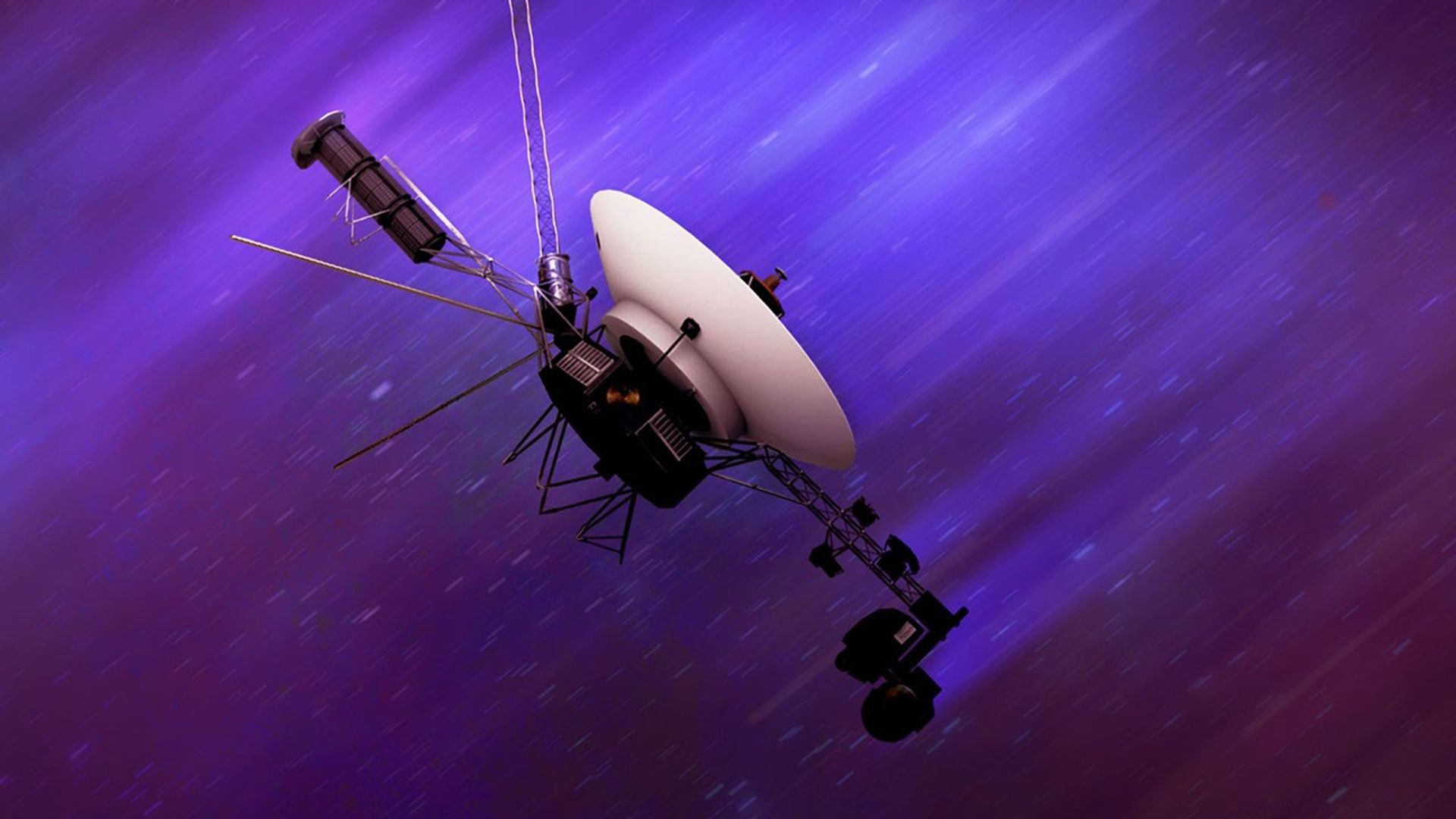
Twenty-four hours. That's how long it takes a beam of light—the fastest thing in our universe—to travel from Earth to NASA's Voyager 1 spacecraft right now.
Nearly five decades after lifting off from Cape Canaveral in September 1977, this 1,600-pound relic of seventies engineering just crossed a threshold no human-made object has ever touched. It's officially one light-day away from home. Roughly 16.1 billion miles (25.9 billion kilometers) out in interstellar space, cruising at around 38,000 miles per hour.
Most headlines treat this like a neat cosmic odometer rollover. They're missing the real story. Crossing one light-day isn't just a big number for trivia nights—it fundamentally changes how NASA's flight team operates a dying machine from across an abyss where every mistake takes two full days to diagnose.
Why One Light-Day Changes Everything for Mission Control
Think about what happens when you click a link on your phone. A signal shoots to a server and bounces back in milliseconds. Now imagine hitting "enter" on a keyboard at NASA's Jet Propulsion Laboratory (JPL) in Pasadena, California, and waiting a full 24 hours just for the command to arrive at the spacecraft.
Then you wait another 24 hours to find out if it worked.
That 48-hour round-trip communication lag turns routine spacecraft maintenance into high-stakes slow-motion chess. If Voyager 1 hits a snag—say, a cosmic ray flips a single bit in its ancient memory banks—engineers on Earth won't even know about it until tomorrow. By the time they write a patch, verify it on ground simulators, and beam the fix back up, four days have vanished.
I've followed deep-space telemetry operations for years, and honestly, the sheer patience required by the JPL Voyager team borders on superhuman. You can't improvise when your radio signal moves at 186,282 miles per second and still feels sluggish. Every single command uploaded through NASA's Deep Space Network (DSN)—those massive 70-meter dishes in Goldstone, Madrid, and Canberra—has to be triple-checked before transmission. There's no quick "undo" button across 16 billion miles.
The Whisper Across the Void
Distance isn't the only headache. Signal strength drops off with the square of the distance, which means Voyager 1's 23-watt transmitter—roughly the power of a refrigerator lightbulb—arrives at Earth as an unimaginably faint whisper.
By the time those radio waves hit the DSN antennas, the received power is measured in billionths of a billionth of a watt. Less than a fraction of a single attowatt. Engineers have to combine multiple massive dishes into an array just to pull coherent ones and zeros out of the background static of the cosmos.
And the data rate? A blazing 160 bits per second. Your nineties dial-up modem was hundreds of times faster.
What Most People Get Wrong About Voyager 1's Journey
Let's clear up a massive misconception right away. Whenever Voyager 1 hits a milestone, social media erupts with claims that it has "left the solar system."
It hasn't. Not even close.
Voyager 1 crossed the heliopause back in August 2012. That's the magnetic bubble inflated by our Sun's solar wind, where the outward push of solar particles finally yields to the pressure of interstellar medium from other stars. Crossing that boundary put Voyager 1 into interstellar space, which is a massive deal scientifically.
Yet the Sun's gravitational grip stretches far beyond the heliopause. Out past the Kuiper Belt lies the Oort Cloud—a vast spherical shell of icy planetesimals and comets loosely bound to our star. According to NASA's own orbital mechanics estimates, Voyager 1 won't even reach the inner edge of the Oort Cloud for roughly 300 years. Passing completely through the other side will take around 30,000 years.
So yes, it's in interstellar space. No, it hasn't escaped the Sun's neighborhood.
Why It Left Launchpad After Voyager 2 Yet Arrived First
Another detail that trips people up is the numbering. Voyager 2 actually launched first, on August 20, 1977. Voyager 1 followed 16 days later on September 5, 1977.
NASA didn't mess up the labels. Voyager 1 was placed on a faster, shorter trajectory designed specifically to reach Jupiter and Saturn first—and to nail a close flyby of Saturn's giant moon Titan. That Titan encounter bent Voyager 1's path sharply upward, shooting it out of the ecliptic plane of the planets at a steep angle. Voyager 2 stayed along the planetary plane to pull off its legendary Grand Tour of Uranus and Neptune, trading raw outward speed for extra planetary science.
That trajectory choice nearly 50 years ago is the exact reason Voyager 1 owns the distance crown today—and why Voyager 2 trails behind at roughly 13.5 billion miles, still a few years shy of its own light-day milestone.
Inside the 1970s Hardware Surviving Interstellar Space
If you cracked open Voyager 1 today, you wouldn't find sleek silicon wafers or modern microprocessors. You'd find 1970s aerospace grit.
The spacecraft runs on three custom-built computer systems—the Command Computer Subsystem (CCS), the Flight Data Subsystem (FDS), and the Attitude and Articulation Control Subsystem (AACS)—each duplicated for redundancy. Combined, their total memory adds up to roughly 69 kilobytes. A single modern smartphone photo takes up more storage than the entire brain keeping Voyager 1 alive.
Code is still written in assembly language and Fortran. Many of the original engineers who built those systems retired decades ago, which forced NASA to dig through boxes of yellowed paper schematics and 1970s microfiche manuals during recent crises.
Surviving the 2023–2024 Memory Crisis
Speaking of crises, Voyager 1 nearly died just a couple of years before reaching this one light-day record. In November 2023, the spacecraft suddenly started transmitting a repeating, unreadable pattern of ones and zeros instead of science and engineering data.
For months, JPL engineers played detective across a 45-hour round-trip communication delay. They eventually traced the failure to a single corrupted memory chip inside the Flight Data Subsystem—likely zapped by an energetic cosmic ray or simply worn down by 46 years of operation.
You can't swap a broken chip 15 billion miles from home. Instead, the team divided the affected code into smaller chunks and tucked those pieces into unused pockets of memory scattered elsewhere in the FDS, rewriting the cross-references so the computer knew where to look. By June 2024, all four remaining science instruments were back online and returning clean data.
Pulling off a remote brain transplant on hardware launched during the Carter administration—and then watching that same machine cruise across the one light-day line—shows why this mission refuses to quit.
The Power Countdown You Should Actually Watch
Distance records make great headlines, but wattage dictates when the music stops.
Voyager 1 doesn't use solar panels. Out where the Sun looks like little more than a painfully bright star, sunlight is way too weak to generate electricity. Instead, the spacecraft relies on three Radioisotope Thermoelectric Generators (RTGs) mounted on a boom. These canisters hold spheres of plutonium-238 oxide. As the plutonium naturally decays, it produces heat, and solid-state thermocouples convert that thermal energy directly into electricity.
At launch in 1977, those three RTGs pumped out about 470 watts of electrical power.
Plutonium-238 has a half-life of 87.7 years, and the thermocouples degrade slowly over time. Every single year, Voyager 1 loses roughly 4 watts of available power. Today, it's running on less than half of what it started with.
How NASA Stretches Every Remaining Watt
To keep the spacecraft warm enough that its hydrazine fuel lines don't freeze solid—hydrazine freezes at around 35 degrees Fahrenheit (2 degrees Celsius)—mission managers have spent years systematically shutting down heaters and non-essential instruments.
Here's what's already gone dark to save power:
- The Imaging Science Subsystem (cameras): Turned off right after taking the famous "Pale Blue Dot" family portrait in February 1990.
- Infrared and Ultraviolet Spectrometers: Powered down years ago once planetary flybys ended.
- Subsystem Heaters: Several instrument heaters have been switched off since 2019, forcing surviving sensors to operate in temperatures far colder than they were ever tested for on Earth.
- Cosmic Ray Subsystem and Low-Energy Charged Particle Instrument: Targeted in recent power-management shutdowns as JPL trims load every single year.
Right now, engineers are essentially trading science instruments for lifespan, keeping the Magnetometer and the Plasma Wave Subsystem running as long as possible because they give us our only direct measurements of interstellar plasma density and magnetic fields.
By the early 2030s, power reserves will drop so low that even the main transmitter won't be able to maintain lock with Earth. When that day hits, Voyager 1 won't explode or crash. It'll simply go quiet, drifting cold and silent through the Milky Way forever.
What Voyager 1 Is Still Discovering Out There
Don't mistake Voyager 1 for a dead buoy just coasting on inertia. The data trickling back across that 24-hour light gap is rewriting astrophysics textbooks.
Before Voyager 1 crossed the heliopause, theorists assumed the transition between our Sun's magnetic domain and interstellar space would be chaotic and gradual. Instead, the spacecraft found a sharp boundary—and discovered that the interstellar magnetic field outside runs surprisingly parallel to the magnetic field inside the heliosphere.
Even weirder, Voyager 1's Plasma Wave instrument detected a persistent, faint "hum" of interstellar gas vibrations far beyond the solar wind. Turns out interstellar space isn't a quiet, empty vacuum. It ripples with continuous, low-level plasma waves driven by distant stellar activity, allowing scientists to measure the density of the interstellar medium continuously rather than waiting for occasional solar shockwaves to pass by.
Every kilobyte that crosses that one light-day gap gives astrophysicists ground-truth measurements that no telescope on Earth or in orbit can replicate. Telescopes look at light from afar; Voyager 1 tastes the actual particles and magnetic fields directly.
How You Can Track Voyager 1 in Real Time
You don't have to take anyone's word for where Voyager 1 is right now. NASA streams live telemetry metrics publicly so anyone can watch the numbers tick upward second by second.
- Check NASA's Eyes on the Solar System: Open NASA's interactive 3D visualization tool in your browser. You can fly right up to the virtual model of Voyager 1, inspect its exact orientation relative to Earth and the Sun, and watch its distance climb in real time.
- Watch the Deep Space Network Live: Visit NASA's DSN Now portal. Whenever one of the massive dishes in Goldstone, Madrid, or Canberra locks onto
VGR1, you'll see a live animated wave beaming from the antenna dish alongside the exact carrier frequency and data rate in bits per second. - Follow JPL's Mission Status Updates: Bookmark the official NASA Voyager mission blog to read engineering dispatches whenever the flight team executes a thruster swap or power-management adjustment.
Next time you check your phone and get frustrated by a two-second loading spinner, pull up DSN Now and watch a 70-meter dish listen for a signal that left a 1977 spacecraft yesterday morning.