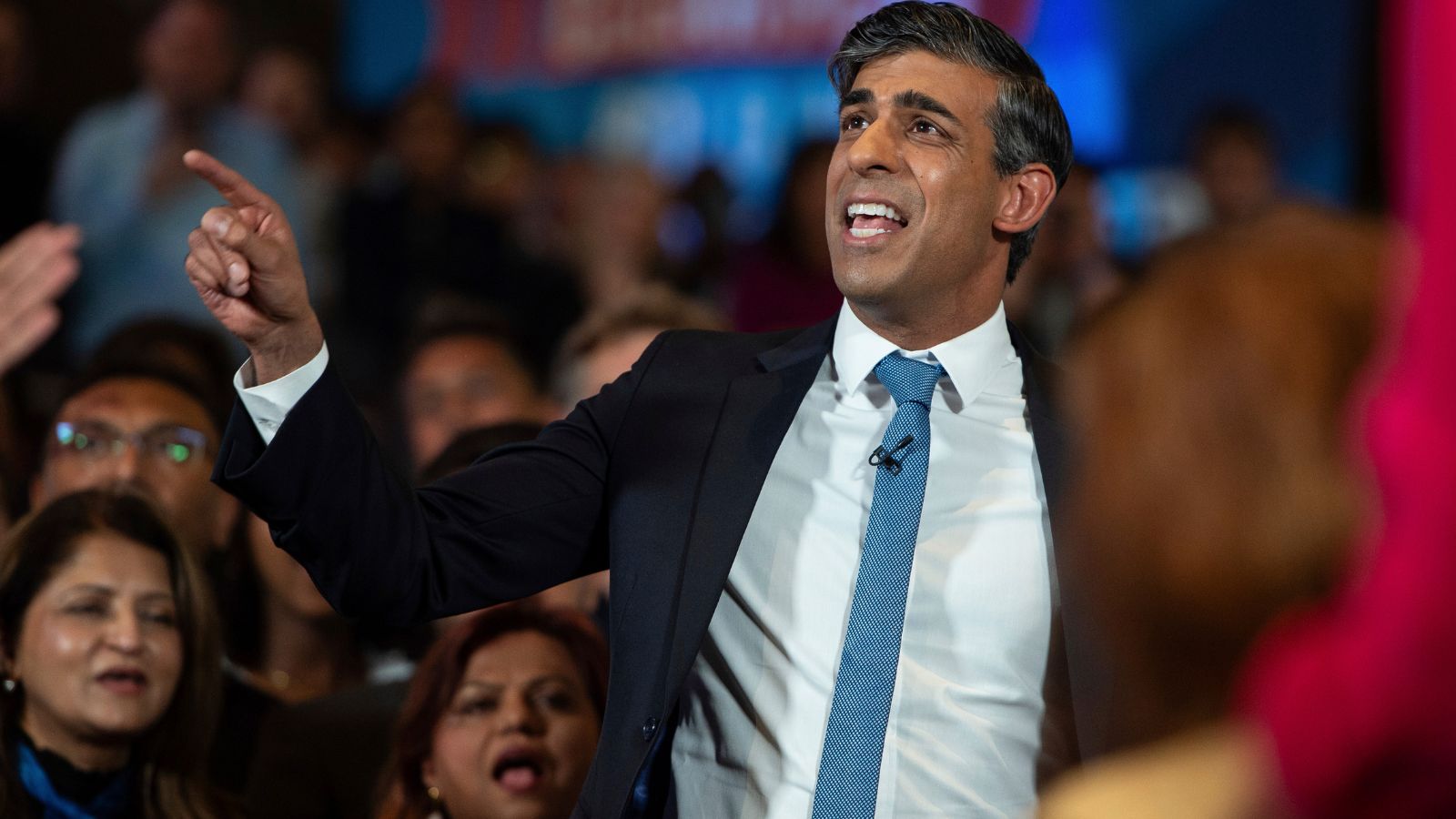
National identity in advanced democracies operates on a sliding scale between civic republicanism, which defines belonging through adherence to laws, shared institutions, and political allegiance, and ethnic nationalism, which anchors identity in ancestry, shared heritage, and immutable characteristics. Recent political discourse in the United Kingdom has exposed a structural tension between these two models. When former Prime Minister Rishi Sunak articulated his position regarding his identity as British, English, and Hindu, he intervened directly in a shifting ideological battleground. This intervention challenged what can be categorized as the reverse Tebbit test. Norman Tebbit’s original formulation measured integration by cricket loyalty, assuming that assimilation could be successfully tracked through cultural preference. The modern iteration, however, shifts the criteria from acquired behavior to innate biology. Under this newer framework, cultural integration, linguistic proficiency, and economic contribution become irrelevant if an individual’s physical appearance or ancestral origin fails to align with an exclusionary definition of nationhood.
This transition from behavioral assimilation to immutable ancestry creates a profound structural fracture within multi-ethnic democracies. From an institutional perspective, civic nationalism relies on predictable rules of membership. Citizens participate in the tax base, respect the judicial system, and engage with the political apparatus, thereby earning equal standing within the state. When identity is redefined through an ethnic lens, the contract between citizen and state breaks down. The primary danger of this ideological drift is the institutionalization of second-class citizenship. If belonging is contingent upon skin color or lineage rather than civic participation, a permanent ceiling is placed on social cohesion. The state risks fracturing into competing demographic factions, each viewing the other's presence through a zero-sum lens.
The Economic and Social Cost Function of High Migration and Delayed Integration
To understand the friction surrounding identity and integration, one must examine the underlying economic and demographic mechanics. Immigration policy in the United Kingdom over the past two decades has generated significant strains on public infrastructure, housing markets, and social services. The inflow of population without a proportional expansion in housing stock, transport networks, and healthcare capacity produces measurable economic frictions. These frictions manifest as rising rental costs, longer waiting lists for medical procedures, and heightened competition for entry-level wages in specific sectors.
However, the public debate frequently conflates the administrative failures of migration management with the moral status of settled minorities. Sunak’s critique of past government performance regarding border control highlights a distinct operational failure: the state’s inability to match immigration inflows with infrastructural absorption capacity. When infrastructure fails to scale alongside population growth, public resentment intensifies. This resentment is subsequently captured by political actors who channel legitimate economic grievances into cultural grievances.
The cost function of delayed integration compounds these infrastructural strains. Integration is not a passive byproduct of residence; it requires active institutional engagement, language acquisition, and participation in shared civic life. When governance structures fail to facilitate economic and social mobility for incoming populations, enclaves form. These enclaves reduce social trust and impede the formation of a unified civic identity. Conversely, when second- and third-generation citizens achieve high levels of integration—participating in national institutions, contributing to the economy, and engaging in cultural touchstones like sport—they validate the success of the multi-ethnic model. The political challenge lies in distinguishing between valid technical critiques of migration volume and racialized rejections of long-standing citizens.
The Political Economy of Border Control and Populist Rhetoric
The political marketplace in contemporary Britain operates within an attention economy that rewards simplification and polarization. Populist political movements thrive on existential narratives that frame demographic change not as a policy challenge to be managed, but as an existential threat to be resisted. Rhetoric describing immigration in martial terms—such as an invasion—serves a specific strategic function: it bypasses technical policy debates about visa quotas, skill-matching, and infrastructure investment, replacing them with moral urgency.
In this environment, mainstream political figures face a strategic dilemma. If they ignore public anxiety over border management, they cede ground to populist challengers. If they adopt populist framing, they risk legitimizing exclusionary definitions of national identity. Sunak’s intervention attempted to draw a hard boundary across this dilemma. By supporting tighter controls on immigration while simultaneously rejecting the proposition that skin color disqualifies someone from Englishness, he attempted to decouple technical border management from ethnic nationalism.
The analytical flaw in many contemporary political strategies is the assumption that border control requires ethno-nationalist purity. Economic theory and historical data demonstrate that sovereign states can maintain rigorous, orderly, and transparent migration systems without resorting to racial essentialism. A well-functioning immigration system relies on transparent criteria, enforceable rules, and verifiable economic utility, completely detached from the racial background of the applicant or the citizen. When political discourse collapses these distinct categories, it creates policy confusion and social division.
The Sociological Mechanics of Shared Public Spaces
Institutions and shared cultural practices act as the connective tissue of a diverse society. In his reflections on national identity, Sunak pointed to sport, specifically cricket, as an operational mechanism for integration. While dismissed by cynics as superficial, shared public spaces fulfill a vital sociological function. They provide neutral arenas where disparate groups interact under common rules toward shared objectives.
Sociological research into intergroup contact demonstrates that proximity alone does not reduce prejudice; structured cooperation toward common goals does. Cricket, football, and other national sporting structures function as civic testing grounds. When individuals from diverse ethnic backgrounds participate in these systems—whether as players, fans, or administrators—they internalize shared narratives that transcend ethnic divisions.
However, relying solely on cultural touchstones is insufficient without institutional backing. Educational systems, legal protections, and meritocratic economic structures must reinforce the principle that civic belonging is open to all who fulfill the obligations of citizenship. When public institutions fail to provide equal protection and opportunity, shared cultural practices lose their adhesive power. The erosion of trust in public institutions directly correlates with the rise of identity-based factionalism.
Institutional Vulnerabilities and the Erosion of Civic Trust
The fragility of a multi-ethnic democracy is proportional to the perceived neutrality of its core institutions. When police forces, judicial systems, and political bodies are viewed as impartial arbiters of justice, citizens across diverse backgrounds invest in the state’s legitimacy. However, when public discourse introduces racial parameters into national belonging, institutional trust erodes.
Minority populations begin to question whether the state views them as full participants or conditional guests. At the same time, native-born populations experiencing economic displacement may feel that the state has prioritized external arrivals over domestic welfare. This dual alienation weakens social cohesion and increases polarization. Restoring institutional integrity requires absolute clarity from leadership: the rule of law must apply equally, and citizenship must remain strictly decoupled from racial or ethnic lineage.
Strategic Direction and Forecasting
Managing the tension between national identity, integration, and immigration requires a clear decoupling of administrative policy from cultural exclusion. Policymakers must treat border management as an exercise in infrastructural capacity planning rather than a cultural defense mechanism. Simultaneously, the political establishment must enforce a zero-tolerance baseline against the reintroduction of racial criteria into definitions of citizenship.
The trajectory over the coming decade will depend on the state's capacity to deliver visible competence in public service delivery while defending the civic framework of the nation. If economic stagnation persists and infrastructure remains overburdened, the temptation to scapegoat minority populations through ethnic nationalism will intensify. Conversely, restoring administrative control over migration while forcefully defending the multi-faith, multi-ethnic democratic settlement offers the only viable path toward social stability. The mandate for political leadership is clear: separate the technical mechanics of borders from the foundational principles of belonging, ensuring that the state remains rigorous in its management and uncompromising in its civic inclusivity.