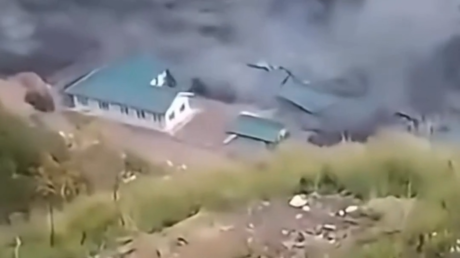
Watching structures dissolve into brown torrents on social media feels surreal, but for communities along Nepal's fragile river corridors, it is an ongoing reality. When sudden flash floods roar down from mountain regions, they do not just flood streets. They rip concrete foundations out of the earth, erase entire neighborhoods, and leave families staring at empty plots where their homes used to stand.
Recent video footage capturing buildings vanishing into raging waters along the Budhi Gandaki, Bhote Koshi, and Trishuli river valleys highlights a terrifying trend. These are not ordinary seasonal monsoons. They are high-energy debris flows driven by thawing permafrost, glacial destabilization, and intense cloudbursts that strike with zero warning.
The Anatomy of a Himalayan Disaster
Why do these floods possess such destructive force? It comes down to physics and geography. When massive volumes of water mix with mud, boulders, and glacial ice, the resulting slurry behaves like a moving wall of concrete.
Unlike clear-water floods that rise gradually, a debris flow carries immense kinetic energy. It pounds riverbanks, undercuts structural footings, and causes multi-story buildings to collapse inward within seconds. Traditional river walls and standard flood defenses stand little chance against millions of cubic feet of material plunging thousands of feet down steep mountain gradients.
Families who survived previous disasters, such as the catastrophic 2015 earthquakes, often find themselves displaced yet again. Rebuilding a life over a decade only to watch it get washed away in minutes creates a cycle of trauma that financial aid struggles to fix.
Why Early Warning Systems Fail
You might wonder why residents aren't evacuated before the water hits. The brutal truth is that current monitoring infrastructure cannot catch micro-scale mountain events in time.
While countries like Switzerland maintain dense networks of weather stations and sensors, the Himalayan region remains severely underequipped. Nepal and surrounding areas operate only a fraction of the automated weather stations per square kilometer compared to European nations. When a high-altitude glacier collapses or permafrost gives way, the resulting wave destroys upstream monitoring gauges before they can transmit an automated alert downstream.
Without functional early warning systems, residents rely entirely on visual cues—sometimes noticing that a river's flow has mysteriously stopped or surged. By the time anyone realizes what is happening, the water is already at the doorstep.
The Long Road to Resilience
Reconstructing infrastructure after these events costs billions of dollars, putting immense strain on a developing economy. Temporary shelters fill up quickly, and repairing vital roads, suspension bridges, and hydropower stations takes months. Communities remain isolated, turning routine trips to local markets or health clinics into day-long ordeals.
International climate summits frequently debate funding for disaster survivors, but aid disbursement is often bogged down by bureaucracy. Meanwhile, winter approaches, leaving displaced families worried about surviving in temporary accommodations.
Protecting these vulnerable regions requires a complete shift in strategy. Governments and international partners must invest heavily in high-altitude monitoring technology, relocate settlements away from high-risk riverbeds, and construct resilient transitional shelters engineered to withstand future debris flows. Until those structural changes happen, every heavy rain season will carry the threat of another avoidable catastrophe.