Every major newsroom spent the week hyperventilating over slabs of concrete and asphalt. The headlines treat the opening of the first cross-border road bridge between Russia and North Korea as an empire-building milestone, a geopolitical masterstroke cementing an axis of defiance against Western sanctions.
They have it completely backwards.
I have spent the better part of two decades auditing supply chains through sanctioned corridors, and when governments start pouring money into asphalt across hostile terrain, it is never a sign of strength. It is a sign of desperation. A road bridge is not a symbol of economic integration. It is an admission that traditional shipping lanes are dead, maritime options are choked, and two isolated regimes are frantically duct-taping their trade routes together because they have nowhere else to go.
Let us dismantle the prevailing lazy consensus.
The Logistics Mirage
The narrative pushed by mainstream analysts suggests this bridge opens up a high-volume trade superhighway. Look closer at the geography and the actual capacity constraints.
North Korea's rail infrastructure is an antique museum piece dating back to the mid-20th century. Trains derail with alarming regularity due to rotting ties and crumbling ballast. For years, the primary link was the railway bridge known as the Friendship Bridge. Shifting a fraction of that tonnage to rubber tires does not magically multiply throughput. Trucks require maintenance, diesel, spare parts, and a functioning highway network on both sides of the border that simply does not exist in the rugged, underfunded terrain of Primorsky Krai and Rason.
When you look at the economics, the numbers do not support a trade boom. North Korea lacks exportable goods that Russia actually wants, beyond basic commodities and cheap labor pools. Russia has plenty of raw materials of its own. What Moscow wants from Pyongyang is munitions and artillery shells to sustain a grinding war of attrition in Ukraine. What Pyongyang wants from Moscow is fuel, food aid, and advanced military technology.
You do not build a multi-million-dollar cross-border road bridge for high-end commerce. You build it because your ammunition transfer needs a more discreet, localized choke point that can bypass maritime tracking.
Why Road Beats Rail Only When You Are Hiding Something
Let us talk about the mechanics of sanctions evasion.
Maritime shipping is subject to satellite surveillance, transponder tracking, and international naval interdiction. Trains are large, highly visible, and easily monitored at fixed rail terminals.
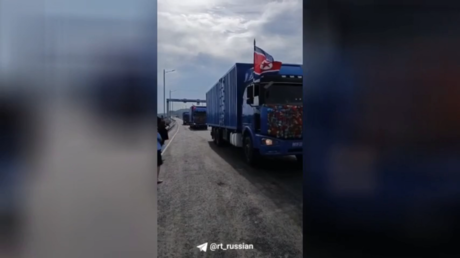
Trucks, however, offer granularity. A fleet of flatbeds crossing a short span over the Tumen River can move palletized cargo directly into decentralized storage bunkers without passing through major commercial container ports. This is about friction reduction for illicit logistics.
Imagine a scenario where a regime needs to quietly transfer millions of rounds of artillery ammunition without triggering immediate imagery intelligence red flags from commercial satellite providers. You shift from predictable weekly freight trains to a dispersed fleet of unmarked heavy trucks operating under the cover of bilateral infrastructure development.
The Western policy establishment keeps treating these developments as formal economic integration. That is a dangerous analytical error. This is a field-expedient bypass route. It is the supply chain equivalent of digging a tunnel under a prison fence because the front gate is locked.
The Cost of Desperation
There is a massive downside to this infrastructure project that nobody in the mainstream press is willing to admit. By tying their logistical fates closer together, both Moscow and Pyongyang are locking themselves into an economic dead-end.
Russia is trading access to global financial systems, modern technology imports, and Western consumer markets for the dubious privilege of buying low-grade munitions from a state that cannot feed its own population. North Korea is trading whatever minuscule leverage it had to play regional powers against each other for complete economic vassalage to Moscow.
When you build a bridge to your only remaining heavy-sanctions partner, you are not expanding your horizons. You are shrinking your world down to a two-lane bottleneck.
History shows that isolated economies do not thrive by trading with each other in a vacuum. They suffocate. The concrete may be fresh, but the foundation is rotting.
Stop looking at this bridge as a monument to a new geopolitical order. It is a toll booth on the road to nowhere.