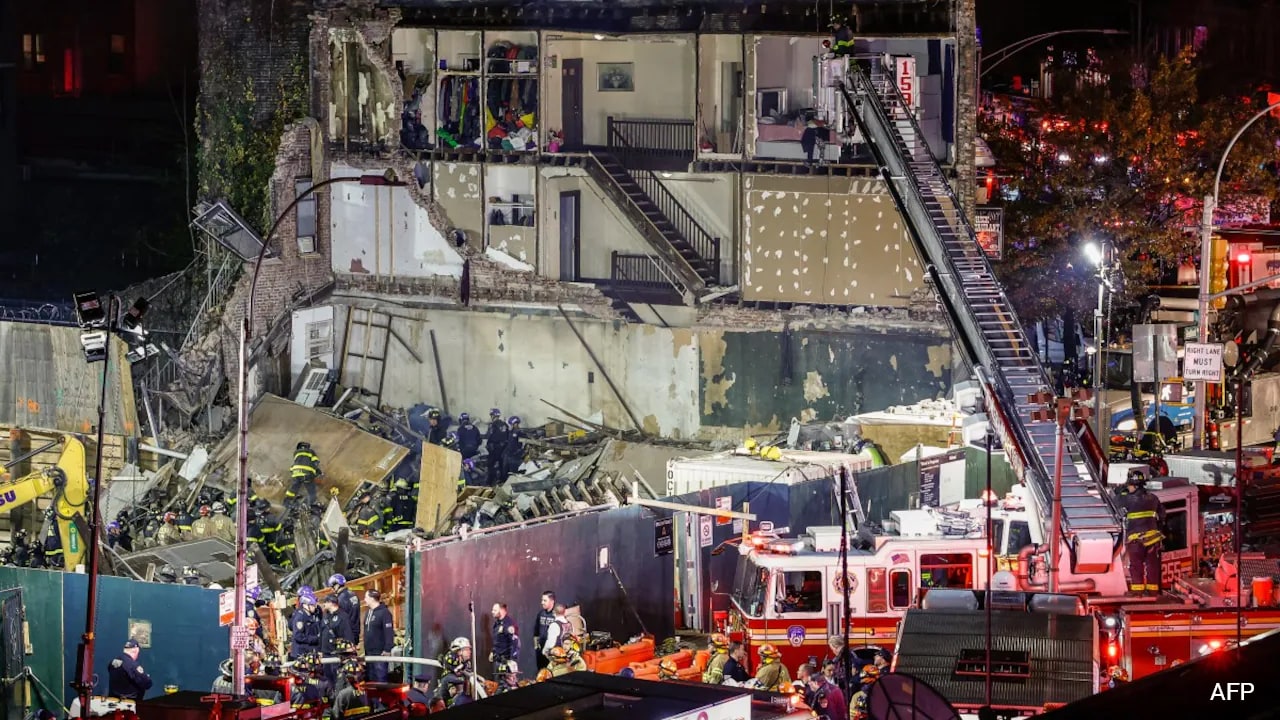
Every time brick, mortar, and steel hit the asphalt in New York City, the media reads from the exact same teleprompter. A sudden catastrophe. Unforeseen structural failure. Heroic first responders digging through rubble while officials promise a thorough investigation.
Stop calling these events accidents. An accident is a stray bolt of lightning. What happens when an aging New York structure pancakes into the street is the predictable mathematical outcome of deferred maintenance, performative inspection laws, and owners treating fines as a cheap cost of doing business.
I have spent two decades walking job sites, reviewing structural engineering reports, and watching real estate operators play Russian roulette with load-bearing masonry. When a building drops in the five boroughs, nobody in the structural engineering or municipal construction trades is actually surprised. We saw the fractures on the facade three years ago. We saw the open violations sitting unaddressed in the Department of Buildings database. We saw the scaffolding go up not to fix the problem, but to hide it until the next fiscal quarter.
The Lie of the Sudden Collapse
The standard breaking-news narrative treats a structural collapse like an earthquake—an act of God that strikes without warning. That framing lets every responsible party off the hook before the dust even settles.
Buildings do not spontaneously lose their structural integrity overnight. Gravity does not take a Tuesday off and suddenly double its pull on Wednesday morning. Steel corrodes slowly. Mortar washes out over decades of freeze-thaw cycles. Unpermitted interior renovations—knocking out a bearing wall to create an open-concept retail floor or overloading a roof deck with heavy HVAC units—create progressive stress concentrations that telegraph their failure months or years in advance.
When a slab fails or a bearing wall buckles, you are witnessing the final second of a multi-year timeline. Calling it a sudden collapse is like watching someone ignore a check-engine light for forty thousand miles and calling a seized motor a freak occurrence.
How Local Law 11 Created a Scaffolding Industrial Complex
If you want to understand why New York buildings fail despite having some of the strictest building codes on earth, look at the sidewalk sheds covering hundreds of miles of city frontage.
Following the tragic death of Grace Gold in 1979—a Barnard College freshman killed by a falling piece of terracotta masonry—New York enacted Local Law 10, later expanded into Local Law 11, officially known as the Facade Inspection and Safety Program (FISP). The law requires owners of buildings taller than six stories to have their facades inspected every five years and to repair unsafe conditions immediately.
On paper, FISP is a triumph of public safety. In practice, it created a perverse economic incentive structure that prioritizes liability shielding over structural repair.
Here is how the game actually works on the ground:
- The Inspection: A Qualified Exterior Wall Inspector (QEWI) finds spalling brick, rusted lintels, or displaced stone and files a status of "Unsafe."
- The Shed: Legally, the owner must immediately erect a sidewalk shed to protect pedestrians from falling debris.
- The Stall: Once the shed is up, the immediate legal urgency evaporates. Repairing a compromised brick facade or rebuilding a parapet wall costs hundreds of thousands—sometimes millions—of dollars. Renting a sidewalk shed costs a few thousand dollars a month.
- The Rot: The owner pays the nominal monthly fines for failing to complete the repairs, leaves the steel shed standing for five, eight, or twelve years, and lets water continue penetrating the building envelope behind the netting.
I have audited properties where the cost of the long-term sidewalk shed rental exceeded the original estimate for the masonry repair. Why did the owner pay more over time to avoid fixing the wall? Because operating expenses on a shed hit the monthly cash flow in small, predictable bites, whereas a capital expenditure for structural shoring requires refinancing, tenant relocation, or dipping into equity. Meanwhile, the water intrusion behind that shed eats away at the structural steel framing—a process called oxide jacking, where rusting steel expands to several times its original volume and literally pushes the masonry apart from the inside.
The Blind Spot Below Six Stories
While tall buildings hide behind perpetual scaffolding, low-rise structures—four- and five-story walk-ups, commercial storefronts, and aging parking structures—operate in an entirely different regulatory shadow.
FISP does not apply to buildings six stories and under. Yet New York is packed with late-19th- and early-20th-century unreinforced masonry buildings built with lime mortar and timber floor joists. These buildings rely on a delicate equilibrium between the weight of the floors and the lateral stability of the exterior brick walls.
Imagine a scenario where a ground-floor commercial tenant decides to renovate a narrow mixed-use building. To make the retail space feel wider, a contractor removes an interior brick partition wall that looked non-structural to an untrained eye, replacing it with an undersized steel beam without proper shoring or foundation underpinning. Above that storefront sit four stories of residential apartments. Over the next eighteen months, seasonal humidity changes and street vibrations from heavy trucks cause the undersized beam to deflect by a fraction of an inch. That tiny deflection shifts the load onto an aging brick pier whose lime mortar has already turned to sand. One rainy afternoon, the pier shears, and the entire front elevation peels away into the street.
No facade inspection law caught it because the building was five stories tall. No city inspector saw the interior work because the contractor never pulled a permit. The system only detects the failure when the 911 calls start coming in.
The Economics of Slumlord Arbitrage
Let us dismantle the most persistent myth in urban real estate: the idea that building owners want to maintain their assets to protect their investment.
In a high-valuation market like New York, the dirt under the building is frequently worth more than the structure sitting on top of it. When an owner holds a rent-stabilized walk-up or an obsolete commercial property with thin operating margins, aggressive maintenance destroys their short-term yield.
Sophisticated operators run a cold calculation. They look at the Department of Buildings (DOB) penalty schedule and compare it against the cost of capital repairs. Until recent legislative tweaks began slowly increasing penalties, the municipal fine for ignoring a Class 1 "Immediately Hazardous" violation was a rounding error on a commercial balance sheet. Even when the city issues an Environmental Control Board (ECB) violation, owners routinely drag out the administrative hearing process for years, negotiate the fines down to pennies on the dollar, and never touch the underlying structural defect.
Worse, the corporate structure of New York real estate insulates the decision-makers from personal ruin. Almost every building is held inside a single-purpose Limited Liability Company (LLC). If a building collapses, the LLC goes bankrupt, the insurance carrier fights the claims in court for a decade, and the principals walk away to manage their other forty LLCs across the river. Until criminal liability and piercing the corporate veil become standard prosecutorial responses to fatal structural neglect, the math will continue to favor deferral over repair.
What "Rescue Operations" Actually Reveal About Urban Fragility
When a collapse happens, media coverage pivots immediately to the bravery of the FDNY rescue teams, the thermal imaging cameras, the search dogs, and the heavy cranes lifting concrete slabs. That heroism is real. New York's urban search-and-rescue units are the best on the planet.
Focusing exclusively on the rescue, however, obscures a terrifying reality: we are relying on elite emergency response to compensate for third-world preventative maintenance.
Every rescue operation in a dense urban core is a high-wire act that risks secondary collapses. When a building fails, the adjacent structures—which often share party walls in older neighborhoods—suddenly lose their lateral bracing. First responders are not just digging through one failed building; they are operating inside a domino line where vibrations from hydraulic jacks or shifting debris can bring down the neighbor's wall on top of them.
We celebrate the extraction of survivors from the rubble without asking why our permitting and enforcement agencies are perpetually starved of field inspectors. You cannot automate structural engineering inspections with a web portal. Somebody with a flashlight, a sounding hammer, and an engineering degree has to physically crawl into the cellar, check the column bases for corrosion, inspect the bearing plates, and verify that nobody cut a trench next to the footing.
The Nuance Nobody Wants to Hear About Over-Regulation
Before anyone mistakes this critique for a simple call to pass ten new municipal laws, let us address the flip side. Knee-jerk regulation is half the reason legitimate owners struggle to fix their buildings.
In New York, doing things by the book is an agonizing, expensive gauntlet. If a conscientious building owner discovers a cracked lintel or a settling foundation pier and tries to pull the proper DOB permits to fix it legally, they face months of plan-examiner objections, astronomical expediter fees, union jurisdiction battles, and adjacent-property access agreements (RPAPL Section 881) where a neighboring owner can hold a repair project hostage for years demanding extortionate license fees just to put protective netting over their yard.
When legal compliance becomes a bureaucratic war of attrition, two things happen:
- Good owners get trapped in red tape while their buildings continue to deteriorate.
- Bad owners bypass the system entirely, hiring unlicensed crews to patch cracks with fresh stucco on a Sunday morning so the building looks fine from the sidewalk.
A fresh coat of stucco over a failing brick wall does not hold up a building. It just traps moisture inside the masonry and hides the warning signs from anyone looking up from the street.
How to Actually Stop Buildings From Falling Down
If you want to end the cycle of preventable urban collapses, you do not need another blue-ribbon commission or a new hashtag. You need four brutal structural reforms to how the city regulates, finances, and polices its built environment.
1. Kill the Perpetual Sidewalk Shed
Put a hard, non-negotiable 180-day clock on sidewalk sheds erected for unsafe facades. If the structural repair is not substantially underway by day 181, the city automatically steps in, hires a pre-vetted municipal contractor to execute the repair, and places a super-priority tax lien on the property for 150 percent of the construction cost. Take away the option to use scaffolding as a cheap permanent bandage.
2. Mandate Cellar-to-Roof Structural Audits for Aging Low-Rises
Stop pretending physics only applies above six stories. Any masonry or steel-frame building over 60 years old—regardless of height—should require a mandatory structural integrity audit every seven years, specifically targeting cellars, foundations, parking decks, and ground-floor commercial alterations. These are the zones where water, road salt, and unpermitted renovations do their deadliest work.
3. Attach Criminal Liability to Ignored Class 1 Structural Violations
Fines do not deter billionaires or shell-company slumlords; handcuffs do. If a building owner or managing agent receives a verified structural hazard notice, fails to shore or remediate the condition within the statutory window, and a structural failure injures or kills someone, prosecute the human beings behind the LLC for criminally negligent homicide or reckless endangerment. Watch how fast capital budgets get approved when prison time enters the spreadsheet.
4. Fast-Track Emergency Structural Permits and Force Neighbor Access
Strip away the bureaucratic friction for legitimate repairs. Structural shoring and facade stabilization permits should receive mandatory 72-hour administrative review. Simultaneously, reform adjacent-property access laws so neighboring owners cannot stall vital structural repairs with frivolous litigation. Public safety on the sidewalk overrides a neighbor's desire to extract a fifty-thousand-dollar nuisance fee.
The Uncomfortable Truth About The Building You Are In Right Now
The next time you walk past a block-long stretch of green plywood and steel pipe in Manhattan, Brooklyn, or the Bronx, look past the scaffolding netting. Look at the dark stains where water has been pouring down the brick for ten winters. Look at the bulging masonry courses and the rusted steel beams peeking through cracked concrete.
The warning signs are always written right on the walls in plain sight. We just choose to walk underneath them and call it bad luck when gravity finally collects its debt.