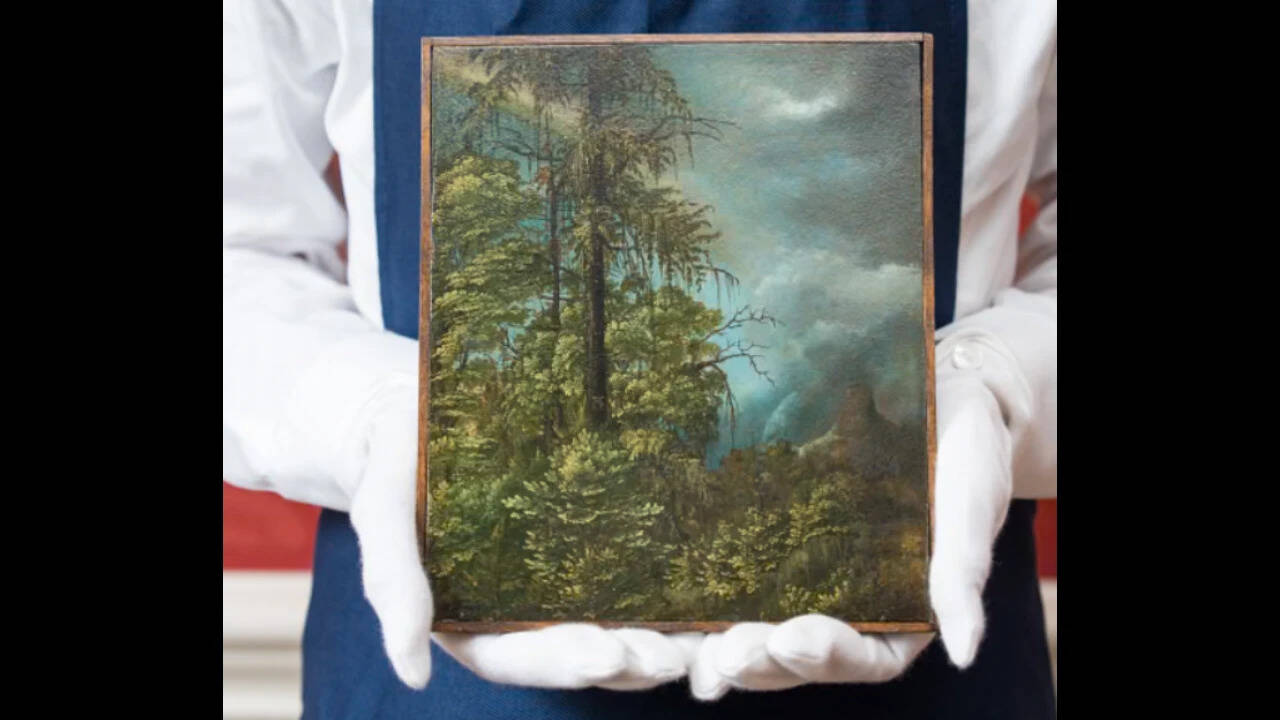
Most people walking past a dusty, unassuming German Renaissance panel wouldn't look twice. Yet when a genuine oil painting by Albrecht Altdorfer hits the Old Masters Evening Sale block with an estimate pushing £5 million, the entire art market stops to stare.
It doesn't happen often. In fact, it almost never happens. For a deeper dive into similar topics, we suggest: this related article.
While household names like Rembrandt, Rubens, and Titian dominate the headlines every auction season, Altdorfer occupies a much rarer, stranger space in art history. He wasn't just another 16th-century court painter churning out stiff portraits of German nobility. He was the pioneer of pure landscape painting in Europe, a master printmaker, and the leading light of the Danube School. Finding an authentic, private-market oil by his hand after decades in the shadows is the art-world equivalent of discovering an unrecorded Beatles track in an attic.
Who Was Albrecht Altdorfer and Why Does His Work Cost Millions
If you haven't spent much time wandering the rooms of the Alte Pinakothek in Munich or the Kunsthistorisches Museum in Vienna, Altdorfer's name might sit slightly behind Albrecht Dürer in your mental index. That's a mistake. Dürer was the intellectual heavyweight of the Northern Renaissance, sure, but Altdorfer was its wild, atmospheric visionary. For additional background on this topic, comprehensive reporting can be read on The Guardian.
Born around 1480, Altdorfer spent most of his life in Regensburg, a prosperous free imperial city on the Danube River. He wasn't a starving bohemian. He served on the city council, worked as the official city architect, and owned multiple properties. Because he didn't rely entirely on commissions to eat, he painted what fascinated him—specifically, the untamed, mossy forests and jagged mountains of Bavaria and Austria.
Before Altdorfer, nature was basically wallpaper. Artists used trees and hills as polite backdrops for biblical scenes or portraits of rich merchants. Altdorfer flipped the script around 1520 with works like Landscape with a Footbridge (now in the National Gallery in London), removing human figures altogether to let the woods take center stage.
When you look at an authentic Altdorfer oil, you're seeing:
- Obsessive, miniature-like brushwork that packs entire cosmic dramas into panels often smaller than a modern laptop screen.
- Dramatic, apocalyptic lighting where sunsets bleed crimson and gold across swirling cloud formations.
- Living, breathing nature where gnarled pine trees feel just as emotionally charged as the saints or soldiers standing beneath them.
Because his surviving output in oil is shockingly small—fewer than 50 accepted paintings exist worldwide, and the vast majority are locked away permanently in major European museums—any fresh emergence on the open market triggers a frenzy among institutional curators and ultra-high-net-worth collectors.
What Makes a Newly Emerged Old Master Worth £5 Million
Auction estimates aren't pulled out of thin air, though sometimes it feels that way when you read the press releases. Pricing a 500-year-old panel involves a ruthless checklist of condition, provenance, and sheer scarcity.
First, let's talk about survival rates. Wooden panels from the early 1500s have spent five centuries battling humidity, woodworm, overzealous 19th-century restorers, and European wars. Many German Renaissance panels were split, planed down, or scrubbed raw with harsh solvents long before modern conservation existed. If a newly surfaced Altdorfer retains its original glazes and crisp detail—especially in the foliage and sky—specialists will immediately push the valuation toward the upper end of that £5 million ceiling.
Provenance plays an equally massive role. When a painting disappears from public view for decades, buyers want ironclad proof of where it's been. Auction house researchers spend months digging through 19th-century auction catalogues, aristocratic inventory lists, and pre-war photographic archives like the Witt Library in London or the Zentralinstitut für Kunstgeschichte in Munich.
If the work has a clean, documented paper trail stretching back to a known European collection without any dark gaps during the 1933–1945 Nazi era, institutional buyers can bid without hesitation. That institutional competition is exactly what drives prices from a respectable £2 million into the £5 million stratosphere. Private collectors love bragging rights, but museum directors armed with acquisition funds hate losing their once-in-a-lifetime chance to fill a gap in their Northern Renaissance galleries.
The Shift in the Old Masters Market
There's a lazy narrative floating around financial circles that the Old Masters market is dying because younger billionaires only want contemporary art, Basquiat canvases, or digital collectibles.
Honestly, that's only half true.
The middle tier of Old Masters—average 17th-century Dutch still lifes, workshop copies of Italian Madonnas, and minor British portraits—has struggled over the past decade. Buyers today don't want dark, dusty brown paintings hanging in minimalist glass-and-concrete homes.
At the absolute top end, however, the market is ferocious. Trophy works with undeniable rarity and intense visual drama are outperforming expectations regularly. Look at how collectors reacted when rare Northern Renaissance works or freshly attributed masterpieces hit London and New York salesrooms in recent years. A painting by Altdorfer fits the modern trophy profile perfectly. Even though it's 500 years old, his psychedelic sunsets, fairy-tale forests, and jewel-like colors look startlingly modern. You don't need a doctorate in 16th-century theology to feel the punch of an Altdorfer landscape. It hits you immediately across a crowded gallery.
Why Authenticating German Renaissance Panels Is So Tricky
Whenever an Old Master "emerges after decades," seasoned collectors immediately squint and check the footnotes. Attribution in 16th-century German art is notoriously treacherous.
Altdorfer ran a workshop, and he had followers, imitators, and talented contemporaries within the Danube School—artists like Wolf Huber and Albrecht's own brother, Erhard Altdorfer. To make matters worse, later collectors frequently slapped fake "AA" monograms onto anonymous German panels to inflate their value.
To justify a multi-million-pound estimate in an Old Masters Evening Sale, specialists rely on hard science alongside traditional connoisseurship:
- Dendrochronology measures the growth rings in the wooden panel to establish the earliest possible felling date of the tree, proving the wood actually dates to the early 1500s.
- Infrared reflectography (IRR) peers beneath the paint layers to reveal the artist's original underdrawing, showing whether the hand moved with Altdorfer's signature loose, energetic calligraphy or a stiff copyist's trace.
- X-ray fluorescence (XRF) analyzes the chemical makeup of the pigments, confirming the presence of period-accurate materials like smalt, lead-tin yellow, and natural ultramarine rather than modern synthetic substitutes.
When the scientific data lines up with the stylistic verdict of top scholars, the market breathes a sigh of relief and the paddles go up.
How Collectors and Art Watchers Can Track These Sales
You don't need £5 million in your checking account to learn from a major Old Masters Evening Sale. Watching how a rare piece like this performs gives you a real-time pulse check on the global art economy.
If you're following the sale—whether as an aspiring collector, an art history nerd, or someone studying high-end alternative assets—pay close attention to three specific details when the catalogue drops and the hammer falls:
- Read the condition report carefully. Major auction houses publish detailed ultraviolet light photos and conservation notes upon request. Seeing how much original paint remains versus later inpainting will teach you more about valuation than any press release ever could.
- Watch the bidding speed and origin. Notice whether the phone bids come from European specialists (often representing public museums or established aristocratic foundations) or New York and Hong Kong desks (typically private wealth buyers).
- Compare the final hammer price against the low estimate. In the Old Masters sector, hitting or slightly exceeding the low estimate is standard for solid works. Blowing past the high estimate signals a genuine bidding war between at least two determined institutions or mega-collectors.
Keep an eye on the London evening sale results, download the digital lot essay while it's still publicly archived, and study the high-resolution images closely—because once a painting this rare sells, it usually vanishes back into a private vault or behind museum glass for another half-century.