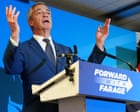
Saying out loud that nobody in your own political party is fit to replace you takes a certain kind of nerve. Yet that's exactly what Nigel Farage did in late November 2026.
Speaking to The Sun amid growing chatter about his political future and stalling poll numbers, the Reform UK leader brushed aside succession talk with blunt certainty. "If I'm not here doing this job right now, who else could? Who else would? I don't see that person," Farage said, before adding that he intends to lead the party into the next general election provided he stays "fit and healthy".
Most politicians spend years cultivating a deep bench of talent so voters see a credible government-in-waiting. Farage took the opposite tack. By framing Reform UK leadership as a one-man operation, he simultaneously fired a warning shot at ambitious colleagues and handed critics fresh ammunition about what a Reform government would actually look like in practice.
Why Farage Shut Down the Succession Talk
Context matters here. Farage's remarks didn't happen in a vacuum—they landed during one of the trickiest stretches Reform UK has faced since its surge in recent years.
Opinion polls have shown Reform slipping from earlier highs, with internal friction bubbling closer to the surface. Senior figures have openly acknowledged a difficult year, local council defections have chipped away at grassroots momentum, and rival movements on the populist right—like Rupert Lowe's Restore Britain—have complicated Reform's electoral math. When a party's polling stalls, whispers about the leader's stamina and exit strategy always follow.
Farage knows how Westminster politics works. Once journalists start seriously handicapping a party's next leader, the current leader's authority starts bleeding out. His answer was to slam the door before anyone could wedge a foot inside.
Instead of praising up-and-coming colleagues or promising an orderly transition down the road, he declared the field empty. Honestly, it's classic Farage. Throughout his career—from UKIP to the Brexit Party to Reform UK—his political vehicles have revolved almost entirely around his personal brand, media instincts, and ability to command a news cycle.
Who Are the Potential Rivals He Just Sidelined
Even if Farage refuses to see an heir apparent, Westminster watchers certainly have a shortlist. Dismissing everyone in the room means sidelining several high-profile figures who've spent months building their own profiles inside the party.
Robert Jenrick
As Reform's economics spokesperson and one of the most prominent former Conservatives to cross the floor, Robert Jenrick brings ministerial experience that most of the party lacks. He knows how Whitehall departments function, understands the machinery of government, and has spent years positioning himself on the right of British politics. Yet bringing in high-profile ex-Tories has caused tension inside Reform, with party figures openly stating that former Conservative MPs won't be allowed to dictate core areas like immigration policy. Farage's comment effectively reminds Jenrick that being a big-name recruit doesn't make you next in line.
Zia Yusuf
Serving as home affairs spokesperson, Zia Yusuf has become one of Reform's most visible organizational and media operators. He represents a more modern, business-minded wing of the movement, capable of handling tough broadcast interviews and party infrastructure. Still, electoral politics runs on name recognition and visceral voter connection—two areas where Yusuf remains miles behind Farage.
Richard Tice
Before Farage returned to take the helm, Richard Tice kept the lights on as Reform UK's leader. He funded much of the operation, fought grueling by-elections, and built the scaffolding Farage later stepped onto. Passing over Tice in a single breath underscores a harsh political truth inside Reform: loyalty and hard graft don't automatically translate into box-office appeal.
The Double-Edged Sword of a One-Man Band
In the short term, Farage's blunt assessment works in his favor. It projects strength to core supporters who want a fighter, not a committee. It also stops rival camps from organizing behind the scenes while the party tries to regain polling momentum.
Zoom out, though, and a glaring contradiction appears.
If no one else inside Reform UK is capable of leading a political party, how can voters trust those same people to run major departments of state? Winning power in Britain isn't just about picking a prime minister. It requires filling roughly twenty cabinet seats and dozens of junior ministerial roles with people who can manage budgets, pass legislation, and handle crises without imploding.
By telling the public that nobody around him has the chops for the top job, Farage accidentally validated his opponents' favorite attack line—that Reform UK is a personality cult rather than a serious governing outfit. You can win protest votes with a charismatic frontman. You rarely win an outright parliamentary majority without convincing swing voters that there's real depth behind the podium.
Why Europe Is Bringing Farage Back to the Frontline
Part of why Farage refuses to step aside comes down to the fight he sees coming next.
While travelling to Brussels—where Andy Burnham was pushing for a closer UK-EU reset deal—Farage told The Times that Europe is about to dominate British politics all over again. "It's going to be absolutely huge. It's going to be much bigger than anyone realises. The genie is out of the bottle; it literally can't be stopped now," he warned.
When asked whether he still had the stomach for another bruising constitutional battle over Brexit, Farage leaned right into it: "Hold my jacket. I'm ready for it." He even floated the prospect of "direct action" on the streets if politicians attempt to reverse Britain's exit from the European Union, while ruling out teaming up with Tory-led anti-rejoin groups like Stay Out.
Look at that strategy closely. Farage knows his polling dips when politics turns into dry debates over local council administration or policy minutiae. He thrives when the conversation becomes existential, tribal, and centered on sovereignty. Re-litigating Brexit gives him the exact stage he needs to rally his base, sideline rivals on the right, and prove why he thinks he's irreplaceable.
What This Means If You Follow UK Politics
Whether you back Reform UK or can't stand them, Farage's refusal to name a successor tells you everything about where British right-wing politics is heading before the next general election.
Watch three specific pressure points over the coming months:
- Internal discipline among ex-Tories: Keep an eye on how figures like Robert Jenrick react to being publicly written off as leadership material. Ambitious politicians rarely stay quiet forever when their ceiling is nailed shut.
- The battle over Europe: Track how fiercely Farage weaponizes Andy Burnham's Brussels outreach. If Europe moves back to the center of the news agenda, Reform's polling floor will likely harden quickly.
- Party professionalization: Look for whether Reform actually builds local campaign machinery and vets candidates properly, or continues relying almost exclusively on Farage's media gravity.
Farage has made his bet: Reform UK lives or dies with him at the front. For a man who has spent decades bending British politics to his will, stepping back was never really an option—even if admitting it means telling his own team they aren't up to the job.
For direct footage of his comments, watch Nigel Farage Insists No-one is Able To Replace Him, which captures how he framed the leadership question to reporters.