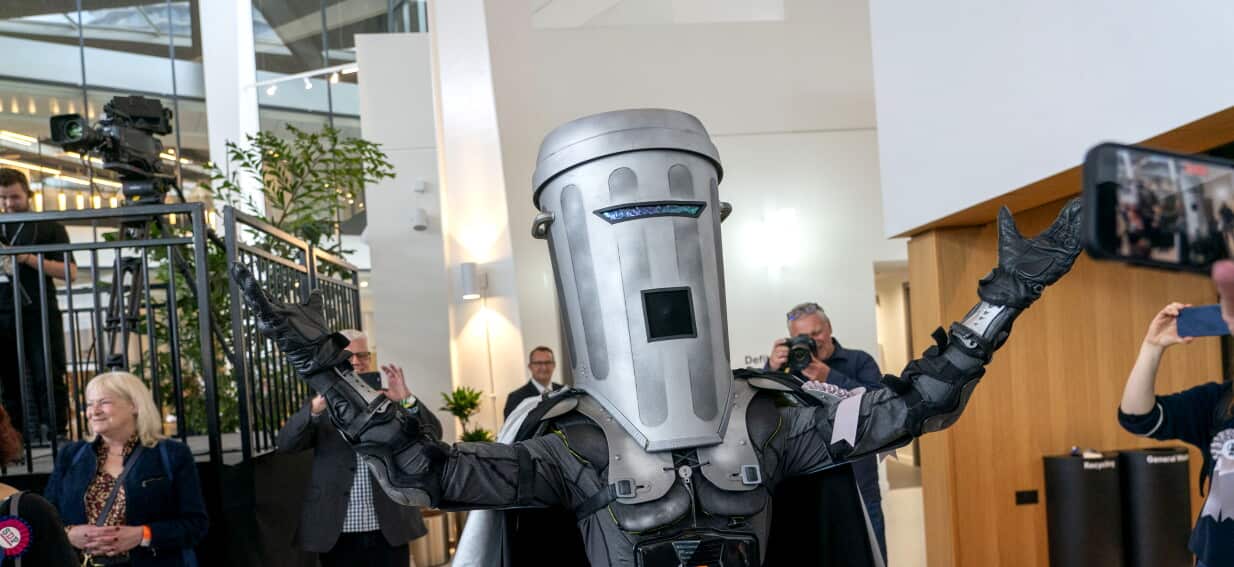
Nigel Farage just triggered a bizarre political standoff by quitting his seat in parliament. The hard-right leader of Reform UK claims he wants a clean fight to clear his name, calling it a matchup between the people and the establishment. The problem is the establishment doesn't want to play. Major political parties are completely ghosting his snap by-election, leaving Farage facing the very real prospect of a summer campaign where his only declared opponent is a man wearing a literal garbage can on his head.
Count Binface, the self-described intergalactic space warrior and perennial joke candidate, jumped straight into the vacuum. When Farage announced his resignation from the Clacton constituency, Binface publicly told the rest of the political spectrum to leave the Reform leader to him. What was supposed to be a grand populist circus now looks like a lonely, humiliating shouting match with an aluminum novelty costume. Recently making news in this space: Geopolitical Friction and Market Liquidity: The Mechanics of the Sensex Compression.
The Real Reason Nigel Farage Left Parliament
Farage did not step down out of a sudden urge to touch grass. He resigned because he is staring down a massive financial scandal. The parliamentary commissioner for standards, Daniel Greenberg, has been running a high-stakes probe into Farage's finances. The core of the investigation involves a non-disclosure issue regarding a £5 million donation from Christopher Harborne, a cryptocurrency billionaire based out of Thailand.
It does not stop there. Farage is under scrutiny for separate alleged gifts from George Cottrell, a 32-year-old crypto entrepreneur with a prior fraud conviction. Farage says the investigations are a political tool used by his opponents to tear him down. He even went to the Bank of England governor, Andrew Bailey, to discuss the crypto landscape. Bailey later confirmed in a letter that the bank is regularly subjected to lobbying but maintained that no policy shifted because of Farage. More insights into this topic are explored by NPR.
By resigning, Farage found a clever loophole. His departure temporarily suspends the parliamentary watchdog's investigation. If he wins the seat back, the probe will probably resume. If he loses or faces an embarrassing turnout, his political leverage shrinks to zero.
How the Major Parties Triggered a Damp Squib
Farage wanted a dramatic battleground. He hoped the Labour government and the Tories would throw everything they had at Clacton, creating a high-profile media frenzy. Instead, the major parties executed a total blackout.
Outgoing Prime Minister Keir Starmer dismissed the move as a desperate stunt by a man up to his neck in sleaze. Conservative leader Kemi Badenoch called it a fake by-election meant to distract the public. Even on his own side of the fence, the right-wing fringe is turning. Rupert Lowe, who split from Reform UK to set up the even more extreme Restore party, called the snap poll an unnecessary sham.
Without a serious challenger, the grand stage collapses. Polling expert John Curtice pointed out that Farage expected a massive political circus but is instead staring down a damp squib. Finance minister Rachel Reeves summed up the government's dismissive attitude on X, stating that if Farage wants to spend his summer arguing with a bin, she won't stop him.
Enter Count Binface
The vacuum left by the mainstream parties belongs to Count Binface. The comedic candidate is a staple of British electoral eccentricity, known for his signature cape and trash-can helmet. He enters this race fresh off a minor by-election in Makerfield, where he secured just 95 votes.
Binface's platform is intentionally ridiculous, though it often highlights real frustrations. For his Clacton campaign against Farage, his core pledge is simple. He promises to act as a unity candidate and build at least one affordable house.
The strategy behind a joke candidate is devastatingly effective against pop-up populism. Populists like Farage thrive on aggressive debate with straight-faced establishment figures. They fall apart when forced to share a stage with a parody. You cannot look like a serious anti-establishment savior when your primary ideological opponent is campaigning on a promise to fix local potholes and adjust the Wi-Fi on public trains.
The Strategic Math for Reform UK
Farage won Clacton comfortably during the general election, taking a massive 46 percent of the vote with a majority of 8,405. Under normal circumstances, this seat is safe territory for him. The danger is not necessarily losing the seat to a novelty act, but what the low turnout and lack of serious opposition will do to his brand.
If the government sets the by-election within the legal 35-day window, Farage will spend the peak of summer campaigning against a ghost town of mainstream opposition. A win against only Count Binface offers zero political vindication. It won't clear his name from the Harborne or Cottrell investigations, and it won't prove he has a national mandate.
If you are keeping an eye on British populism, look closely at the total voter turnout numbers when Clacton heads to the polls. A massive drop-off in voters will show that the public is getting tired of the constant personal drama and manufactured crises. Keep tabs on whether any serious independent local candidates jump into the race at the eleventh hour, because an actual local challenger could turn this joke of a by-election into a genuine nightmare for Farage.