The stadium clock does not care about history. It ticks with a cold, mechanical indifference, slicing away seconds from men who have spent their entire lives running away from obscurity.
On the pitch, the contrast was almost absurd. On one side stood Argentina. The Albiceleste. A footballing superpower woven from the DNA of legends, carrying the weight of millions of expectant souls and the golden tint of recent global dominance. On the other side stood Cape Verde. A cluster of volcanic islands anchored in the Atlantic Ocean, with a total population that could comfortably fit into a handful of Buenos Aires neighborhoods.
By all established laws of sports economics, talent concentration, and historical precedent, this match should have been a formality. A routine training exercise under the floodlights.
Then came the seventy-first minute.
To understand what happened when Deroy Duarte struck the ball, you have to look past the scoreboard. You have to look at the hands of the Cape Verdean fans in the stands, calloused and trembling, holding flags that many in the stadium had to look up on their phones just an hour prior. You have to understand the sheer, terrifying gravity of playing against Argentina, where every pass feels like trying to outrun an avalanche.
Argentina had taken the lead early, playing with that familiar, suffocating arrogance that defines teams who know they are superior. They moved the ball like chess grandmasters, confident that the islanders would eventually tire, crack, and surrender. For the better part of an hour, it looked like they were right. Cape Verde was chasing ghosts, their lungs burning, their jerseys soaked through with sweat that felt more like desperation than ambition.
But football has a strange way of rejecting scripts.
The Physics of Defiance
Imagine standing in a storm, holding a flimsy umbrella, determined to stop the rain. That is what defending against the Argentinian frontline feels like. Every wave of attack brings a different kind of misery. If you step up, they exploit the space behind you. If you drop deep, they invite you into a slow, agonizing suffocation.
Blue-collar football is not elegant. It is a grueling sequence of sliding tackles, desperate headers, and running until your vision blurs at the edges. The Cape Verdeans did not match Argentina’s poetry; they matched it with prose. Hard, unyielding prose.
Deroy Duarte, a midfielder who plies his trade far from the glamorous, hyper-monetized lights of Europe’s elite clubs, spent most of the match doing the dirty work. He was tracking back, clogging passing lanes, and feeling the breath of world-class attackers on his neck. In games like this, players like Duarte are expected to be footnotes. They are the obstacles that the protagonists overcome on their way to a predictable victory.
Then, a momentary lapse in the Argentinian midfield occurred. A heavy touch. A fraction of a second where the giants assumed the game was already won.
It was not.
The ball broke loose, skittering across the grass like a live wire. In that singular moment, the collective tactical spreadsheets of both coaching staffs evaporated. It became about instinct. Duarte anticipated the bounce, his body leaning into the challenge with a fierce, almost reckless hunger.
The Strike That Silenced the Giants
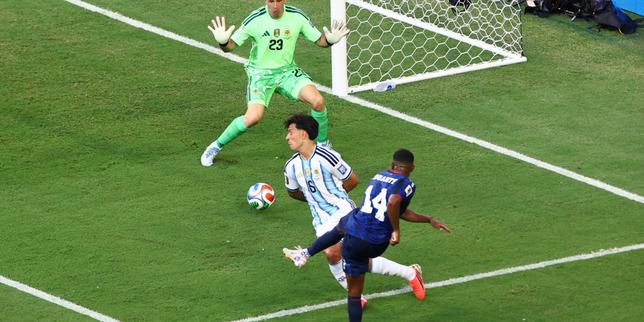
When the ball left Duarte’s foot, a strange collective silence fell over the arena. It was the gasp of fifty thousand people realizing, all at once, that the predictable world they had walked into was shifting on its axis.
The shot was not a thunderbolt. It was something far more dangerous: precise, deliberate, and laced with the defiance of an entire archipelago. The Argentinian goalkeeper stretched, his fingers clawing at the air, a man trying to catch a shadow.
He missed.
The net rippled. For a heartbeat, there was a profound, eerie stillness. Then, the corner of the stadium where the blue-and-white island flags flew erupted into a beautiful, chaotic madness.
Duarte did not slide on his knees or perform a choreographed dance for the cameras. He ran with his arms wide open, his face contorted in a mix of disbelief and pure, unadulterated ecstasy, pursued by teammates who looked as though they had just witnessed a miracle.
They had. They had equalized against Argentina.
The Beautiful, Terribleness of Hope
Sports culture loves to talk about tactical setups, Expected Goals, and defensive transitions. We analyze heat maps until our eyes bleed. But none of those metrics can quantify the sudden, intoxicating injection of hope into an underdog's veins.
After the equalizer, the game transformed. The cold superiority of Argentina curdled into panic. The passes that were crisp ten minutes ago became rushed and erratic. The crowd, sensing the vulnerability, grew tense. Every time a Cape Verdean player touched the ball, the whistles from the home fans grew louder, a sonic manifestation of anxiety.
Consider what happens to the human mind under that kind of pressure. For Argentina, failing to beat Cape Verde is not just a bad day at the office; it is a national crisis. For Cape Verde, every second they remained level was a historic victory. The psychological tables had completely turned.
The final whistle eventually blew, cutting through the tension like a knife. The scoreboard read 1-1.
On paper, it was a draw. In reality, it was a seismic shift. The Argentinian players walked off the pitch with their heads bowed, staring at the grass as if searching for answers that weren't there. They looked like men who had lost something irreplaceable.
Across from them, the Cape Verdeans were weeping. Not from sorrow, but from the overwhelming realization of what they had just achieved. They had gone into the lions' den, faced the most formidable footballing culture on the planet, and refused to be devoured.
Deroy Duarte stood in the center of the pitch long after the matches had ended, staring up at the towering stands. His jersey was torn, his socks pulled down to his ankles, his body entirely spent. He looked small in the massive stadium, a lone figure against the towering concrete structure. Yet, on this night, he was the tallest man in the room.
The world of international sports will move on quickly. There will be other matches, bigger tournaments, and loftier trophies to chase. The pundits will return to their statistics, and the bookmakers will adjust their odds. But for one unforgettable evening, a group of islanders reminded us why we look at twenty-two people chasing a piece of leather in the first place. They reminded us that history is not written by the powerful; it is written by those who refuse to believe they have already lost.