The wind does not whisper in the Arabian desert; it bites. It carries the fine, abrasive dust of an ancient seabed, scouring paint from steel and finding its way into the smallest gears of a watch, the seams of a flak jacket, the corners of a weary mind.
At Camp Arifjan in Kuwait, past midnight, the wind was the only constant. Until the sky split open.
To understand what happened when the Iranian strikes forced United States troops to temporarily abandon a key position, you have to strip away the dry nomenclature of military press briefings. You have to remove terms like "tactical repositioning" and "force protection posture." You have to stand where the soldiers stood, breathing in the stale air of a reinforced bunker, listening to the low, thrumming bass of incoming ordnance that turns your chest cavity into a tuning fork.
Silence. Then concussion.
Ground vibration is not a sound you hear with your ears; it is something your teeth feel first. A dull, heavy thud that travels upward through the soles of your boots, rattling the concrete foundations of logistics hubs that had spent decades operating under the comfortable assumption of invulnerability.
For months, the regional chessboard had been trembling. Proxy attacks, intercepted drones, intercepted rhetoric—a slow-motion collision of red lines and strategic ambiguities. But theory is a clean thing. War, when it arrives at your doorstep, is filthy, chaotic, and entirely indifferent to your plans.
Consider a young sergeant, twenty-four years old, hailing from a humid corner of rural Georgia. Let us call him Miller. Miller is not thinking about geopolitical deterrence or the complex calculus of the Joint Chiefs of Staff when the sirens begin to wail. Miller is thinking about whether he secured the manifest on the motor pool inventory, and whether the heavy steel door of his shelter is properly sealed against what is coming.
When the first strike hits nearby, the lights flicker and die. The hum of the environmental control units—the blessed machinery keeping forty-degree desert heat at bay—cuts out. Within seconds, the thick, suffocating heat of the desert night begins to press inward.
This is the hidden reality of modern logistics warfare. The United States military does not win wars solely with aircraft carriers and elite operators; it wins through an invisible, staggering mountain of supply chains. Kuwait has long been the logistics heartbeat of American operations in the Middle East—a massive, sprawling nervous system of warehouses, fuel depots, vehicle maintenance yards, and communications arrays. It is the unglamorous anchor holding a vast maritime and aerial architecture in place.
When hostile ballistic missiles and loitering munitions began raining down on regional nodes, the calculus shifted in a fraction of a second.
Commanders faced an agonizing, ancient dilemma: hold the ground for the sake of pride, or disperse personnel to save lives. The doctrine of force protection is unforgiving. If you cluster your troops in fixed, predictable installations, you present a stationary target to a modern adversary armed with precision guidance systems.
So, the order came down. Clear the immediate sector. Disperse. Abandon the exposed perimeter positions and seek maximum dispersion.
To the outside world, reading a breaking news alert that U.S. troops were forced to "abandon" a base sounds like a rout. It evokes images of frantic disarray, dropped rifles, and panicky retreats. But reality is far more clinical, and far more tense. It is orderly, deliberate, and soaked in cold sweat.
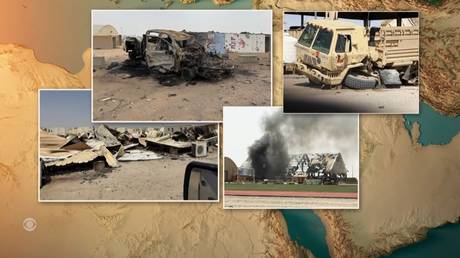
Imagine walking out of a reinforced bunker into a sulfurous haze, the air tasting of burnt composite and cordite. The desert sky is bruised purple and orange, illuminated by the distant flare of counter-rocket systems intercepting incoming threats. Overhead, the invisible architecture of electronic warfare hums—radars painting the sky, encrypted data streams bouncing off satellites, commanders miles away staring at telemetry screens, holding their breath.
Troops did not flee in panic. They executed a tactical retrograde, moving from vulnerable surface footprints into hardened subterranean shelters or dispersing across secondary defensive nodes in the vast, unforgiving expanse of the Kuwaiti interior.
Yet, the psychological impact cannot be sanitized by strategic terminology.
For an entire generation of service members who grew up or served in an era of absolute air superiority—where forward operating bases were secure bubbles complete with Green Beans coffee shops and reliable Wi-Fi—the sudden realization that a regional rival could systematically target, pressure, and temporarily displace U.S. forces from a major logistical hub was seismic.
The illusion of sanctuary evaporated.
This is what happens when technological parity catches up with geopolitical ambition. For years, the narrative of American dominance rested on the idea of over-the-horizon projection. We can strike anywhere; no one can touch us here. But the proliferation of low-cost, long-range precision missiles and suicide drones has democratized destruction. You no longer need a massive air force to disrupt a superpower; you just need enough guided metal to make staying put an unacceptable gamble.
When the dust settled and the all-clear was eventually sounded, the troops returned to their posts. The generators were restarted. The logistics hubs slowly hummed back to life, their computer screens blinking through the dust.
Outwardly, things went back to normal. The supply trucks rolled out at dawn. The administrative reports were filed.
Inwardly, nothing was the same.
Because every soldier walking those perimeter paths now knew the exact sound of the air tearing open. They knew that the vast, empty expanses of the desert no longer offered isolation, only concealment for a shadow war that had finally found its light.
The base was reoccupied, but the old era was left behind in the smoking craters outside the wire. History does not always turn on grand treaties signed in mahogany rooms. Sometimes, it turns in the dark, beneath the roar of incoming fire, when the ground shakes and the desert demands to be heard.