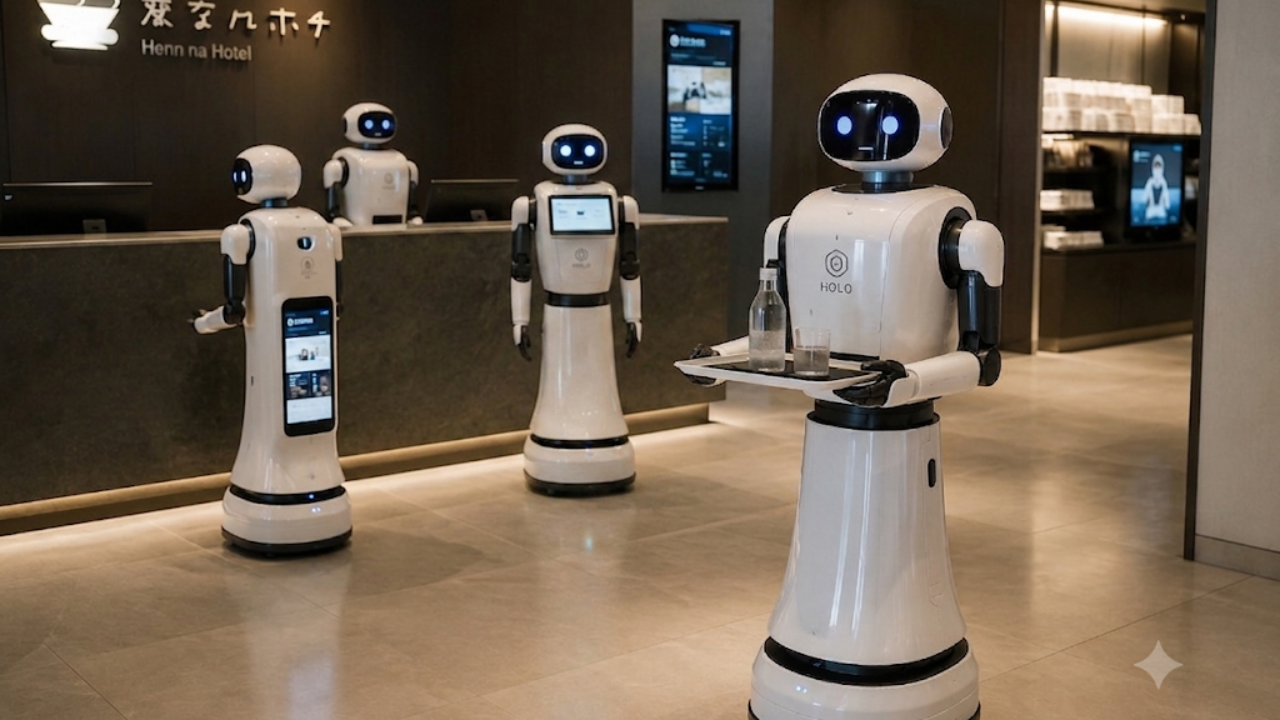
The heavy glass doors of the luxury hotel slide open, but there is no rush of warm air, no scent of fresh lilies, and no familiar, welcoming nod from a concierge. Instead, there is only the soft, rhythmic hum of low-voltage electricity.
You step onto the polished marble. Your footsteps echo. Meanwhile, you can find other stories here: The Changing Shadow Over the Pacific.
In Chengdu, China, a towering architectural marvel of steel and glass is preparing to open its doors to the public in 2027. It will be hailed as a triumph of modern engineering: the world’s first completely automated, robot-run hotel. The press releases describe it with sterile enthusiasm. No receptionists. No housekeepers. No human staff whatsoever. Every interaction, from check-in to checkout, from a fresh towel request to a midnight room-service cocktail, will be executed by autonomous machinery.
To the venture capitalists and tech evangelists, this is the holy grail of hospitality. It is a frictionless ecosystem where labor disputes vanish, overhead plunges, and efficiency reaches absolute perfection. To explore the bigger picture, check out the excellent analysis by Wired.
But stand in that hypothetical lobby for a moment. Feel the chill of it.
We are about to find out what happens when we remove the soul from the spaces meant to harbor us.
The Ghost in the Concierge Desk
Hospitality has never actually been about beds and bathrooms. Anyone with a smartphone can find a square room with a mattress. True hospitality is an ancient, almost sacred contract between a stranger and a host. It is the unspoken reassurance that when you are far from home, vulnerable and exhausted, someone is looking out for you.
Consider a hypothetical traveler named Sarah. She has just survived a fourteen-hour flight, a missed connection, and a lost suitcase containing the presentation that could save her logistics company. She arrives at her hotel at 2:00 AM, bleeding adrenaline and tears.
In a traditional hotel, a perceptive night auditor sees the slump of her shoulders. He doesn't just hand her a plastic key card. He listens. He offers a bottle of water on the house. He makes a quick phone call to ensure the kitchen can scrape together a late-night club sandwich, even though the menu officially closed at midnight. That tiny, unscripted moment of empathy is a lifeline. It bridges the gap between a hostile, unfamiliar city and a place of safety.
Now, place Sarah in the 2027 Chengdu automated hotel.
She approaches a gleaming kiosk. A high-resolution camera scans her retinas. A synthesized voice, calibrated to a perfectly neutral frequency, requests her digital passport. The machine does not notice her stained shirt or her trembling hands. It cannot read the exhaustion in her eyes, because it only processes pixels and data points. When she tries to explain that her luggage is gone and she needs a basic dental kit, the algorithm routes her request through a pre-programmed troubleshooting menu.
Select option one for amenities. Select option two for maintenance.
If her crisis falls outside the parameters of the code, the system stalls. The machine does not care. It cannot care. It is a monument to transaction, utterly devoid of relation.
The Mathematics of the Invisible Machine
The shift toward fully automated hospitality is driven by numbers that are, admittedly, intoxicating to a balance sheet. Human employees are expensive, unpredictable, and fragile. They require healthcare, parental leave, and breaks. They get tired. They have bad days that bleed into their customer service.
Robots don't sleep.
The technology underpinning the Chengdu project relies on a complex web of central artificial intelligence, automated guided vehicles (AGVs) for room service delivery, and specialized mechanical units for housekeeping. When a guest checks out, a signal triggers a cleaning unit equipped with ultraviolet sanitization matrices and high-efficiency vacuum systems. The room is stripped, scrubbed, and reset with terrifying speed and mathematical precision. Sheets are pulled to exact geometric tolerances.
On paper, the operational efficiency increases by an estimated 65%.
But this efficiency introduces a profound paradox. When you eliminate the friction of human interaction, you also eliminate the serendipity. The most memorable hotel experiences are almost always born from beautiful inefficiencies—a conversation with a bartender that changes your worldview, a housekeeper who notices your favorite tea and leaves extra packets on the nightstand, or a bellhop who recommends a hidden alleyway restaurant not found on any travel app.
When we automate the hotel, we turn a travel experience into a vending machine. You get exactly what you pay for, but nothing more. No surprises. No delight. Just a cold, predictable loop of execution.
The Silent Corridors
The physical design of an unstaffed hotel changes the very nature of human architecture. Traditional hotels are designed as social hives. The lobby is a theater; the bar is a crossroads.
In an automated hotel, the architecture shifts toward optimization and isolation. Corridors no longer need to feel wide and welcoming for human staff pushing heavy laundry carts. They become subterranean transit lanes for sleek, metallic cylinders gliding silently on rubber wheels. The lighting is optimized for machine vision, utilizing spectrums that human eyes find subtly unsettling.
Imagine walking down those halls at night.
There is no comforting murmur of a shift change down the hall. No distant sound of a vacuum cleaner operated by a tired but real human being. There is only the soft clicking of electronic locks and the low whir of internal cooling fans. You are entirely alone, yet hyper-surveilled by an omnipresent network of sensors designed to track your movement, your room temperature, and your consumption patterns.
It raises a deeper, more unsettling question about the future of our shared spaces. If a hotel becomes an automated pod, why leave home at all? The joy of travel is rooted in the wild, chaotic tapestry of human culture. If every destination offers the exact same sterile, machine-managed environment, geography loses its meaning. Paris, Tokyo, and Chengdu begin to feel identical, wrapped in the same corporate, algorithmic skin.
The True Cost of Perfection
We have spent the last decade chasing a myth. We believed that if we could just automate enough of our daily lives, we would unlock a utopia of leisure and ease. We automated our groceries, our banks, and our communication.
But the real problem lies elsewhere. Every time we replace a human face with a screen, we chip away at the social fabric that keeps us grounded. The receptionists, the housekeepers, and the doormen are not just line items on a profit-and-loss statement. They are the frontline ambassadors of our shared humanity.
When the Chengdu hotel opens its doors in 2027, it will undoubtedly be a financial success initially. It will attract the curious, the tech-obsessed, and the pathologically introverted. It will be clean, fast, and flawlessly efficient.
But as the initial novelty fades, the silence will set in.
Guests will sit in their perfectly climate-controlled rooms, staring at walls cleaned by machines, eating food delivered by drones, and they will feel an unmistakable, hollow ache. It is the realization that we have built a world so optimized for convenience that we have accidentally engineered ourselves right out of it.
The heavy glass doors will close, locking out the chaotic, beautiful, messy world of human connection, leaving nothing but a spotless, empty room.
:max_bytes(150000):strip_icc()/GettyImages-2192014718-e18efe654b3f4b769a45c8692acc5f39.jpg)