Static. That is what three days of sleeplessness sounds like when you are staring at a glowing wall of county-by-county data at two in the morning.
In November 2022, inside a cramped fourth-floor apartment overlooking a rain-slicked street in Phoenix, a retired high school civics teacher named Arthur—a hypothetical stand-in for millions of Americans who held their breath that week—sat with a cold mug of coffee and watched a red-and-blue electronic map refuse to settle. Outside his window, the desert air was unusually crisp. Inside, the television hummed with the low, rhythmic murmur of cable news anchors filling dead air while clerks in Maricopa and Clark counties counted paper ballots by hand.
Then came the chime.
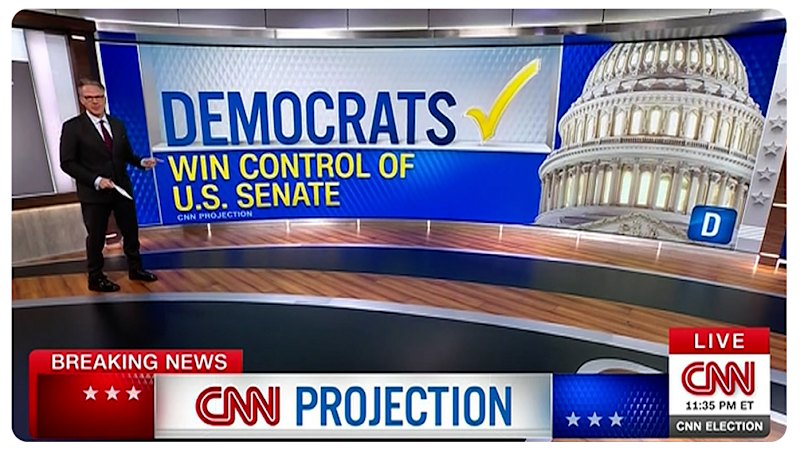
On Saturday, November 12, 2022, at 9:13 p.m. Eastern Time, CNN’s Decision Desk flashed a projection across millions of screens: Senator Catherine Cortez Masto had won reelection in Nevada. With that single call, Democrats had secured 50 seats in the United States Senate, retaining control of the upper chamber regardless of the looming December runoff in Georgia.
Most news reports treated that broadcast moment like a box score. They listed the margins. They noted that Cortez Masto edged out Republican challenger Adam Laxalt by fewer than eight thousand votes. They mentioned Senator Mark Kelly’s earlier victory in Arizona and John Fetterman’s flip of a Republican-held seat in Pennsylvania. They reduced a seismic shift in American governance to a tidy headline about a broadcast projection.
They missed the real story entirely. A television network calling a race is not merely a media milestone; it is the exact second when invisible power changes hands in rooms the public will never enter.
The Architecture of a Fifty-Seat Majority
To understand why that Saturday night projection mattered so deeply, you have to strip away the theatrical red-and-blue graphics and look at the cold machinery of the United States Senate.
Think of the Senate not as a debating society, but as a massive railway switchyard. A majority leader does not simply get more votes on the floor; the majority leader owns the switches. Whoever holds that gavel decides which bills leave the station and which ones sit rusting on a dead-end track until the two-year congressional term expires.
Had Republicans won just one more seat in November 2022—flipping either Nevada or Arizona—the switchyard would have locked shut overnight. With a 50-50 split, Vice President Kamala Harris held the constitutional tie-breaking vote, giving Democrats the narrowest possible functional majority. Later, when Raphael Warnock won the Georgia runoff in December, that margin expanded to 51-49, freeing Democrats from the exhausting logistics of power-sharing agreements on Senate committees.
Without that Nevada projection, however, every judicial nominee proposed by President Joe Biden would have hit a brick wall before even reaching a committee hearing. Federal district courts, appellate benches, and any potential Supreme Court vacancy would have remained frozen for two full years. Subpoena power would have flipped instantly, turning Democratic-led oversight committees into Republican-led investigative engines aimed squarely at the White House.
Yet, sitting on a worn sofa in 2022, it was remarkably easy to feel cynical about the whole spectacle. For four days after Election Day, the country existed in a state of suspended animation. The predicted "red wave"—a historical pattern in which the president’s party almost always suffers heavy midterm losses during times of high inflation—never materialized. Instead, the nation got a slow-motion drip of precinct totals from Las Vegas and Reno.
I remember watching those returns come in, feeling that familiar knot of exhaustion in my stomach—the creeping suspicion that our democratic process had become too fragile, too slow, and too incomprehensible for ordinary people to trust. When margins shrink to tenths of a percentage point, democracy stops looking like a grand civic exercise and starts looking like an accounting audit.
Why Nevada Held the Key
Why did the entire balance of national power come down to a handful of mail-in ballots in Clark County, Nevada?
The answer lies in the demographic collision happening across the American West. For decades, political strategists treated Nevada as a predictable bellwether driven by unionized hospitality workers on the Las Vegas Strip. By 2022, rising gas prices, soaring housing costs, and lingering pandemic anxieties had bruised working-class voters across the state. On paper, Catherine Cortez Masto—the first Latina ever elected to the U.S. Senate—looked like the most vulnerable incumbent on the map.
Her opponent, former Nevada Attorney General Adam Laxalt, ran a disciplined campaign focused relentlessly on inflation and border security. Meanwhile, outside groups poured more than one hundred million dollars into the state, blanketing television screens and mailboxes until voters could barely open their front doors without stepping on glossy attack ads.
Consider what happens next when a state becomes the final domino: every flaw and strength in local election law gets magnified under a national microscope.
Nevada sends mail-in ballots to every active registered voter, and state law allows ballots postmarked by Election Day to arrive up to four days later. That single rule created the four-day suspense window that kept CNN’s anchors standing in front of touchscreens from Tuesday night until Saturday evening. Every batch of late-arriving ballots from Las Vegas nudged Cortez Masto’s tally upward by a few hundred votes at a time, slowly erasing Laxalt’s early election-night lead.
To a casual viewer, it looked erratic. In reality, it was pure arithmetic. Urban mail ballots, which leaned heavily Democratic, simply took longer to verify and tabulate than in-person rural votes from Elko or Nye counties, which leaned heavily Republican and reported within hours of polls closing.
The Human Weight Behind the Graphic
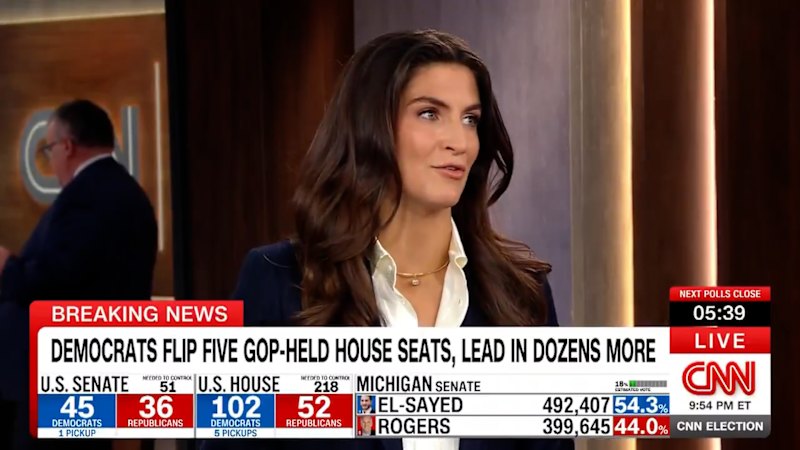
When CNN anchor Wolf Blitzer finally delivered the projection on Saturday night, the studio reaction was brisk and professional. Political director David Chalian walked through the math. John King zoomed in on Washoe County on his touchscreen map. Within minutes, the broadcast moved on to analyzing what the call meant for the upcoming Georgia runoff and the incoming Republican majority in the House of Representatives.
Pause for a moment and step outside the television studio.
Imagine a young couple in Columbus, Ohio—let us call them Elena and Marcus, a hypothetical family navigating the real-world fallout of that broadcast—trying to figure out whether a federal agency will enforce clean-water rules near their neighborhood, or whether a federal judge appointed to their circuit will uphold workplace protections. They do not know the names of the members of the Senate Judiciary Committee. They did not watch the Saturday night broadcast live.
Yet their daily lives were quietly altered at 9:13 p.m. on November 12.
Because Democrats retained the Senate, the Biden administration went on to confirm more than two hundred federal judges during its four-year term, reshaping the ideological makeup of the federal judiciary for decades. Confirmations require only a simple majority of senators present and voting. In a divided government—where Republicans narrowly won control of the House of Representatives that same week—legislation largely ground to a halt, turning the Senate’s confirmation power into the single most consequential lever left in Washington.
History rarely announces its turning points with trumpets. More often, it arrives as a quiet click of a mouse in a television control room, followed by a lower-third banner sliding across the bottom of a screen.
What the Projection Exposed About Modern Democracy
Look closely at the mechanics of a network election call, and you begin to see a fascinating paradox in modern journalism.
A news organization like CNN has zero legal authority to certify an election. Certifications belong strictly to county boards, secretaries of state, and state governors weeks after the polls close. Yet in the public imagination, the moment a major network projects a winner is the moment reality solidifies. Markets adjust. Campaign staffs pack up boxes. Concession speeches get drafted, or, in an era of deep institutional distrust, legal challenges get filed.
Decision desks operate on strict statistical thresholds. Statisticians model remaining uncounted ballots by precinct, comparing early votes, mail-in returns, and historical turnout patterns. They do not call a race when a candidate is simply ahead; they call it only when the remaining uncounted ballots cannot mathematically allow the trailing candidate to catch up, within a margin of error so tiny it approaches certainty.
Still, waiting four days for that certainty tested the patience of an anxious public. In the vacuum between Tuesday night and Saturday evening, conspiracy theories flourished online. Every routine pause in ballot counting became fodder for suspicion. Every late batch of votes was framed by bad-faith commentators as suspicious rather than procedural.
That tension revealed a hard truth about twenty-first-century politics: our voting systems were built for accuracy, while our media ecosystem was built for instant gratification.
When those two timelines collide, trust erodes. People begin to confuse slowness with corruption. They forget that counting millions of individual pieces of paper by hand and machine—verifying signatures, curing mismatched envelopes, auditing tallies—is supposed to take time when the margin between two candidates is thinner than a razor blade.
The Aftershocks That Still Echo
Looking back from the vantage point of several election cycles later, that November 2022 projection stands as one of the sharpest anomalies in modern American political history.
Since the Civil War, the president’s party had almost invariably lost seats in both chambers of Congress during midterm elections—especially when presidential approval ratings hovered in the low forties and inflation sat at a forty-year high. By every traditional metric, Democrats should have lost three to five Senate seats that autumn.
Instead, they gained one.
They did it because voters weighed economic frustration against other urgent concerns—most notably the Supreme Court’s decision earlier that summer in Dobbs v. Jackson Women's Health Organization, which overturned Roe v. Wade and ended the constitutional right to abortion. Suburban women, young voters, and independents turned out in numbers that defied historical midterm slumps, particularly in battleground states like Pennsylvania, Arizona, and Nevada.
For Republican strategists, the moment CNN projected Nevada was a bitter wake-up call. Candidate quality mattered more than partisan tailwinds. In state after state, nominees who focused heavily on relitigating the 2020 presidential election underperformed traditional Republicans on the exact same ballot.
For Democrats, the projection brought relief, though not complacency. Retaining the Senate meant preserving a firewall against conservative legislation passed by the new Republican House majority, keeping the federal courts open to Biden nominees, and ensuring that the apparatus of the executive branch could remain staffed with confirmed cabinet and agency officials.
The Quietest Room in Washington
Think back to Arthur, our retired civics teacher in Phoenix, watching the glow of his television fade into the early hours of Sunday morning.
After the celebratory punditry died down and the studio lights dimmed in Atlanta and Washington, he walked over to his window and looked down at the empty street. Nothing outside had visibly changed. The streetlights still hummed. The asphalt still glistened from the rain.
Yet on Capitol Hill, two thousand miles away, invisible locks had just clicked into place, securing the doors of committee rooms, judicial chambers, and legislative calendars for the next two years—all because fewer than eight thousand people in the Nevada desert took the time to seal an envelope and drop it in the mail.