The bass from the Christopher Street Day closing party was still thumping against the damp evening air when the world split open.
It was Saturday night in Berlin. Just a few hundred meters from the iconic Brandenburg Gate, the Tiergarten park hummed with the fading energy of celebration. Thousands had marched under a canopy of rainbow flags, trading corporate cynicism for radical joy. They danced because history told them they had to. They danced because visibility is a shield.
Then came the white van.
It did not belong on the park path. It mounted the curb with a mechanical scream, shearing through the periphery of the crowd with calculated violence. One moment, strangers were laughing over warm drinks; the next, steel and momentum tore through flesh. When the van finally stalled against a thick oak tree, the driver kicked open the door, stepped out into the panic, and brandished a machete.
Twenty-nine bodies would eventually bear the marks of that rampage. One woman would not leave the park alive.
Consider what happens next: the city fractures into silence. Sirens begin to stitch together the dark. Police cordoned off the perimeter, flashing blue lights painting the trees in erratic strokes. But the face behind the wheel had already vanished into the sprawling labyrinth of the German capital.
Authorities moved quickly, leaking a name that would soon dominate every screen in Europe: Abdul Ballout.
He was twenty-one years old. Born in Germany to a family with Lebanese roots, Ballout was not an abstract ghost from a distant conflict. He was a product of the local soil, yet his mind had drifted elsewhere. Investigators quickly mapped a trajectory of radicalization that felt chillingly familiar. Months prior, he had traveled to the Middle East, chasing the toxic ghost of the Islamic State before being detained abroad. He had stood before a German court just months ago, convicted of plotting a serious act of state-endangering violence, only to be released on a suspended sentence while prosecutors fought for a harsher penalty.
He was a fracture line in the pavement that everyone saw coming, yet nobody managed to seal.
For nearly twenty-four hours, Berlin held its breath. The manhunt spanned train stations, highways, and quiet neighborhood blocks. The city's pulse slowed to a nervous tick. People checked their phones. They locked their doors. They wondered if the terror was a singular anomaly or the opening chord of a longer song.
The end came Sunday evening in Spandau, a quiet suburb tucked away on the western edge of the city.
An allotment garden complex—a patchwork of small wooden huts and overgrown tomato patches separated by weathered hedges—became the final theater. Special forces closed the trap around 6 p.m. They expected a surrender. Instead, they found a cornered zealot. Ballout burst from the foliage, sprinting straight toward the tactical officers with a sharp, bladed weapon raised.
Gunfire fractured the twilight.
It was over in seconds. Despite frantic resuscitation efforts by emergency responders on the damp grass, he died within sight of the garden sheds. The twenty-four-hour terror was extinguished with lead and smoke, leaving behind a vacuum of answers.
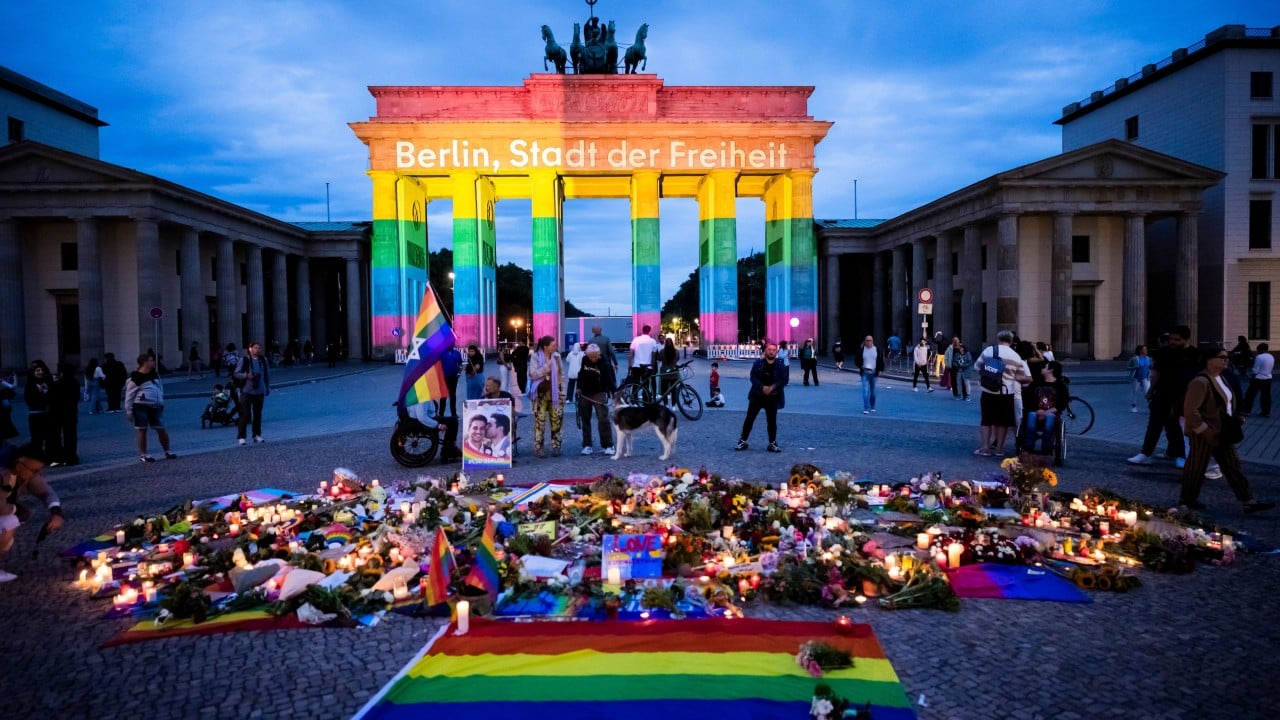
By Sunday night, the flowers began to pile up near the Brandenburg Gate.
A makeshift shrine of carnations, candles, and handwritten cardboard signs sprouted from the pavement. Among them, a simple message fluttered in the evening breeze: The only thing more powerful than hate is love. Thousands gathered not with megaphones, but in heavy, shared mourning. They embraced in the shadows of the monuments, refusing to let an act of Islamist extremism dictate the terms of their existence.
The van is gone. The suspect is dead. But the questions linger in the Berlin air, heavy as smoke, refusing to clear with the morning light.


