Cold.
That is the first thing anyone from Seoul remembers about the night of December 3, 2024—not the constitutional crisis, not the emergency broadcasts interrupting late-night dramas, and not the sudden roar of military helicopters slicing through the winter air above Yeouido, but the biting, metallic chill of a December midnight when ordinary people grabbed their coats and ran toward the National Assembly to stand in front of armored vehicles with nothing in their hands except smartphones and thermos flasks.
For six hours, South Korea held its breath while martial law hung over a modern democracy like a ghost from the 1980s. Then lawmakers scaled the fences, voted the decree down, and the tanks turned around. What followed over the next two years felt, to millions of citizens, like the slow, grinding machinery of accountability finally catching up to the architects of that night.
Until the Supreme Court spoke.
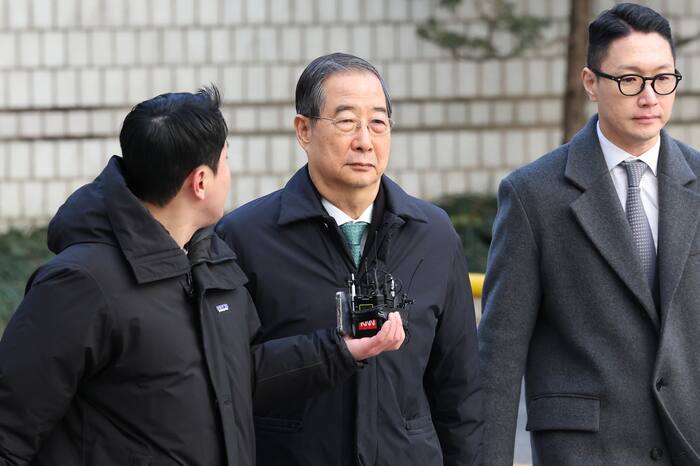
When South Korea’s top court overturned the charges against the former prime minister—Han Duck-soo—over his alleged role in the martial law episode, the headlines across the wire services were brisk, clinical, and almost entirely devoid of pulse. A conviction reversed. A legal threshold unmet. Case remanded or dismissed on points of statutory interpretation. Read one way, it was a dry procedural update from a high bench in Seocho-dong. Read another way, it felt like someone had walked into a crowded room, turned down the volume on history, and asked everyone to go home.
To understand why that ruling sent a quiet shockwave through living rooms from Busan to Incheon, you have to step away from the legal briefs and look at the invisible architecture of power—and what happens when the law decides that sitting in the room where democracy nearly died is not the same thing as pulling the trigger.
The Anatomy of an Empty Chair
Consider a hypothetical scene—one grounded in the well-documented mechanics of how cabinets operate during national emergencies, even as the exact private exchanges inside the presidential compound remain the subject of fierce judicial scrutiny.
Imagine a long mahogany table at 10:15 PM. Outside, special forces units are already receiving deployment orders. Inside, a handful of senior officials are summoned with almost no notice. There are no briefing binders, no minutes being formally recorded in the usual manner, and no time to call legal counsel. The president announces that he is declaring martial law to break what he calls anti-state paralysis in the legislature.
Now put yourself in the chair immediately to his right.
You are the prime minister. On paper, under Article 82 of the South Korean Constitution, acts of the president relating to state affairs must be executed in writing and countersigned by the prime minister and the members of the State Council concerned. You are the administrative anchor of the executive branch, the seasoned technocrat brought in precisely because you know how the gears of government are supposed to turn when political tempers flare.
What does responsibility look like in that room?
If you object, do you resign on the spot? Do you walk out the door and call the Speaker of the National Assembly? Or do you stay seated, urging caution in a low voice, hoping to manage the fallout while signing—or failing to block—the procedural steps that give the decree its veneer of legality?
That single question sits at the bleeding heart of the Supreme Court’s decision to overturn the charges against the former prime minister. Prosecutors had argued that participating in the cabinet meeting surrounding the martial law declaration, failing to stop an unconstitutional directive, or facilitating its administrative execution amounted to complicity in insurrection or abuse of authority. Lower courts, operating in the white-hot aftermath of public fury, had been willing to read those actions as active participation in a coup-like breakdown of constitutional order.
The top court drew a much sharper, colder line.
In criminal law, especially when charges carry the weight of treasonous rebellion or constitutional subversion, proximity is not proof of intent. A court cannot convict a man merely because he failed to be a hero. To sustain a criminal conviction for aiding an insurrection or abusing official power, prosecutors must prove beyond a reasonable doubt that the defendant possessed specific intent to subvert the constitutional order or actively coerced subordinates into unlawful acts. Attending a chaotic, last-minute cabinet session—even one that precedes a catastrophic executive order—does not automatically transform a hesitant bureaucrat into a co-conspirator.
Legally, the reasoning is textbook. Emotionally, for the people who stood outside the National Assembly gates in sub-zero weather, it lands like a slap.
Why Technocrats Rarely Look Like Villains
We have a cinematic addiction to how we picture threats to democracy. We look for generals in mirrored sunglasses, firebrand ideologues pounding podiums, or secret cabals plotting in subterranean bunkers. We rarely look at the man in the impeccably tailored charcoal suit holding a stack of trade spreadsheets.
That is precisely why the former prime minister’s legal saga struck such a raw nerve. Throughout a career spanning decades—serving as trade minister, ambassador to Washington, and twice as prime minister across administrations of different political stripes—he embodied the ultimate Korean civil servant. He was the steady hand, the bilingual policy wonk who reassured foreign investors in Davos and Washington that no matter how noisy Seoul’s domestic politics became, the grown-ups were still minding the store.
When martial law was declared in December 2024, that comforting illusion shattered overnight.
If the grown-ups were in the room, how did an emergency decree straight out of the Park Chung-hee and Chun Doo-hwan eras make it onto live television?
This is where the distinction between political accountability and criminal guilt becomes excruciatingly difficult to explain—and even harder to accept. Ask any Constitutional Court scholar or veteran Seoul defense attorney, and they will give you an analogy that goes something like this: Imagine a ship’s captain suddenly orders the vessel steered straight toward a reef in the middle of the night. The first officer stands on the bridge, warns the captain that the charts show shallow water, fails to physically wrestle the wheel away, and logs the order into the ship’s manifest. When the ship runs aground, public outrage demands everyone on the bridge be thrown in prison. Yet when maritime judges review the black box, they separate the man who gave the order from the man who failed to mutiny.
The law punishes active sabotage; it struggles mightily to criminalize institutional paralysis.
In South Korea, that struggle carries generational trauma. Older citizens still remember May 1980 in Gwangju, when martial law meant paratroopers, live ammunition, and decades of censored grief. Younger Koreans, raised in one of Asia’s most vibrant, hyper-connected democracies, grew up believing those stories belonged in museum exhibits. When soldiers in tactical gear tried to enter the National Assembly rotunda in 2024—blocked by aides spraying fire extinguishers and citizens linking arms—two generations collided in the same cold air.
For months afterward, the country demanded a total reckoning. Special prosecutors combed through phone records, cabinet entry logs, and command transcripts. Indictments rained down on military commanders, intelligence chiefs, the president himself, and top civilian ministers. Every conviction felt like bricks being mortared back into a damaged wall.
Then came the appellate review, and finally the Supreme Court’s reversal of the charges against the former prime minister.
The Invisible Cost of a Narrow Verdict
Step outside the courthouse in Seoul on the day of a major political ruling, and you can hear the country’s divisions before you see them. Protesters line both sides of the wide boulevard—one side waving national flags and cheering the exoneration as proof that the prosecution overreached in a political witch hunt; the other side holding printed placards demanding total accountability, warning that acquitting the top civilian official sets a dangerous precedent for future crises.
Both sides are reacting to real things, even if neither wants to admit the other has a point.
Consider what happens if prosecutors can easily imprison any cabinet minister who fails to stop an unlawful presidential order. On the surface, it sounds like an ironclad safeguard for democracy. In practice, weaponizing criminal law against administrative hesitation creates a terrifying tool that any future government can turn against its political rivals. Today it is used against officials from a conservative administration; five years from now, a different prosecutor’s office could use the exact same loose standard of "complicity by presence" to jail ministers from a progressive government over a disputed emergency policy.
South Korea knows this danger intimately. For decades, the country’s political pendulum has swung with brutal ferocity, where leaving the Blue House or the presidential office in Yongsan has too often meant trading an executive chair for a prison cell. Restraining prosecutorial overreach is not a loophole; it is how a rule-of-law state keeps justice from turning into victor’s vengeance.
Yet look at the other side of the ledger—the invisible cost that never appears in a Supreme Court syllabus.
When the highest civilian official in the government walks away without criminal liability after a martial law declaration, what message does that send to the next generation of senior bureaucrats? It whispers a quiet, seductive lesson: Keep your head down. Voice your doubts softly so you can cite them later, do not make a scene, and whatever happens, you will survive the fallout.
In moments of true constitutional danger, democracy rarely dies because a majority of officials enthusiastically cheer for authoritarianism. It dies because the people sitting closest to the lever decide that breaking protocol is scarier than letting the order go through. They wait for someone else to stand up first. They worry about pensions, reputations, chain of command, and whether they have all the facts. By the time they are certain the house is on fire, the doors are already bolted from the outside.
What the Court Left Behind
I have spent years watching how institutions behave under pressure, and the hardest truth to accept is that courts are built to audit the past, never to rescue the future.
A Supreme Court justice reads transcripts in a quiet, climate-controlled chamber years after the sirens have faded. They examine timestamps, statutory definitions, and burdens of proof with surgical precision. They are right to insist that criminal guilt requires concrete, individual wrongdoing rather than collective shame. If we abandon that standard when we are angry, we will have nothing left to protect us when someone else is angry at us.
Still, there is an unsettling silence left behind when the gavel comes down and the charges disappear.
The former prime minister is cleared of criminal culpability for that night, his legal record scrubbed of the stain of insurrection or abuse of power. The clerks archive the files. The news cycle moves on to semiconductor tariffs, housing prices in Gangnam, and the next parliamentary showdown.
Somewhere in Seoul, though, a young civil servant sitting in a ministry briefing room is watching how this story ended. They are taking notes on what the law punishes and what the law forgives. And if another midnight ever comes—if the phones buzz with an unscheduled summons and the helicopters rise again over the Han River—the fate of the country will not depend on what the Supreme Court wrote in its ruling.
It will depend on whether anyone in that room remembers how cold the concrete felt outside the gates, and decides to stand up before the ink dries.