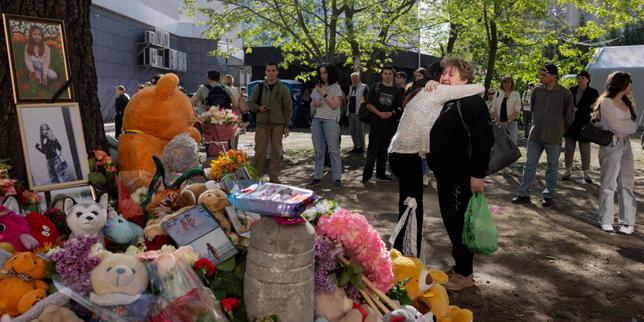
The sirens in Kyiv do not merely sound; they vibrate in the marrow of your bones. It is a low, guttural wail that turns the ordinary act of swallowing coffee or tucking a child into bed into a frozen moment of suspense. For months, residents learned to compartmentalize the sound, trading the damp dark of underground shelters for the fragile defiance of their own beds. But Tuesday morning destroyed that fragile truce.
When the metal rained down on the Okhmatdyt children’s hospital, the abstraction of war evaporated.
Imagine a room painted with cartoon characters, designed to make chemotherapy or dialysis bearable for a seven-year-old. Now replace that image with shattered glass, dust thick enough to choke on, and doctors in blood-stained scrubs digging through concrete with their bare hands. This is not a strategic military achievement. It is a raw, bleeding wound in the heart of a city trying desperately to live.
In the immediate aftermath, as smoke plugged the summer sky, Ukrainian President Volodymyr Zelensky did not offer the usual diplomatic platitudes. His voice, hardened by years of managing a tragedy on a global stage, carried a different kind of weight. He promised retaliation. Not out of blind rage, but out of a calculated, desperate necessity. Ukraine is shifting its gaze directly toward the engine that funds this destruction: Russia’s oil refineries and military hubs.
The strategy is simple, dangerous, and entirely alters the calculus of the conflict.
The Geography of Fire
To understand why Ukraine is pushing its drones deeper into Russian territory, you have to look at the anatomy of modern warfare. It is a math problem written in blood and fuel.
Every missile that tears through a Ukrainian apartment block requires three things: a factory to build it, a launchpad to fire it, and billions of rubles to fund the entire enterprise. Russia’s financial lifeline is not a secret. It flows through thousands of miles of pipelines and cooks in the massive distillation towers of refineries scattered across its vast territory.
For the first two years of the full-scale invasion, these facilities existed in a bubble of safety. The West, terrified of escalating the conflict and causing global energy spikes, repeatedly urged Kyiv to keep its hands off Russia's economic engine. Ukraine complied, fighting a defensive war with one hand tied behind its back.
But the strike on the Kyiv children’s hospital changed the moral arithmetic.
Consider what happens next when a nation decides the rules of engagement no longer apply to its survival. Zelensky’s declaration means the war is moving away from the frozen trenches of the Donbas and into the backyard of the Russian energy elite. By targeting oil depots in regions like Krasnodar and Rostov, Ukraine is attempting to induce a stroke in the Russian war machine. If you starve the tanks of diesel and the state treasury of petrodollars, the front lines must eventually starve too.
The Human Cost of Abstract Strategy
It is easy to analyze this through the cold lens of geopolitics. Pundits speak of "strategic depth" and "asymmetrical capabilities." But spend an hour on the ground in Kyiv, and those phrases crumble.
Olena, a thirty-four-year-old mother, was three blocks away from the hospital when the missile struck. The blast wave didn't knock her down, but it rattled the windows of her apartment with a violent, metallic crack. She describes the silence that followed as the most terrifying part.
"For ten seconds, nobody breathed," she said, her hands still shaking as she cleaned glass from her windowsill hours later. "Then the screaming started. You realize then that there is no safe place. Not a church, not a school, not a hospital bed where a child is hooked up to an IV. If they can hit that, they will hit anything."
This is the psychological reality Zelensky is operating within. A leader cannot look his citizens in the eye and preach patience while their children are pulled from the rubble of a pediatric ward. The promise to strike back at Russian infrastructure is not just a military doctrine; it is a psychological lifeline thrown to a population on the brink of despair. It is a statement that Ukraine refuses to be a passive victim.
But this shift brings immense friction.
The international community watches these developments with a mixture of awe and profound anxiety. The global economy is a fragile ecosystem. A sudden drop in Russian oil production could send gas prices soaring in Paris, Berlin, and Washington. Western leaders find themselves trapped in a cynical paradox: they condemn the slaughter of Ukrainian civilians, yet they nervously check the markets whenever a Russian refinery goes up in flames.
Kyiv’s message to its allies is becoming increasingly blunt: our survival matters more than your inflation rates.
The Invisible Stakes
We often treat war as a series of distinct events, a chronological sequence of battles won or lost. But the true nature of this conflict is an endurance test of two competing logistics systems.
Russia relies on its sheer mass—more men, more artillery, more oil money. Ukraine relies on agility, precision, and an agonizingly high tolerance for pain. When Ukrainian drones travel hundreds of miles through sophisticated air defense networks to strike a oil terminal in Tuapse, it is a triumph of engineering born out of desperation.
These domestic drones, built in hidden workshops across Ukraine, are funded by citizen donations and assembled by tech workers who were designing mobile apps before the war. They are slow, noisy, and look almost fragile compared to military-grade hardware. Yet, they possess the uncanny ability to bypass millions of dollars worth of Russian radar systems.
When one of these low-flying machines hits a distillation column, it doesn’t just cause a fire. It destroys highly specialized equipment that Russia cannot easily replace due to Western sanctions. It takes months, sometimes years, to rebuild these units. Every successful strike acts as a tourniquet on Russia's economic arteries.
Yet, this strategy is a double-edged sword. Every strike inside Russia gives the Kremlin ammunition for its internal propaganda machine, allowing it to paint the war to its domestic audience not as an aggressive invasion, but as a defense of the homeland. It hardens Russian public resolve, matching the grim determination found on the streets of Kyiv.
The Silence After the Blast
As dusk falls over Kyiv, the smoke from the morning's tragedy begins to clear, leaving behind the acrid smell of burnt insulation and pulverized stone. Volunteers still line up at the hospital site, passing buckets of debris from hand to hand in a quiet, rhythmic dance of resilience.
There is no celebration here when news breaks of a successful drone strike on a Russian fuel depot hours away. There is only a grim, collective nodding of heads. The illusion of a distant, contained war is gone forever. The conflict has evolved into something much more volatile, where the boundaries of the battlefield are defined only by the reach of a drone's propeller and the resolve of a leader with nothing left to lose.
The world watches, waiting to see if these retaliatory strikes will force a pause or ignite a larger conflagration. But in the dimming light of Kyiv, people are not looking at the global map. They are looking up at the sky, listening closely to the wind, waiting to see if the sirens will stay quiet for just one night.