The coffee in St. Petersburg used to taste different. For decades, the city prided itself on a specific kind of northern detachment. It was the imperial capital, Peter the Great’s window to Europe, a place of canals, baroque palaces, and an unspoken agreement that the messy, violent realities of the modern world happened somewhere else. Far to the south. Or far across the ocean.
Then came the low, persistent hum. You might also find this similar story interesting: The $200,000 Flutter in the Dark.
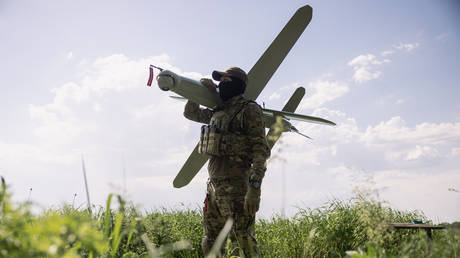
It is a sound that defies the geography of modern warfare. It doesn't sound like a supersonic jet or a heavy artillery shell. It sounds like a lawnmower. A lawnmower flying through the clouds at three in the morning. When that sound ripples over the Gulf of Finland, thousands of miles from the front lines of the war in Ukraine, the illusion of distance shatters.
Suddenly, a city of five million people realizes that the frontline is no longer a abstract line on a map. It is right above their heads. As highlighted in detailed articles by NBC News, the effects are significant.
The Illusion of the Safe Horizon
For the first two years of the conflict, the war was something that happened on television screens for most residents of Russia’s northern metropolis. It was a reality mediated by state broadcasts, a distant drumbeat affecting other families, other regions. St. Petersburg remained a sanctuary of culture and commerce, insulated by sheer geography. Moscow was closer to the border. Belgorod was under fire. But St. Petersburg? It was tucked away safely in the Baltic pocket.
That safety evaporated in a single night.
When Ukrainian long-range strike drones bypassed Russia's layered air defense networks to strike an oil terminal on the city's edge, they didn't just ignite a fuel tank. They ignited a profound psychological shift.
To understand how a cheap piece of molded fiberglass and a hobbyist engine can re-engineer global geopolitics, you have to look past the military communiqués. You have to look at the geometry of fear.
Consider a hypothetical resident named Elena. She lives in a high-rise apartment in the Primorsky district, overlooking the water. For years, her view was a source of pride—a sweeping vista of the Gulf, the glittering lights of the Lakhta Center spire piercing the fog. Now, every time the wind changes or a heavy truck rumbles on the highway below, she pauses. She listens. She looks at the sky.
Elena represents the unspoken target of this new campaign. The drones do not possess the explosive payload to level a city block. They are not designed to carpet-bomb infrastructure. They are precision instruments of disruption, designed to prove a point: You are not out of reach.
The Math of the Asymmetric Sky
The sheer physics of these attacks reveals a terrifying math problem for modern militaries.
A standard long-range attack drone utilized by Ukraine might cost anywhere from $20,000 to $100,000 to manufacture. They are often made of carbon fiber or compressed wood, material that offers a minimal radar cross-section. They fly low, hugging the terrain, hiding in the radar shadows cast by hills, forests, and high-rise buildings. They move slowly, intentionally, mimicking the flight profiles of large birds or civilian light aircraft.
Now look at the defensive side of the ledger.
To intercept a single one of these low-tech intruders, an air defense battery must fire a missile. A Pantsir-S1 or an S-400 interceptor missile does not cost tens of thousands of dollars. It costs millions.
- The Drone: Cheap, mass-produced, easily replaced.
- The Interceptor: Expensive, highly complex, finite in supply.
But the financial cost is only the surface of the problem. The real crisis is spatial. Air defense systems are finite resources. Every battery deployed to protect an oil refinery in St. Petersburg is a battery that cannot be used to protect a military logistics hub in Rostov or a command center in Donbas. By stretching the target map thousands of kilometers to the north, Ukraine forces a brutal calculus upon the Russian high command. They must choose what to defend, and what to leave exposed.
This is the definition of asymmetric warfare. It is the art of forcing your opponent to spend a fortune to defend everything, while you spend a pittance to attack anywhere.
The Changing Rhythm of the Neva
Walk down the Fontanka Embankment today, and the physical signs of this shifting reality are subtle but unmistakable.
You see it in the GPS anomalies. Taxi drivers navigate by memory now because their navigation apps frequently place them in the middle of the Gulf of Finland or show them driving through solid brick walls. The electronic warfare spoofing networks, spun up to blind incoming drone guidance systems, have effectively blinded the civilian city.
You see it in the security guards standing on the roofs of industrial facilities, scanning the horizon with handheld anti-drone jamming guns that look like oversized plastic rifles from a science fiction movie.
You see it in the conversations that abruptly stop when a sudden noise echoes across the water.
The Kremlin’s official statements rarely change. They speak of intercepted targets, suppressed electronic signals, and minor debris falling in industrial zones. They assure the public that the situation is entirely under control.
But the smoke plumes rising from the horizon tell a different story. They speak of a technological evolution that has outpaced traditional doctrine. The Soviet-era air defense philosophy was built to stop fleets of high-altitude NATO bombers or incoming ballistic missiles. It was never designed to hunt a swarm of low-flying, automated lawnmowers weaving through the Baltic fog.
The Vulnerability of the Monolithic Machine
There is a deep irony in how these operations unfold. The very infrastructure that made St. Petersburg an economic powerhouse—its massive oil terminals, its sprawling port facilities, its interconnected energy grid—now serves as its greatest vulnerability.
A modern industrial economy is a highly complex, interconnected organism. It relies on predictability. Refineries operate on razor-thin margins of safety and timing. When a drone strikes a fractionation column, it doesn't just cause a fire; it halts production for weeks, sometimes months. In a world bound by international sanctions, replacing highly specialized, Western-made refinery components is not a matter of ordering a part online. It is a logistical nightmare of backchannel supply chains and makeshift engineering.
The true impact of these strikes is measured not in casualties, but in friction.
It is the friction of rising insurance premiums for cargo ships entering the Baltic. It is the friction of factory workers spending their shifts looking out the window instead of at the assembly line. It is the friction of a population realizing that the state's promise of absolute protection has a geographic expiration date.
The strategy relies on consistency. A single strike can be dismissed as a fluke, an anomaly, a lucky breach of the perimeter. But when the sirens wail week after week, when the explosions become a recurring feature of the local news cycle, the narrative changes. The extraordinary becomes routine. The distant war becomes a local reality.
The Weight of the Unseen
Human beings are remarkably adaptable creatures. We learn to live with the absurd, the terrifying, and the unstable. In St. Petersburg, life continues. The theaters are full. The restaurants serve beef stroganoff and cold vodka. The bridges still rise over the Neva every night to let the cargo ships pass through to the interior.
But the atmosphere has hardened. The carefree arrogance of a city that considered itself untouchable has been replaced by a quiet, watchful tension.
It is a tension born of the realization that the sky is no longer empty space. It is a highway. And on that highway, the traffic moves both ways.
As dawn breaks over the Baltic, the white nights of summer begin to fade into the gray, heavy mists of autumn. The searchlights on the oil docks continue to sweep the horizon, cutting through the damp air, searching for a shape that is barely there, listening for a sound that might never come—or might arrive in the next thirty seconds.
The city waits, suspended between its grand history and its fragile present, watching the gray water turn to black.