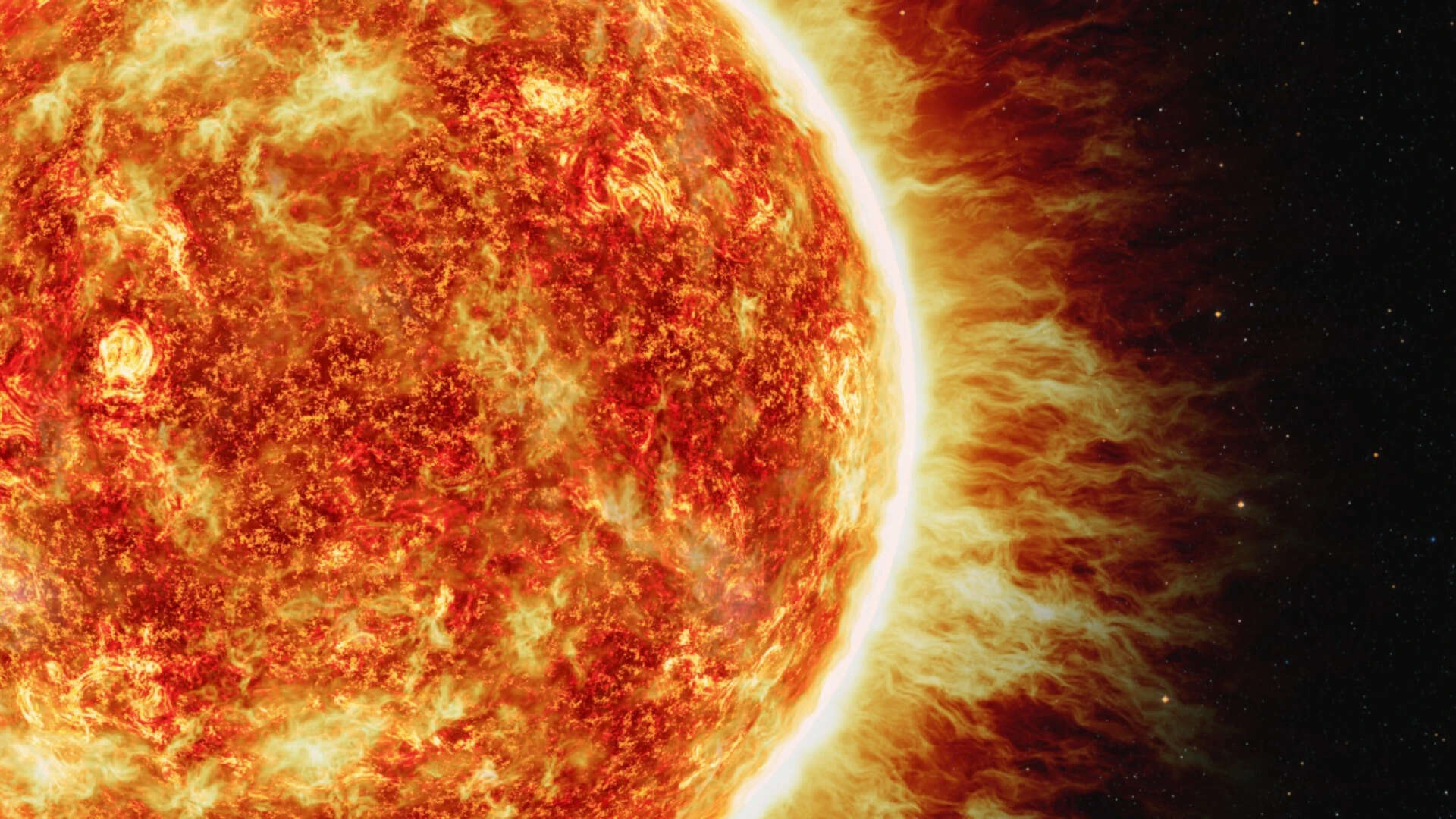
We tend to think of the sky as an absolute certainty. The Sun rises, it warms our skin, and it sets, repeating a predictable cadence that has anchored human sanity since the dawn of time. But if you talk to the people who monitor the invisible currents humming just above our atmosphere, the sky feels a lot less stable. It feels like a living, thrashing thing.
Consider a hypothetical grid engineer named Marcus. It is 2024, and Marcus is sitting in a windowless control room in the United Kingdom, staring at a monitor that is rapidly turning a worrying shade of crimson. Outside, the night sky is glowing with an eerie, breathtaking violet light—an aurora borealis so vibrant it can be seen from southern England. To the average citizen, it is a miracle of nature, a moment to capture on a smartphone. To Marcus, it is a ghost story.
The Sun was throwing a historic tantrum. A cluster of massive sunspots had just hurled a billion tons of superheated plasma directly toward Earth, causing the most violent geomagnetic disturbance to strike our planet in more than two decades. In Marcus’s world, those beautiful lights mean induced currents are currently melting transformers, threatening to plunge millions of homes into darkness. For decades, people in his position have operated under a terrifying reality: we are entirely at the mercy of a star we do not understand.
We knew the Sun operated on a rough eleven-year cycle, breathing in and breathing out, its magnetic field flipping like a coin. But trying to guess exactly how violent the next cycle would be was an exercise in futility. The calculations were always clunky, inaccurate, and arrived far too late to give grid operators or satellite companies any real time to prepare.
Until now.
The Heartbeat that Suddenly Stops
For generations, the prevailing wisdom was that the Sun behaved like an old campfire. It would rage during its peak, and then slowly, gradually, the embers would cool down before the next cycle began. It was a comfortable, intuitive metaphor.
It was also completely wrong.
A team of astrophysicists at the University of Warwick, led by Professor Sandra Chapman, just upended that entire foundation at the Royal Astronomical Society’s National Astronomy Meeting in Birmingham. They discovered that the Sun doesn’t gently drift off to sleep. It doesn't fade.
It shuts off. Like a light switch.
"The Sun doesn't gently go to sleep and then gently wake up again," Professor Chapman explained. "Instead, we've discovered that the most extreme space weather switches off quite suddenly at a specific point in every solar cycle."
By mapping the chaotic, irregular rhythms of the Sun onto a standardized "sunclock," the researchers noticed a bizarre, recurring phenomenon. Right in the middle of the star’s decline, the violent solar flares and catastrophic coronal mass ejections do not slowly taper off. They stop on a dime.
The cosmic tempest simply ceases.
The Seven-Year Warning
This sudden silence isn't just an astronomical quirk; it is a Rosetta Stone for space weather forecasting.
The Warwick team realized that the number of sunspots left on the surface of the Sun at the exact moment of this "switch-off" point acts as a mathematical mirror. Count those sunspots during that brief window of quiet, and you can accurately predict exactly how powerful the next solar cycle will be.
This shifts the entire timeline of human preparedness. Traditional forecasting models only gave us a vague, frantic heads-up shortly before a cycle began. The switch-off method allows scientists to look six to seven years into the future.
Think about what that means for a society deeply dependent on fragile electronics. Seven years of warning means satellite constellations can be engineered to withstand specific radiation levels. It means power grids can be reinforced. It means we stop reacting to cosmic disasters and start out-planning them.
The method has already proven its worth. While other traditional models underestimated the current Solar Cycle 25, Chapman's sunclock correctly predicted that it would be unexpectedly fierce—giving us the historic, terrifyingly beautiful auroras of recent years.
Waiting for the Quiet
Right now, we are living through the peak of the storm. The current Solar Cycle 25 is still raging, throwing erratic bursts of energy across the solar system. But the clock is ticking.
We are approximately two years away from the next switch-off point.
Right now, scientists have to rely on preliminary projections. Using these early estimates, the team has cast a tentative gaze toward Solar Cycle 26, predicting a relatively moderate cycle with roughly 100 to 120 sunspots at its peak—making it slightly tamer than the chaotic weather we are experiencing today.
But the real magic happens in twenty-four months. When Solar Cycle 25 hits that invisible wall and its extreme weather abruptly dies, the projections will be replaced by cold, hard observations. Scientists will count the remaining sunspots, lock in the data, and hand humanity a precise, seven-year roadmap of the sky.
It is a humbling reminder of our place in the universe. We are small creatures living on a blue marble, completely dependent on the nuclear furnace next door. For centuries, we could only watch its moods with anxiety. But soon, when the Sun throws its next switch and falls suddenly silent, we will finally be listening to what that silence is trying to tell us.