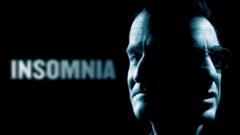
The air in Small Town, USA, usually smells like cut grass or diesel exhaust. In Nightmute, Alaska, the air tastes like damp salt and ancient, indifferent stone. It is a place where the geography itself feels like a jury box. When Will Dormer arrives there, he isn’t just a detective stepping off a plane. He is a man carrying a heavy, jagged secret in his pocket, hoping the northern wilderness is vast enough to swallow it whole.
He is played by Al Pacino, but not the Pacino of "Hoo-ah!" and explosive charisma. This is a version of the actor that looks like he hasn't slept since the seventies. His eyes are bags of bruised skin. His voice is a dry rasp. He is the physical embodiment of a conscience that has been rubbed raw by the friction of a "necessary" lie.
Then there is the light.
In the height of the Alaskan summer, the sun does not go down. It hangs in the sky like a fluorescent bulb in an interrogation room that someone broke the switch for. It is aggressive. It is judgmental. For a man like Dormer, who has done something terrible in the fog, the lack of darkness is a refined form of torture. He needs the shadows to hide his guilt, but the sky refuses to provide them.
The Fog and the Fatal Error
The plot of Insomnia is ostensibly a murder mystery. A teenage girl has been killed. Dormer and his partner, Hap Eckhart, are sent from Los Angeles to help the local police. It should be a standard procedural. But the film, directed by Christopher Nolan before he became the architect of spinning hallways and dream heists, isn't interested in a simple whodunit. It is interested in what happens when a "good" man realizes he is no longer different from the monster he is hunting.
During a stakeout in a suffocatingly thick fog, Dormer sees a shape. He fires. When the mist clears, it isn't the killer lying in the dirt. It’s Hap.
In that heartbeat, Dormer has a choice. He can tell the truth and let his career—already under investigation by Internal Affairs back home—disintegrate. Or he can nudge a shell casing, tell a small lie, and blame the fugitive. He chooses the lie. He chooses the path of the "greater good."
But someone saw him.
The Man in the Window
Walter Finch is not a typical movie villain. He doesn't want to blow up the world. He doesn't even want to get away with murder, at least not in the traditional sense. He wants a friend. Robin Williams plays Finch with a terrifying, muted stillness. It is a performance that strips away the manic energy of his comedy, leaving behind something cold, pale, and desperately lonely.
Finch is a writer. He understands narratives. He watched Dormer kill his partner through the fog, and instead of running to the police, he feels a kinship. He calls Dormer in the middle of the "night"—that bright, mocking Alaskan night—and speaks to him as a peer.
"You're a clean-up man," Finch says. He recognizes that they both took a life because it was convenient, or necessary, or simply because they were tired.
This is where the movie stops being a thriller and starts being a psychological autopsy. The stakes aren't about whether Dormer will catch Finch. The stakes are about whether Dormer can survive the reflection he sees in Finch’s eyes. The detective is a man who has spent his life putting people in cages, only to realize he has built one for himself out of his own choices.
The Weight of the Eyelids
Insomnia is a physical ailment, but in this story, it’s a spiritual one. Nolan uses the camera to make the viewer feel the grit behind Dormer’s eyes. We see the way the light bleeds through the cracks in the hotel window blinds. We hear the ticking of clocks and the humming of refrigerators that become deafening in the silence of a town that can't sleep.
Dormer begins to hallucinate. The lines between his memories of the shooting and his present reality begin to smear like wet ink. He tries to tape garbage bags over his windows to keep the sun out, but the guilt is a light that shines from the inside.
Consider the local cop, Ellie Burr. She is played by Hilary Swank as a symbol of pure, unblemished idealism. She idolizes Dormer. She has studied his old cases. To her, he is the gold standard of justice. Her presence is a constant, stinging reminder of the man Dormer used to be—or at least, the man he pretended to be. Every time she looks at him with admiration, it’s like a fresh slap to a sleep-deprived face.
The Logic of the Damned
The film challenges the comfortable lie we tell ourselves: that the end justifies the means. Dormer justified his past corruption by telling himself it put bad guys behind bars. He justifies the cover-up of Hap's death by telling himself he needs to stay free to catch Finch.
But Finch uses that same logic. He killed the girl because she rejected him, but in his mind, it was an accident of passion—a momentary lapse not unlike Dormer's finger on the trigger in the fog.
The two men enter a parasitic relationship. They meet on rocky beaches and in quiet ferries, two ghosts haunting the living. Finch offers a deal: silence for silence. It’s a logical arrangement. It’s efficient. It’s also the total evaporation of Dormer’s soul.
The Final Descent into the Mist
As the film reaches its crescendo, the exhaustion becomes unbearable. Dormer is moving through a dreamscape. The colors are desaturated. The world feels thin. When the final confrontation occurs, it isn't a high-octane action sequence. It’s a messy, desperate struggle in a wooden cabin that feels like the end of the earth.
Dormer is forced to decide if he will double down on his lie or finally embrace the darkness he has been trying to avoid. The tragedy of the character is that he is too good of a cop to ever truly be a good criminal. He knows the evidence. He knows the trail. Even when the trail leads directly to his own heart, he can't help but follow it to the end.
There is a moment near the end where Dormer is lying down, the struggle over. The sun is still there, indifferent as ever.
"Let me sleep," he says.
It isn't a request for a nap. It’s a plea for the end of the light. For the end of the scrutiny. For the end of the relentless, unforgiving clarity that comes when you can no longer hide who you are.
The credits roll not on a victory, but on a profound sense of exhaustion. You realize that the scariest thing in the world isn't a killer hiding in the dark. It’s the truth standing right in front of you, bathed in a light that never goes out.