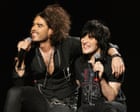
Every celebrity crisis playbook in London has the exact same first page. Wait until the silence becomes expensive. Release a four-word statement of shock. Watch the press cycle move on to the next target.
When Noel Fielding finally spoke out about his former comedy partner Russell Brand, declaring himself horrified and deeply disturbed, entertainment outlets treated it like a moral reckoning. Headlines framed the quote as closure. Commentators praised the distancing. Fans breathed a collective sigh of relief that the whimsical host of The Great British Bake Off had drawn a clean line between himself and a man facing severe criminal allegations.
That reaction is pure PR theater. And buying into it lets an entire television industry off the hook.
The lazy consensus around this story assumes that once a former double-act partner expresses disgust, the ledger is balanced. One man is the monster; the other man is the innocent bystander who simply didn't know. Both assumptions ignore how British panel shows, commissioning editors, and comedy booking agencies actually operated during the 2000s and early 2010s.
The Myth of the Clueless Co-Star
Noel Fielding and Russell Brand were not casual acquaintances who crossed paths in a green room once a year. They were one of the most heavily promoted comedic pairings in Britain. From The Big Fat Quiz of the Year to Never Mind the Buzzcocks and live charity galas, broadcasters packaged their dynamic as peak anarchic charm. Brand played the manic, hyper-sexualized Victorian dandy; Fielding played the surreal, wide-eyed fairy-tale eccentric. Together, they printed ratings.
In television production, chemistry is currency. When two performers generate viral clips and boost youth demographics, networks do not ask uncomfortable questions about off-camera behavior. They build formats around them.
To understand why a delayed statement of horror rings hollow, you have to understand the mechanics of performative distancing. In crisis communications, performative distancing occurs when a public figure issues a belated moral condemnation only after legal, financial, or reputational consequences become unavoidable for the brand they currently represent. Notice the timing. Silence holds steady while rumors circulate inside comedy clubs. Silence holds steady when whispers reach green rooms. The public horror only arrives once formal charges, parliamentary inquiries, or major network sponsors threaten the speaker's own active contracts.
I have watched talent agencies in Soho manage these exact fallout windows for fifteen years. The priority is never accountability. The priority is containment. If a client is anchored to a family-friendly juggernaut like The Great British Bake Off, any lingering association with a toxic co-star is treated like a hazardous waste spill. You don't investigate how the spill happened. You hire a hazmat crew to spray a fresh coat of paint over the fence and issue a press release saying you hate pollution.
Why Audience Members Are Asking the Wrong Question
Search trends around this story obsess over one predictable angle. People want to know if Noel Fielding knew what Russell Brand was doing behind closed doors.
That is the wrong question. Even if you take Fielding at his absolute word—even if he never witnessed a single non-consensual act or criminal offense—asking what one comedian knew about another misses the structural machine that rewarded the behavior in plain sight.
Brand did not hide his persona. His entire commercial value rested on boundary-pushing sexual aggression disguised as edgy banter. Broadcasters didn't tolerate it; they commissioned it. Producers booked guests specifically to be steamrolled by it on camera because awkwardness made great television. When an industry hands a performer a microphone, a primetime slot, and a massive paycheck specifically to act as an unchecked predator in jest, nobody on set gets to act surprised when the camera turns off and the behavior continues.
What People Actually Want to Know
- Did Noel Fielding and Russell Brand stay close in recent years? No. Their professional paths diverged sharply over the past decade as Fielding transitioned into mainstream, family-oriented television while Brand pivoted toward fringe political commentary and wellness grifting. Distance, however, is not the same thing as accountability.
- Can a comedy partner really be unaware of a co-star's private life? Yes, especially in a work environment built on late-night tapings, separate dressing rooms, and distinct social circles. Knowing someone's stage act is not proof of knowing their crimes. Yet claiming total ignorance of the culture that enabled them requires selective amnesia.
- Does expressing disgust change anything for victims? Not a single thing. Statements crafted through publicists serve to protect future syndication rights and brand endorsements, not to repair harm or reform booking practices.
The Two-Tier Accountability Trap in British Entertainment
British comedy operates on an unwritten buddy system that protects bankable talent until the exact second they become a liability. Look at the historical pattern across UK broadcasting, from Jimmy Savile to the wave of revelations documented in the Dispatches investigation. Red flags are treated as eccentricities so long as the talent delivers audience share.
When the dam finally breaks, the industry executes a neat trick. It isolates the accused individual as a singular, inexplicable aberration—a bad apple that somehow rolled onto the set undetected—while every enabler, producer, runner, and co-star steps backward and declares themselves horrified.
Let's be fair to the nuance here. There is a massive legal and moral gulf between committing violent sexual crimes and being a guy who told jokes next to the perpetrator on a panel show fifteen years ago. Conflating a comedy partner with an offender is lazy, dangerous, and factually wrong. Fielding is not responsible for Brand's actions. Nobody should pretend otherwise.
The downside to rejecting celebrity apology tours is obvious: if you criticize every public figure who speaks out late, you risk incentivizing total silence forever. People are allowed to feel genuine revulsion when formal charges lay bare the reality of someone they once called a friend. Human beings compartmentalize. Friends miss obvious signs in people they trust all the time.
Still, acknowledging human blind spots does not require applauding standard-issue PR damage control as moral courage.
How Real Accountability Looks in Entertainment
If broadcasters, producers, and high-profile performers actually wanted to prove they are disturbed by what happened in the 2000s comedy circuit, they would stop issuing four-word quotes to tabloid reporters and start changing how productions operate.
- Audit the legacy catalogs. Streaming platforms and networks continue to monetize archival panel show episodes featuring disgraced talent without context, demonetization, or revenue redirection. If the behavior is truly horrifying, stop collecting ad revenue on the clips that normalized it.
- Eliminate unchecked green-room hierarchies. On most comedy productions, the headliner dictates the room. Junior researchers, runners, and female guests have zero leverage when a star crosses a line. Independent on-set welfare officers with actual authority to halt taping—not HR representatives paid by the production company—are mandatory.
- Drop the amnesia act. Veterans of that era who now hold executive or hosting power should speak candidly about how toxic the banter culture actually was, rather than pretending they worked in a monastery until yesterday morning.
- Stop rewarding crisis silence. Audiences and entertainment journalists need to stop treating delayed, lawyer-approved expressions of shock as breaking news. A quote given under pressure is a press strategy, not a conscience.
British television spent fifteen years turning predatory swagger into primetime entertainment, clapping along while the ratings climbed, and cashing every check. Calling the aftermath horrifying now isn't bravery. It is just the cost of keeping the current gig.


