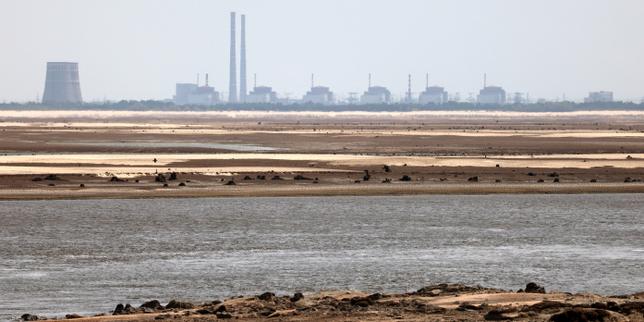
Military kinetic activity around the Zaporizhzhia Nuclear Power Plant (ZNPP) represents a deliberate weaponization of nuclear risk, shifting the conflict from conventional territorial attrition to asymmetric deterrence. Standard live-blog reporting treats International Atomic Energy Agency (IAEA) condemnations as reactive diplomatic headlines, obscuring the underlying operational mechanics of a pressurized water reactor complex operating inside an active artillery corridor. Understanding the true threat profile at Zaporizhzhia requires separating political rhetoric from thermodynamic reality, mapping the exact failure modes of nuclear containment, and analyzing how armed actors exploit international regulatory paralysis.
The Seven Pillars of Nuclear Safety Under Siege
To evaluate the severity of strikes near ZNPP, analysts must strip away generalized alarmism and apply the IAEA’s Seven Indispensable Pillars of Nuclear Safety and Security. These pillars define the minimum operational requirements to prevent a radiological release during armed conflict. Kinetic strikes against the facility or its surrounding grid directly compromise four specific operational layers.
- Physical Integrity of Facilities: The six VVER-1000 reactors at Zaporizhzhia are housed within reinforced concrete containment structures designed to withstand external impacts, including accidental commercial aircraft strikes. The primary vulnerability does not lie in the reactor vessels themselves, which are currently in cold shutdown, but in the auxiliary structures: spent fuel pools, dry cask storage facilities, and the turbine halls. Unlike the primary containment domes, spent fuel pools sit under standard industrial roofing. A direct hit from high-explosive artillery or a loitering munition on a spent fuel pool degrades cooling water circulation, initiating a slower but equally catastrophic radiological release pathway.
- Off-Site Power Supply: Nuclear reactors require continuous electrical power to run pumps that circulate coolant through the reactor cores and spent fuel pools, even years after fission reactions cease. ZNPP relies on external high-voltage transmission lines—specifically the 750 kV Dniprovska line and the 330 kV Ferosplavna-1 backup line—to maintain this baseline load. Artillery strikes repeatedly sever these lines, forcing the plant onto emergency diesel generators.
- Emergency Backup Systems: When external grid connections fail, ZNPP relies on 20 emergency diesel generators. These units are designed as temporary bridge solutions, not continuous power plants. They require uninterrupted diesel fuel logistics through active combat zones and suffer from mechanical fatigue under prolonged load. A failure cascade occurs when off-site power is severed simultaneously with diesel supply interdiction or generator damage.
- Operational Staff Capacity: Safe nuclear operation depends on a licensed, rested, and psychologically stable workforce. The occupation of ZNPP fractured the original Energoatom workforce, replacing experienced operators with personnel unfamiliar with the specific modifications made to the Ukrainian units over the past two decades. Decision-making latency under shelling increases the probability of human error during emergency switching procedures.
Thermodynamics of Cold Shutdown Versus Active Operation
Public reporting frequently conflates the risks of an operating reactor with those of a reactor in cold shutdown, leading to flawed risk assessments. All six units at Zaporizhzhia have been placed into cold shutdown, a state where the reactor coolant temperature is maintained below 100 degrees Celsius and atmospheric pressure is stabilized.
This operational state drastically alters the timeline of a potential accident. In an active reactor, a loss-of-coolant accident triggers core meltdown within hours due to intense decay heat. In cold shutdown, decay heat generation drops by several orders of magnitude. If all external power and emergency diesel generators fail at ZNPP today, operators have a window of several days—rather than minutes or hours—before coolant water boils off and exposes the nuclear fuel assemblies.
This extended thermal margin does not eliminate risk; it merely changes the mechanism of failure. The primary threat shifts from rapid core melt to prolonged station blackout, where continuous shelling prevents repair crews from restoring high-voltage lines or refueling diesel tanks before the multi-day thermal buffer expires.
The Structural Limits of IAEA Monitoring
The IAEA maintains a permanent mission—the IAEA Support and Assistance Mission to Zaporizhzhia (ISAMZ)—on-site, yet its operational mandate contains built-in structural limitations that belligerents systematically exploit.
- Attribution Blindness: The IAEA’s statutory mandate restricts it to verifying nuclear safety, security, and safeguards. The agency lacks the forensic mandate and geopolitical authority to assign culpability for artillery strikes or drone impacts. When the Director General condemns "deadly attacks" without naming the perpetrator, the ambiguity creates an informational vacuum. Both Moscow and Kyiv exploit this neutrality, using identical IAEA incident reports to accuse the opposing force of nuclear terrorism.
- Access Restrictions: ISAMZ inspectors do not have unrestricted, real-time movement across the facility. Access to specific turbine halls, reactor rooftops, and perimeter defensive positions requires prior clearance from the occupying military authority. Delays of 24 to 48 hours between a kinetic incident and physical inspection allow forces to clear debris, remove munition fragments, or stage the scene, degrading the forensic value of the agency's observations.
- Absence of Enforcement Mechanisms: Condemnation carries zero kinetic deterrent. Without a demilitarized zone enforced by a neutral third-party peacekeeping force—an arrangement both belligerents reject due to tactical disadvantages—IAEA presence functions solely as an early-warning tripwire rather than a protective shield.
Asymmetric Deterrence and the Weaponization of Risk
Kinetic activity around Zaporizhzhia is rarely accidental; it reflects a calculated use of nuclear risk as a tactical and strategic instrument. By militarizing the perimeter of Europe's largest nuclear power plant, an occupying force creates a sanctuary for artillery batteries and troop concentrations, betting that the opposing force will refrain from heavy counter-battery fire to avoid triggering a radiological disaster.
Conversely, localized strikes against substations, cooling towers, or training centers adjacent to the perimeter serve to test the opponent's risk tolerance and signal escalation dominance to international observers. Every strike forces Western policymakers to weigh the strategic cost of continued military support against the catastrophic economic and environmental fallout of a European nuclear incident. The plant ceases to be energy infrastructure and becomes a geopolitical hostage.
This dynamic creates a dangerous equilibrium. Belligerents calibrate strikes to stay just below the threshold of containment breach—targeting administrative buildings, cooling towers, or transmission switchgear rather than reactor domes. However, artillery and unmanned aerial systems operate with inherent circular error probable (CEP) margins, electronic warfare interference, and mechanical failure rates. Relying on precision strikes to manage escalation around a nuclear facility introduces a high probability of unintentional catastrophic error.
Operational Imperatives for Risk Mitigation
Preventing a radiological event at ZNPP requires abandoning diplomatic appeals in favor of concrete engineering and operational adjustments.
- Grid Hardening and Micro-Grid Isolation: Engineering teams must prioritize the physical hardening of the 330 kV and 750 kV switchyards using reinforced concrete blast walls and overhead anti-drone netting. Simultaneously, establishing isolated, buried cable connections to nearby non-nuclear thermal or hydroelectric substations reduces reliance on vulnerable overhead transmission corridors.
- Decentralized Mobile Cooling: Rather than relying solely on centralized diesel generator halls, plant operators must deploy dispersed, mobile pumping units and containerized diesel generators positioned behind blast barriers across the site. Decentralization prevents a single munitions strike from disabling the entire backup cooling architecture.
- Automated Telemetry Disclosure: To neutralize the attribution problem, the IAEA must push for automated, tamper-proof radiation and seismic telemetry streaming directly to Vienna. Continuous seismic data correlated with acoustic sensors can establish the trajectory and origin of impacts in real time, stripping away the plausible deniability that currently incentivizes perimeter shelling.
Diplomatic condemnations will not alter the kinetic reality on the ground. Until international actors tie specific, pre-determined economic and military escalation triggers directly to verified telemetry breaches at ZNPP, the facility will remain an active instrument of coercive warfare.