Ink smells like panic when you are twelve years old and the clock is bleeding seconds onto a test paper.
I remember the exact texture of cheap newsprint in a crowded classroom where success was measured by the speed of our subtraction. Numbers were not concepts then. They were weapons. They were iron bars keeping us inside the lines of an expected future. Most of us learned to hate them quietly, dragging our pencils across margins with a dull, hollow dread. Also making headlines recently: Why the Cook Islands Party Win Changes Everything for the Pacific.
Then came Jiang Ping.
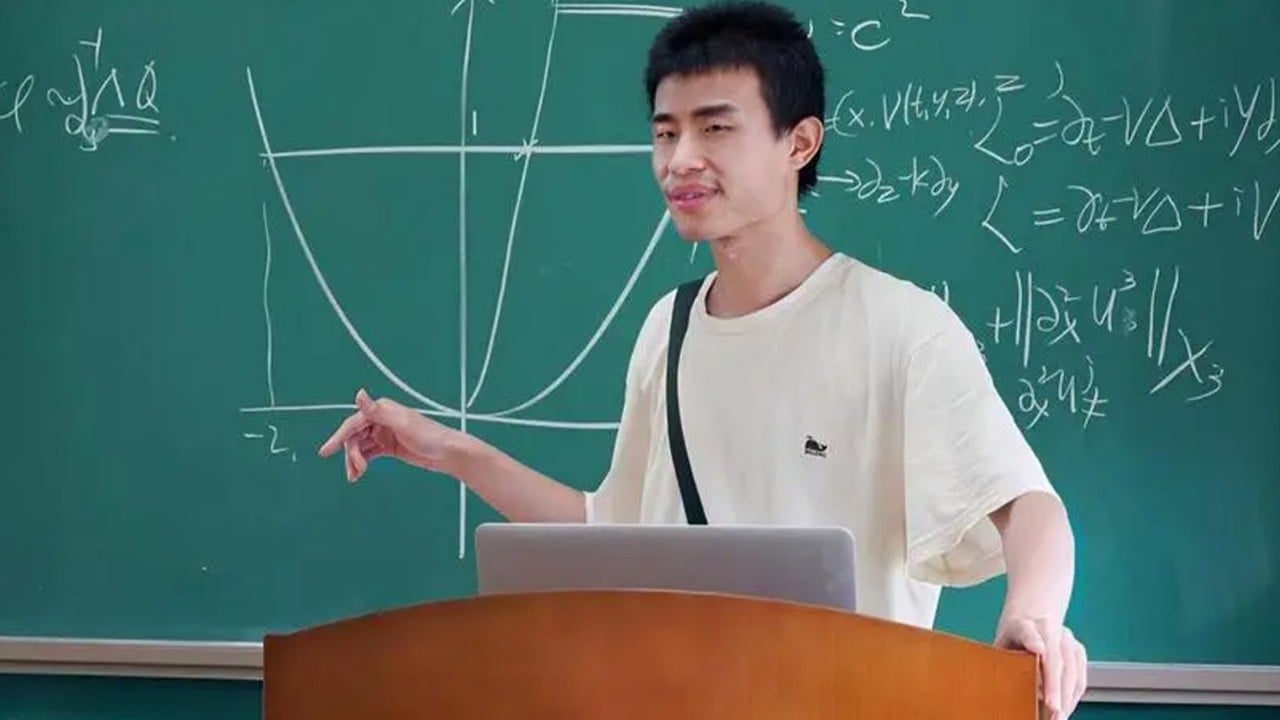
She did not look like an academic executioner. A vocational school student in rural Jiangsu, standing quietly in front of a chalkboard filled with equations that made university professors blink twice. Her name broke through the rigid glass ceiling of China's hyper-competitive testing culture like a brick through a stained-glass window. She placed 12th in a global mathematics competition, competing against Ivy League graduates and prodigies who had breathed elite tutoring since infancy. Further details on this are covered by Reuters.
The internet gasped. The algorithm devoured her.
And now, the aftermath has arrived in the quietest form imaginable. Twenty-six thousand copies of a new mathematics workbook, sold in four days.
People are arguing about it on Weibo. Critics whisper about ghostwriters, about media hyper-fixation, about whether a vocational student can truly author advanced pedagogical texts. Parents scramble to buy the books, desperate to bottle whatever lightning struck her small desk. Mixed reactions ripple across the public square like stones tossed into a stagnant pond.
Noise. So much noise.
To understand what is actually happening, we have to look past the sales figures and step inside the psychological engine room of a society obsessed with scholastic validation.
Let us be honest about what a workbook represents in this context. It is an artifact of hope and an instrument of torture. For decades, the Asian academic machine has operated on a simple, brutal premise: drill until the reflex replaces the thought. Millions of children stare at flashcards until their eyes blur, trained to solve standardized tests with the cold efficiency of microprocessors. It is a system that produces incredible technical output while quietly crushing the soul of genuine curiosity.
When Jiang Ping solved those calculus problems, the public did not just see a high score. They saw an escape hatch.
How did she do it? That was the question burning through every household. If a teenager studying fashion design in a county-level vocational school could master partial differential equations on her own time, armed only with borrowed university textbooks and a relentless hunger, then perhaps the system's gatekeepers were not infallible. Perhaps talent was wilder and more feral than the Ministry of Education wanted to admit.
Consider what happens next in a culture hungry for miracles.
Capitalism moves faster than empathy. Within weeks of her sudden fame, the machinery of production seized upon her brand. A workbook emerged bearing her intellectual wake. Twenty-six thousand copies vanished in ninety-six hours.
(To be clear: when I speak of the workbook here, I am observing the phenomenon of its rapid commodification—the way a human spark of rebellion is instantly packaged into stationery for anxious parents to place on their children's desks.)
Parents bought them because they want their own children to catch the ghost. They believe, with a desperate maternal and paternal superstition, that if a child writes in the margins of a book touched by a viral prodigy, some of that genius will osmosis its way into their gray matter. It is modern sympathetic magic. We buy the pencil of the writer, hoping we will learn to write the sentence.
Yet the mixed reactions point to a deeper, healthier discomfort.
The skeptics are not entirely wrong to ask questions. Can a vocational student really design a rigorous curriculum? Is this empowering a working-class icon, or is it exploiting a novelty for quick e-commerce revenue? The public is caught between two competing desires: the desperate need to believe in meritocracy, and the cynical suspicion that every miracle is just another marketing campaign.
I feel that cynicism in my bones. I have lived through the assembly line of academic pressure. I know the weight of a parent's expectation resting on the tip of a HB graphite pencil. I know the numbness that comes from solving ten thousand equations that have no bearing on the beauty of the universe, only on the ranking of a percentile.
Mathematics should be a language of stars and fluid dynamics, of music and the architecture of bridges. Instead, for millions, it is a border checkpoint.
Jiang Ping’s brief flash in the spotlight exposed this fracture. She approached math not as a prison guard, but as an explorer. While her peers were memorizing formulas to survive the gauntlet of the Gaokao, she was reading advanced texts for the sheer, intoxicating thrill of the puzzle. That is the secret the workbook buyers are missing. You cannot bottle her hunger by purchasing her practice problems. Hunger cannot be printed on 70-gram offset paper.
The twenty-six thousand buyers will open their packages tomorrow morning. Millions of children across crowded apartments will sit down at their desks, sliding the new books out of their plastic wrap. The smell of fresh ink will fill the room.
For a moment, they will feel close to greatness. They will trace the cover with their thumbs, imagining what it feels like to shock the world from a quiet room.
Then the clock will start ticking again.
The margins will fill with pencil marks. Some will get the answers right. Most will struggle, feeling that familiar, heavy drop in the pit of the stomach when a concept refuses to click. And the workbook, despite its famous name, will remain what it has always been: just paper, waiting for someone brave enough to look past the numbers and find the language underneath.
The room grows quiet. The ink dries. The numbers remain, waiting to see what we will do with them next.