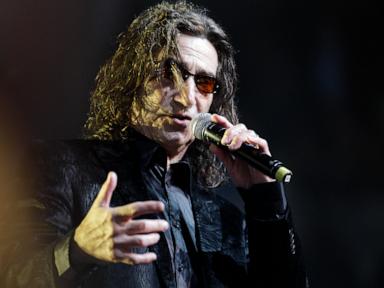
Every entertainment outlet in Nashville is running the exact same script right now. They will tell you Richard Sterban, the iconic bass singer of The Oak Ridge Boys who passed away at 83, was simply a beloved barbershop-style vocal anchor who sang "oom-papa-mow-mow" on "Elvira."
That lazy consensus reduces a ruthless master of vocal architecture and touring economics to a novelty punchline.
If you buy the mainstream obituary framing, you view Sterban as a nostalgic sidekick in a four-part country harmony group. You miss the actual mechanics of how he engineered one of the most durable, recession-proof business models in live entertainment, and why modern music executives are actively destroying their own artists by ignoring his blueprint.
The "Novelty Bass" Myth
Music journalists love easy hooks. Because "Elvira" crossed over to number five on the Billboard Hot 100 in 1981 and went double platinum, casual observers flattened Sterban’s five-decade career into a single three-second vocal drop.
I have sat in countless A&R meetings where young executives dismiss bass singers as relic gimmicks from the mid-twentieth century. They look at modern pop production—where sub-bass frequencies are generated entirely by 808 synthesizers and side-chained kick drums—and assume the human low end is obsolete. They are dead wrong.
In acoustic vocal arranging, a true bass voice does not just sing the lowest note. It dictates the harmonic center of gravity for the entire chord. Without Sterban anchoring the bottom end of The Oak Ridge Boys—alongside Duane Allen, Joe Bonsall, and William Lee Golden—the tenors would have had no acoustic floor to push against.
When you strip away a genuine bass vocalist and replace him with studio compression and digital low-end boosts, you lose the overtone series that makes human harmony physically resonate in a live theater. Sterban started in southern gospel quartets like J.D. Sumner and the Stamps—even backing Elvis Presley in the early 1970s—where microphones were primitive and monitors were terrible. If you could not project a clean, resonant low E or C across an auditorium without muddying the mix, you were fired. That discipline turned The Oak Ridge Boys from a struggling gospel act in the early 1970s into a crossover juggernaut that broke every rule on Music Row.
Why Nashville Executives Nearly Killed the Golden Goose
To understand what Sterban actually accomplished, you have to look at the sheer institutional resistance The Oak Ridge Boys faced when they pivoted from gospel to country in the mid-1970s.
In 1977, Nashville operated on rigid silos. Gospel acts stayed on the gospel circuit; solo male crooners dominated country radio. Group harmonies were considered risky, expensive to tour, and difficult to market. Record labels wanted a single charismatic frontman they could put on an album cover and control. A four-man democracy where a towering bass singer in the back row commanded just
Why Everyone Mourning Richard Sterban Misses What Made Him a Genius
entertainment
Every obituary running across Nashville trades right now tells the exact same lazy story. They call Richard Sterban a legendary bass singer. They mention the "oom-papa-mow-mow" hook from "Elvira." They slap a nostalgic bow on fifty years with The Oak Ridge Boys and call it a day.
It is lazy journalism. And it completely misses the point of why the man mattered.
Treating Richard Sterban like a novelty baritone who hit low notes on a 1981 crossover hit is like calling Eddie Van Halen a guy who tapped his fingers fast. You are looking at the surface trick while ignoring the structural engineering underneath. Sterban was not just a vocalist in a quartet. He was the human subwoofer that allowed a gospel group to hijack mainstream country radio and rewrite the commercial rules of Music Row.
The Myth of the Novelty Bass
Walk into any studio on 16th Avenue South and ask a veteran producer about vocal quartets. They will tell you the tenor gets the glory and the lead gets the girls. The bass singer? He is treated like acoustic furniture. He sits at the bottom of the chord, holds down the root note, and stays out of the way.
That is the industry consensus. And Sterban spent five decades proving it dead wrong.
Before Sterban joined The Oak Ridge Boys in 1972, the group was a respected, traditional Southern gospel outfit. They had harmonies. They had heritage. What they lacked was sonic mass. When William Lee Golden, Duane Allen, and Joe Bonsall brought Sterban in from J.D. Sumner’s Stamps Quartet—where he had just finished backing Elvis Presley on the road—the physics of the band changed overnight.
Think about the actual frequency spectrum of a 1970s radio broadcast. AM radio compressed everything into a muddy midrange box. FM was just starting to dominate country formats, and car stereo speakers were still cheap paper cones. Most country records of that era relied on an upright bass or a flat-wound Fender Precision to carry the low end.
Sterban replaced the need for low-end instrumentation with his own vocal cords.
When he dropped down to a low C or a B-flat, he was not just singing a pitch. He was generating physical air pressure that rattled dashboard speakers from Dallas to Detroit. I have sat in mixing rooms with engineers who worked those early ABC and MCA sessions. They will tell you the same thing—you did not need to boost the 80Hz range on the console when Richard stepped up to the Neumann U47. You actually had to roll off the bottom end just to keep him from overloading the tape.
How a Gospel Quartet Outsmarted Country Radio
To understand what Sterban actually accomplished, you have to look at the structural shift in country music between 1975 and 1985.
Nashville was terrified of losing its core audience to the Urban Cowboy pop-country wave. Record executives wanted smooth, safe, solo crooners who sounded like Kenny Rogers or Ronnie Milsap. A four-part gospel harmony group wearing matching suits and sporting chest-length beards was supposed to be commercial poison.
The Oak Ridge Boys did not survive that era by compromising. They survived by weaponizing Sterban’s voice as a rhythmic percussion instrument.
Look at the mechanics of their biggest hits:
- "Y'all Come Back Saloon" (1977): The song establishes their crossover template. Sterban does not sit back and drone. He punches the rhythm, acting as a secondary kick drum that drives the tempo forward.
- "Leaving Louisiana in the Broad Daylight" (1979): While Duane Allen carries the narrative melody, Sterban’s subterranean harmonies create an acoustic floor that makes the chorus feel twice as wide as any solo artist on the chart.
- "Elvira" (1981): Dallas Frazier wrote the song in 1966, and Rodney Crowell cut a version in 1978 that went nowhere. Why did The Oak Ridge Boys turn it into a double-platinum monster? Because producer Ron Chancey built the entire arrangement around the dynamic drop into Sterban’s solo vocal hook.
Nobody in Nashville expected a bass solo to become the biggest pop-country hook of the decade. Programmers at Top 40 stations in New York and Los Angeles put "Elvira" in heavy rotation solely because listeners kept calling in to hear "that guy with the impossibly deep voice."
Sterban did not ride the coattails of a hit song. His vocal timbre was the hook. Without that specific resonance, "Elvira" is just another upbeat country shuffle that stalls at number 25 on the Billboard chart.
The Elvis Connection Nobody Analyzes
Every tribute piece mentions that Sterban sang with Elvis Presley. They drop it in as a fun piece of trivia, right next to his love for the Philadelphia Phillies.
That is another failure of basic music analysis.
Sterban’s stint with J.D. Sumner and the Stamps Quartet from 1971 to 1972 was the ultimate boot camp in stadium acoustics and crowd psychology. Elvis did not hire bass singers because he liked traditional gospel quartets. Elvis hired them because he needed a wall of sound that could fill a 20,000-seat arena without turning into mush.
J.D. Sumner held the Guinness World Record for the lowest note sung by a human voice, and Sterban stood right next to him night after night, watching how a master manipulator used extreme low frequencies to trigger a visceral, physical reaction in an audience.
When Sterban left Elvis to join The Oak Ridge Boys—a move everyone in the gospel industry thought was career suicide at the time—he brought that arena-sized vocal architecture with him. He understood something that studio-bound Nashville session singers never learned: a bass voice is not meant to be heard. It is meant to be felt in the sternum.
I have watched dozens of vocal groups try to replicate the Oak Ridge formula over the last thirty years. They hire a guy with a deep speaking voice, put him on the far left of the stage, and tell him to sing low. It fails every single time. Why? Because most bass singers lose all vocal clarity and pitch definition once they drop below a low E. They turn into a gravelly, indistinct rumble.
Sterban maintained complete tonal clarity and rhythmic articulation all the way down into the basement of his register. You could understand every single syllable he sang, even when he was vibrating below the range of a standard cello. That combination of extreme depth and razor-sharp diction is a biological anomaly. You cannot teach it at Belmont University, and you cannot fix it with Auto-Tune.
What People Get Wrong About Vocal Longevity
If you search for Sterban’s career history, you will see endless questions about how he kept his voice intact well into his eighties while other country stars blew out their vocal cords by fifty.
The standard answer from vocal coaches is "good technique and hydration." That is generic nonsense.
The real reason Sterban’s voice endured—and actually improved in texture over fifty years—comes down to vocal fold mass and biological physics. Tenors and high baritones rely on high longitudinal tension across the vocal folds to hit their money notes. Every night on stage, they are stretching delicate tissue to its absolute mechanical limit. Scar tissue builds up. Nodes form. By age sixty, the high notes are gone, and they are dropping the keys of their old hits by a step and a half.
Bass singers operate under the exact opposite mechanical principle. To produce extreme low frequencies, the vocal folds must be thick, relaxed, and completely free of tension. You cannot force a low C. If you tighten your throat, the pitch goes up.
As Sterban aged, the natural loss of elasticity in his vocal cords actually worked in his favor. Instead of losing his range, his voice gained weight, grit, and harmonic richness. While his contemporaries were struggling to survive a 45-minute casino set, Sterban was walking out at 80 years old and hitting the exact same notes he recorded in 1981 without changing a single key.
There is a catch to this, of course, and it is the downside nobody likes to admit about relying on a foundational bass vocalist. When you build a band's entire sonic identity around a single irreplaceable frequency, you create a single point of failure. You cannot sub out Richard Sterban. You cannot cover his parts with a keyboard patch or a background track without the entire harmonic structure of the group collapsing.
The Death of the Bass Vocalist in Modern Country
Look at the Billboard Country Airplay chart right now. Count how many prominent bass singers you hear.
Zero.
Modern country production has completely abandoned the human low end. Today’s producers build tracks out of synthesized sub-bass drops, programmed 808 kicks, and heavily compressed acoustic guitars. Vocals are pushed high into the upper midrange, stacked with dozens of digital harmonies, and stripped of any natural chest resonance so they cut through cheap smartphone speakers.
We traded biological resonance for digital loudness.
In doing so, the industry killed off an entire vocal tradition. Young singers with naturally deep voices are actively discouraged from singing bass because radio consultants claim low vocals "muddy up the mix." They are told to push their range up into a strained, nasal baritone just to sound like everyone else on Spotify’s Hot Country playlist.
Richard Sterban’s passing is not just the end of a remarkable fifty-year run with one of music's most enduring quartets. It is the closing of the book on a specific, physical era of sound engineering—a time when four men standing around a microphone could generate more low-end power than a wall of Marshall stacks.
Next time someone puts on "Elvira" and smirks at the "oom-papa-mow-mow" line, tell them to turn up the volume and put their hand on the speaker cabinet. That is not a novelty act. That is pure, unadulterated acoustic physics. And nobody in Nashville has the lungs to replace it.


