Picture a room in Washington where the air usually smells of stale coffee, floor wax, and guarded institutional caution. For decades, the choreography of political crisis management followed a predictable script. When a nominee faced mounting scrutiny, the principal stepped back. Surrogates issued carefully parsed statements from behind podiums adorned with official seals. Journalists asked questions through established channels, and the machinery of vetting hummed quietly behind closed doors.
Then came an afternoon that tore up the playbook.
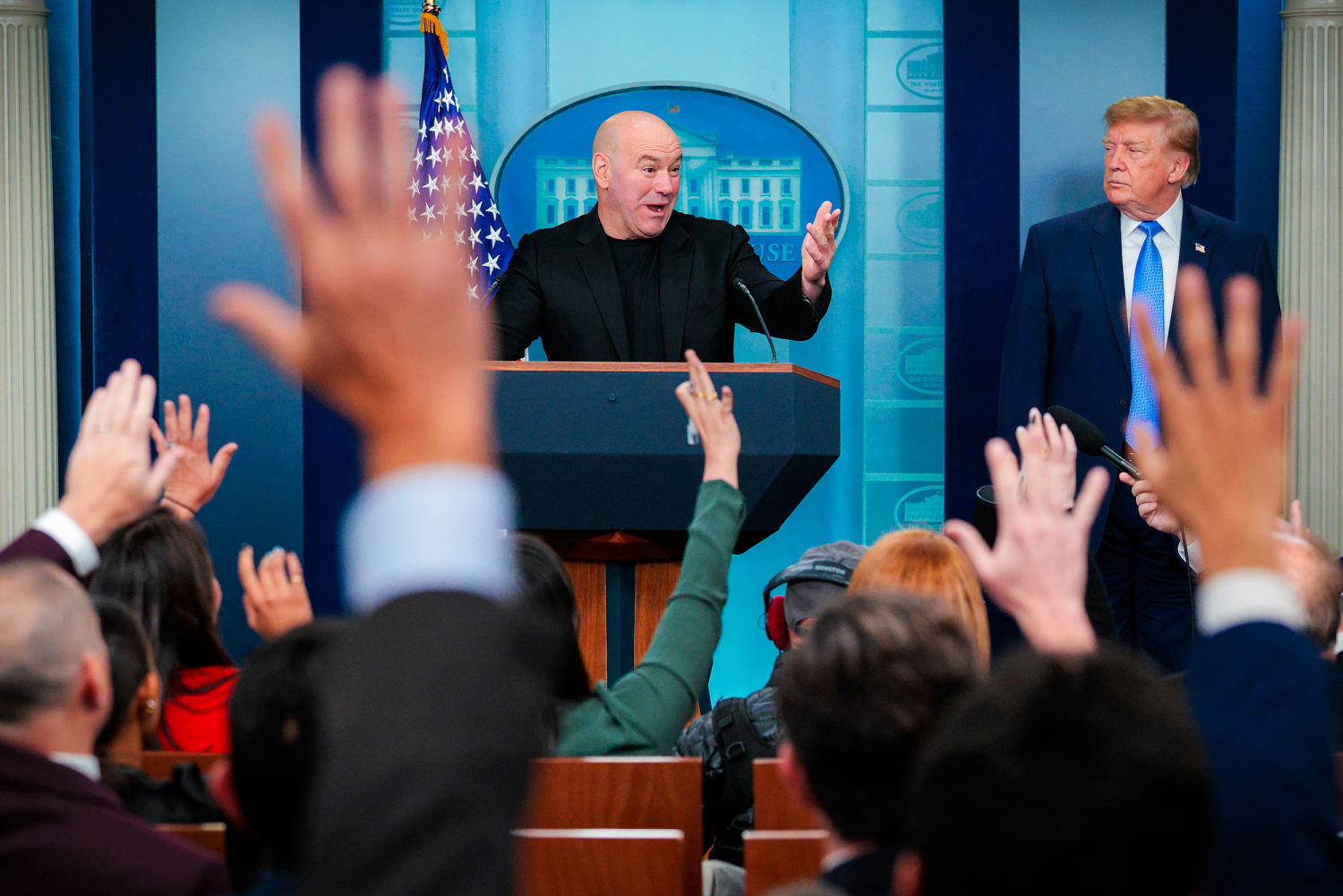
According to news reports covering the event, President Donald Trump stepped into a surprise news briefing alongside Ultimate Fighting Championship CEO Dana White and used the unscripted forum to mount a vocal defense of Pete Hegseth, his pick to lead the Department of Defense. No advance schedule had telegraphed the appearance. No traditional national security backdrop framed the remarks. Instead, standing beside the architect of modern mixed martial arts, the president brushed aside mounting questions surrounding Hegseth's qualifications and personal history, framing the criticism as partisan resistance against a fighter.
Wait.
Look closer at that staging, because the physical arrangement of people in a room often tells a sharper truth than the transcript of what they say. To understand why an unexpected press briefing featuring a combat-sports promoter and a embattled defense nominee drew immediate national attention, you have to step back from the daily churn of headlines and examine how political authority is projected, defended, and contested when traditional norms collide with populist theater.
The Architecture of an Unscripted Defense
In standard Washington crisis communications, proximity is rationed. A president rarely stands shoulder-to-shoulder with a embattled nominee during an unscheduled press availability unless the goal is to signal absolute, non-negotiable backing. By stepping before cameras without prior notice, the White House bypassed the slow drip of anonymous background briefings and forced the narrative onto terrain of its own choosing.
According to accounts of the briefing, reporters pressed Trump on reports concerning Hegseth's past conduct, management record at veterans' advocacy organizations, and readiness to oversee a Pentagon workforce of nearly three million military and civilian personnel. Trump's response relied on direct personal validation rather than granular policy rebuttals. He praised Hegseth's military service, dismissed critics as entrenched opponents, and projected confidence that the confirmation process would succeed.
Standing beside him was Dana White, a figure whose entire career has been built on turning high-stakes confrontation into mass entertainment. White did not speak as a defense analyst or a Senate liaison. He did not need to. His mere presence altered the semiotics of the room.
Think of the difference between a courtroom and an arena. In a courtroom, legitimacy flows from procedure, precedent, and documentary evidence. In an arena, legitimacy flows from crowd energy, loyalty under pressure, and the refusal to back down when cornered. Bringing White into the frame imported the visual grammar of the UFC directly into executive-branch politics. It communicated to supporters that the nomination battle was not a bureaucratic vetting exercise, but a title fight—and that the administration intended to win it on its own terms.
What Happens Inside the Room When Norms Shift
Consider a hypothetical scenario that mirrors the reality facing dozens of veteran Washington correspondents and congressional staffers during moments like this.
Imagine Sarah, a mid-career defense reporter who has covered Pentagon budgets and Senate Armed Services Committee hearings for twelve years. Her professional reflexes were trained on predictability. She knows how to read a nominee's financial disclosure forms, how to cross-reference inspector general audits, and how to decode the subtle phrasing of a senator who says a candidate "deserves a fair hearing" versus one who says a candidate "has my full support."
When a surprise briefing erupts with Dana White standing next to the commander-in-chief, Sarah's traditional toolkit suddenly feels incomplete. If she reports only the literal words spoken about Pete Hegseth, she misses the strategic theater driving the event. Yet if she focuses solely on the spectacle of a UFC executive appearing at a political briefing, she risks overlooking the concrete institutional stakes: who will command the world's most powerful military, how the Senate will exercise its constitutional advice-and-consent role, and what standards govern cabinet-level leadership.
That tension is not merely a media problem. It is a civic dilemma that affects every citizen trying to make sense of how decisions are made at the highest levels of government.
I have spent years watching how institutional norms erode not through dramatic overnight collapses, but through small, jarring juxtapositions that gradually reset expectations. The first time a boundary is crossed, observers treat it as an anomaly. By the third or fourth time, the unusual becomes routine. When political loyalty is demonstrated through surprise appearances alongside sports promoters, the traditional separation between governance and celebrity culture blurs until the line is nearly invisible.
Two Competing Theories of Political Strength
To understand why this single briefing sparked such polarized reactions across the country, it helps to examine the two fundamentally different lenses through which Americans view leadership and accountability.
From one perspective—voiced by administration allies and supporters of Hegseth—the briefing represented refreshing authenticity. Critics of the Washington establishment argue that traditional vetting processes are often weaponized by political opponents and entrenched bureaucrats to derail outsiders before they can reform sprawling federal agencies. In this view, Hegseth's background as an Army National Guard officer who served in Iraq and Afghanistan, combined with his years as a television commentator vocalizing frustrations shared by rank-and-file service members, makes him an agent of necessary disruption. Having Dana White at the briefing reinforced an image of toughness, camaraderie, and defiance against elite gatekeepers.
From another perspective—raised by Democratic lawmakers, former defense officials, and several Republican senators seeking deeper scrutiny—the briefing underscored troubling questions about institutional stewardship. The Secretary of Defense sits second only to the president in the military chain of command. The office manages a budget exceeding eight hundred billion dollars, oversees global force posture across Europe, the Middle East, and the Indo-Pacific, and bears responsibility for nuclear deterrence and crisis response. Critics contended that public expressions of personal loyalty cannot substitute for thorough background checks, formal committee hearings, and clear answers regarding past allegations of workplace misconduct or financial mismanagement.
Both viewpoints are rooted in deeply held convictions about what the country needs. One side fears a permanent bureaucracy unaccountable to voters; the other fears the weakening of guardrails designed to ensure competence and integrity in national security leadership.
The Invisible Stakes Behind the Cameras
Strip away the cable-news chyrons and social media clips, and the stakes of the Hegseth confirmation fight become intensely practical.
Every four years, a transition team faces the monumental task of staffing the executive branch. Roughly four thousand political appointments must be filled, with more than a thousand requiring Senate confirmation. History shows that cabinet nominations rarely fail, yet when they do, the reasons usually follow a familiar pattern. Past nominees such as John Tower in 1989—whose nomination for Defense Secretary was rejected by the Senate amid scrutiny over personal conduct and defense-contractor ties—demonstrate that the confirmation process has long served as a pressure test for both the nominee and the White House's political capital.
What made the briefing with Dana White distinctive was how early and publicly the president staked his personal prestige on the outcome. In political terms, that move raises the cost of retreat. When a president defends a pick through subtle surrogates, a quiet withdrawal remains possible if Senate math turns unfavorable. When a president steps before cameras unannounced and ties the nominee's fate to his own political brand, backing down looks like defeat.
For senators on Capitol Hill, that dynamic transforms a constitutional duty into a high-wire loyalty test. Lawmakers must weigh the concerns of constituents, military families, and defense leaders in their home states against the political reality of opposing a president who has publicly declared the matter settled.
Meanwhile, inside the Pentagon itself, career civil servants and uniformed officers watch these public battles with quiet pragmatism. The military is built on chain of command, continuity, and readiness. Yet prolonged uncertainty at the top—or deep divisions over how civilian leadership is selected—inevitably ripples through strategic planning, budget negotiations, and alliances abroad. Foreign ministries in London, Tokyo, Seoul, and Brussels read the transcripts of Washington briefings closely, searching for clues about how the next American defense leadership will approach alliances, deterrence, and burden-sharing.
Why Spectacle Captures Attention While Process Decides Outcomes
There is an old metaphor in political science that compares government to an iceberg: the visible tip above the waterline is rhetoric, rallies, and surprise press appearances, while the massive structure beneath the surface consists of statutes, committee rules, background investigations, and institutional memory.
The surprise briefing with Dana White was pure above-the-waterline theater. It generated immediate headlines, viral clips, and intense debate over style and substance. Dana White's presence bridged two worlds that increasingly overlap in modern American life: partisan politics and combat sports. Over the past decade, UFC events have become regular stops on the political circuit, drawing crowds that skew younger, male, and skeptical of conventional media narratives. By bringing White into an official briefing setting, Trump tapped directly into that cultural ecosystem, signaling solidarity with an audience that prizes direct talk and visible toughness.
Yet beneath the waterline, the mechanics of confirmation remain stubbornly procedural. No press conference can waive the requirement for a Senate Armed Services Committee vote. No viral moment replaces FBI background checks, ethics disclosures, or sworn testimony under questioning from senators across the political spectrum.
That collision between spectacle and procedure defines much of modern governance. Attention gravitates toward the unscripted moment—the unexpected guest at the podium, the sharp exchange with reporters, the defiant soundbite. Outcomes, however, still hinge on quiet conversations in Senate cloakrooms, document reviews by committee staff, and the slow accumulation of trust or doubt among decision-makers who hold actual votes.
Living Through the Blur of Politics and Entertainment
If you feel a slight sense of vertigo watching a defense nomination play out beside the CEO of a mixed martial arts promotion, you are not alone. Even seasoned observers admit that the boundaries separating public administration from pop culture have grown harder to map.
Part of the confusion comes from how rapidly communication norms have evolved. A generation ago, a president's words were filtered through formal speeches, press secretaries, and evening news broadcasts. Today, every briefing is simultaneously a policy statement, a campaign commercial, and a social media artifact engineered to travel across algorithms in seconds.
In that environment, traditional distinctions lose their edges. A sports executive becomes a visual symbol of political resolve. A cabinet vetting dispute becomes a serialized drama with daily plot twists. Voters are left to navigate between competing narratives, deciding whether an unorthodox defense represents courageous defiance of an unfair system or an evasion of legitimate accountability.
Navigating that landscape requires a kind of double vision. You have to watch the stage without forgetting the machinery behind the curtain. You have to listen to the rhetoric while tracking the verifiable record—the dates, the documents, the senate schedules, and the concrete responsibilities attached to the office in question.
The Quiet Weight of the Room After the Cameras Turn Off
Eventually, the cameras pack up. The cables are coiled across the floor. Dana White returns to the business of matchmaking and arena promotions. Pete Hegseth returns to preparing for Senate hearings, reviewing briefing binders, and meeting with lawmakers behind closed doors. Reporters file their stories and move on to the next breaking alert.
What remains in the quiet room is the enduring question that outlasts any single briefing or news cycle: how a democracy balances personal loyalty with institutional accountability when choosing who holds power over life, death, and national security.
The spotlight may belong to the arena, where strength is measured by who stands tallest under the glare of the lights—yet the fate of the nation still rests in the quieter rooms where promises are tested against the weight of the office itself.