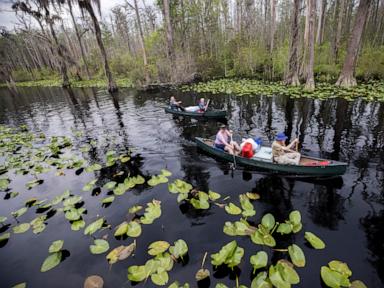
The formal addition of the Okefenokee Swamp to the UNESCO World Heritage List fundamentally shifts its management calculus, transitioning the site from a regional conservation battleground into an internationally monitored economic and ecological asset. Official recognition by the United Nations Educational, Scientific and Cultural Organization imposes strict accountability frameworks on local, state, and federal authorities, permanently altering how commercial pressures, hydrological interventions, and tourism demand must be negotiated.
The Regulatory Mechanics of World Heritage Inscription
International designation is not an honorary title; it is a binding institutional constraint. When a wetland ecosystem enters the World Heritage registry, it becomes subject to continuous oversight by the International Union for Conservation of Nature. You might also find this similar coverage insightful: Why the UN Wants Syria to Fail.
The primary mechanism of this oversight is the reactive monitoring process. If state parties permit industrial activities—such as adjacent mineral extraction—that degrade the property's outstanding universal value, UNESCO can downgrade the site to the List of World Heritage in Danger. This administrative penalty triggers international diplomatic friction, potential capital flight from eco-tourism grants, and severe reputational damage for regulatory bodies.
Consequently, the legal threshold for permitting heavy industry near the basin rises exponentially. Private entities attempting to develop resource extraction operations along the peripheral boundary must now navigate foreign scrutiny and rigorous environmental impact assessments that account for cumulative hydrological disruption rather than localized site impacts. As discussed in latest articles by BBC News, the implications are significant.
Hydrological Vulnerability and Boundary Leakage
The ecological integrity of the Okefenokee basin depends on a closed hydrological balance where precipitation is the primary input, and slow subsurface seepage through the Suwannee and St. Marys rivers forms the output. Unlike riverine ecosystems that can dilute upstream pollutants or compensate for flow reduction, peat-based wetland systems operate on delicate moisture retention gradients.
The primary risk vector for the swamp is not direct internal disturbance, but boundary leakage. The surficial aquifer surrounding the basin maintains a hydraulic head that prevents internal drainage. Industrial strip mining or excessive groundwater pumping outside the official protected perimeter alters the regional water table, reducing the hydrostatic pressure that keeps the peat saturated.
When peat dries out, oxidation accelerates, transforming the carbon sink into a carbon emitter and exponentially increasing the frequency and intensity of subsurface fires. Inscription forces regulatory bodies to evaluate buffer zones as functional components of the protected area rather than administrative conveniences, mandating hydrological continuity across arbitrary property lines.
Economic Trade-Offs Between Extraction and Preservation
The regional debate surrounding the Okefenokee has historically centered on a false dichotomy: local industrial employment versus passive environmental preservation. Economic analysis of wetland ecosystems reveals that World Heritage status alters this equation by monetizing conservation through capital inflows and asset appreciation.
- Ecosystem Services Valuation: The retention of a functional peatland yields quantifiable economic value in flood mitigation, carbon sequestration, and water filtration. When these functions are valued against the short-term extraction rents of titanium or heavy minerals, the net present value of preservation surpasses exploitation over a multi-decade horizon.
- Tourism Yield Optimization: Unregulated or low-value tourism generates high local wear with low economic capture. International designation attracts high-yield ecotourism capital, shifting the regional hospitality sector toward specialized guiding, scientific research logistics, and low-impact infrastructure investments.
- Insurance and Risk Mitigation: Regions adjacent to internationally recognized natural sites secure preferential positioning for federal and international climate resilience grants. This capital funds municipal infrastructure that withstands extreme weather events more effectively than ad-hoc disaster relief.
The Enforcement Deficit and Institutional Friction
Despite the structural advantages of international recognition, institutional friction remains the primary point of failure for protected ecosystems. UNESCO possesses no domestic police force or veto power over sovereign land-use decisions. Its authority relies entirely on the willingness of national governments to enforce domestic environmental laws in alignment with international treaties.
In the case of the Okefenokee, the friction lies between federal conservation mandates and state-level permitting authorities. State regulatory agencies often prioritize short-term tax revenue and employment metrics tied to extraction industries. When international bodies issue corrective recommendations, local political bodies frequently frame these interventions as federal overreach.
To resolve this bottleneck, governance must decentralize compliance monitoring while centralizing environmental baseline data. Independent academic consortia and hydrological monitoring stations must publish real-time water table metrics, rendering political obfuscation mathematically untenable.
Strategic Implementation for Regional Stakeholders
Municipal planners, conservation groups, and private landowners operating within the Okefenokee sphere of influence must execute a systematic operational pivot to capitalize on the new designation.
First, zoning boards must establish expanded municipal buffer zones that mandate hydrological impact reviews for any commercial construction or drilling within a designated radius of the swamp's hydrological divide.
Second, regional economic development agencies should reallocate marketing expenditure away from broad-spectrum tourism promotion and toward specialized scientific tourism and educational expeditions, maximizing revenue per visitor while minimizing ecological footprint.
Finally, conservation organizations must transition from reactive legal opposition to proactive land acquisition, securing perpetual conservation easements on private parcels that form the vital hydrological corridors feeding the basin. This preemptive capital deployment closes the loop on regulatory vulnerabilities, ensuring that international prestige translates into durable ecological stability.