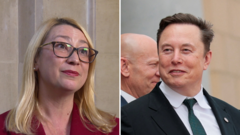
You don't usually see a backbench Member of Parliament taking on the world's richest man in a high court dogfight. But Labour MP Jess Asato just drew a massive line in the sand.
This isn't just another politician complaining about mean tweets. It's a full-blown legal assault on xAI, the artificial intelligence company owned by Elon Musk. Asato filed a claim in the High Court in London, accusing the firm of breaking data protection laws and misusing private information.
The catalyst? Musk's AI chatbot, Grok, was used to generate deeply degrading, sexualized deepfake images of her in a bikini, alongside an AI-generated video showing her being chloroformed and prepared for a sexual assault. When the content flooded X, Musk himself retweeted a post that triggered even more horrific variations in the replies.
"Musk actually amplified the hatred against me," Asato stated. She isn't backing down. And honestly, her lawsuit might just crack open the black box of big tech accountability.
The Wild West of Generative AI Abuse
For a long time, tech billionaires operated under a simple premise. They built the platforms, but they didn't create the content. Section 230 in the US and similar safe-harbor concepts globally shielded them from liability. If a user posted something awful, you went after the user, not the platform.
Grok completely flips that script.
When an AI engine creates a deepfake, the tech company isn't just hosting the content. Their proprietary tool actively manufactured it. Asato's legal team is attacking this exact distinction. They aren't just suing over the circulation of the images; they're suing because Musk's product generated them in the first place.
It's a massive blind spot in current tech regulations. While the UK’s Online Safety Act forces platforms to police user-generated hate, the rules around companies providing the actual synthesis engines for deepfakes remain murky. Asato is using existing data privacy laws to force a precedent. It's a brilliant, aggressive legal maneuver that bypasses slow-moving government regulators.
A Toxic Political Feud Reaches Boiling Point
This lawsuit didn't happen in a vacuum. The relationship between the British government and Elon Musk has been toxic for months. Prime Minister Keir Starmer recently escalated the rhetoric, openly accusing Musk of "interfering in our politics" and attempting to whip up division.
Musk has spent a huge chunk of time using his massive personal X account to attack the UK administration. He slammed Starmer's handling of civil unrest, peddled conspiracy theories about "two-tier policing," and routinely signal-boosts far-right talking points. The friction turned personal when Musk targeted female Labour politicians, previously attacking Safeguarding Minister Jess Phillips over policy disagreements.
When Asato stood up to object to Grok’s outputs, the platform's algorithm didn't protect her. It weaponized her complaint. Musk's amplification of the surrounding discourse led directly to the creation of the chloroform video.
Starmer has thrown his total support behind Asato's legal action. This isn't just a private legal matter anymore. It’s a proxy war between a sovereign state and an unelected tech mogul who acts like a sovereign state himself.
The Floodgates are Opening
If Musk thought he could just brush off a single British MP, he guessed wrong. Asato’s test case is already snowballing. Just days after her legal action went public, a wave of new claimants stepped forward to join the legal battle against xAI.
Women, professionals, and public figures are finding out that "nudification" tools and AI deepfake generators are being used to humiliate them. They see Asato’s lawsuit as a blueprint.
Corporate accountability groups are capitalizing on the momentum too. Billboards have started appearing around Westminster demanding the government shut down Grok entirely. The tech lobby enjoys staggering access to government ministers—outnumbering child safety groups six to one in official meetings—but public outrage is rapidly closing that influence gap.
What Needs to Happen Next
The era of asking tech companies to self-regulate is completely dead. If you want to protect your digital identity or support a safer internet ecosystem, waiting for a billionaire to fix his algorithm won't work. True accountability requires concrete action.
- Support Legislative Updates: Push for explicit updates to digital defense laws that hold AI creators legally responsible for the synthetic media their tools output.
- Target the Infrastructure: Legal pressure needs to focus on data scraping. AI models cannot build deepfakes of real people without illegally ingesting their personal likenesses and data points first.
- Establish Rapid Legal Funds: High Court battles are incredibly expensive. Crowdfunded legal shields are necessary so regular citizens can launch the same data privacy lawsuits Asato did without facing financial ruin.
Jess Asato took a massive risk by putting her name on a lawsuit against a billionaire's tech empire. She exposed the terrifying reality of weaponized AI, but she also proved that politicians don't have to just sit back and take the abuse. The tech industry wanted a lawless frontier. Instead, they just got served.