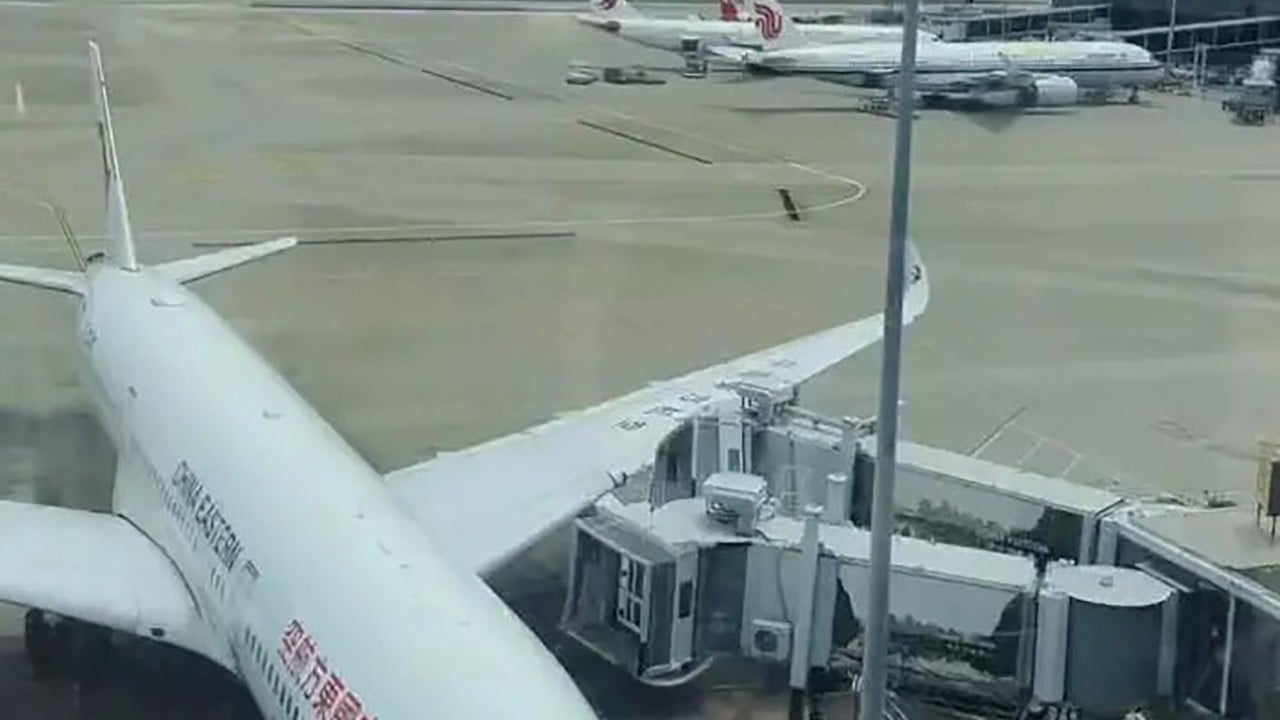
The collision between a China Eastern Airlines aircraft and a passenger boarding bridge (PBB) at Shanghai Hongqiao International Airport is not an isolated mishap but a systemic failure of high-precision ground telemetry. In the aviation industry, a "minor" contact incident represents a breach of the sterile safety zone, a $5$-meter perimeter where human error and mechanical latency must be mitigated by rigid operational protocols. When an airframe worth upwards of $100 million makes contact with a fixed or semi-fixed terminal structure, the secondary costs—lost opportunity, technical inspection downtime, and structural fatigue assessment—frequently outweigh the immediate physical repair expenses.
The Kinematics of PBB Engagement
The docking of an aircraft is a high-stakes coordination between the Pilot-in-Command (PIC), the ground marshaler (or Automated Visual Docking Guidance System), and the PBB operator. The failure at Shanghai highlights a breakdown in the Triad of Approach Control:
- Velocity Management: The aircraft must approach the stop line at a speed typically not exceeding $0.5$ meters per second. Kinetic energy scales with the square of velocity; a marginal increase in taxi speed transforms a "bump" into a structural compromise.
- Spatial Alignment: The PBB must be retracted to a designated "home" position before the aircraft enters the stand. If the PBB is pre-positioned too aggressively, the safety envelope is narrowed to a margin of centimeters.
- Communication Latency: Whether via hand signals or electronic sensors, the delay between a "stop" command and the physical cessation of movement involves the reaction time of the pilot and the hydraulic brake response time of the aircraft.
China Eastern's apology suggests a deviation from these standards. In ground operations, an apology serves as a proxy for acknowledging a breakdown in Standard Operating Procedures (SOPs). The structural integrity of a fuselage is designed for internal pressurization, not external lateral impacts. Even a low-speed collision necessitates a non-destructive testing (NDT) phase, involving ultrasound or X-ray scans to detect subsurface delamination in composite materials or hairline fractures in aluminum alloys.
The Cost Function of Ground Damage
Ground Support Equipment (GSE) incidents are often categorized by airlines as "preventable friction." The economic impact of the Shanghai collision is calculated through the Total Loss Equation:
$$Total Loss = C_{repair} + C_{AOG} + C_{disruption} + C_{reputation}$$
The variable $C_{AOG}$ (Aircraft on Ground) is the most volatile. Every hour an Airbus A320 or Boeing 737 sits idle, the airline loses the amortized revenue potential of that hull. In a high-utilization market like China’s domestic "Golden Triangle" (Beijing-Shanghai-Guangzhou), a single grounded aircraft can trigger a cascade of 4-6 cancelled or delayed flights across the network within 24 hours.
The structural damage to the PBB itself introduces a separate bottleneck. Terminals operate on a strict gate-turnaround schedule. A damaged bridge renders a gate "inoperative," forcing incoming flights to use remote stands. This necessitates busing passengers, which increases the turnaround time ($TAT$) by an average of 15-20 minutes, directly degrading the hub's efficiency.
Human Factors and Occupational Burnout
The Shanghai incident occurred within a broader context of rapid capacity recovery in the Chinese aviation sector. As flight frequencies return to pre-pandemic levels, the "Experience Gap" becomes a primary risk factor.
- Skill Decay: Ground crews and operators who worked through periods of low traffic may experience a degradation in "feel" for the equipment.
- Cognitive Loading: High-density airports like Hongqiao require operators to manage simultaneous variables—radio chatter, environmental noise, and strict timing windows.
- The Marshaller-Pilot Feedback Loop: If the ground crew provides a late signal, the pilot must execute a heavy brake application. If the nose gear crosses the stop line by even 30 centimeters, the engine cowling or the wing's leading edge can enter the PBB's swing radius.
The "Swiss Cheese Model" of accident causation suggests that for this collision to occur, multiple layers of defense failed simultaneously. The bridge was likely not in its correct safety stowage, the aircraft did not stop at the precise mark, and the observers (wing-walkers) failed to signal an emergency stop.
Structural Vulnerabilities in Modern PBB Design
Modern boarding bridges are sophisticated robotic interfaces. They utilize sensors to track the aircraft's door height, which fluctuates as passengers deplane and the aircraft becomes lighter (the "stepping" effect). However, these sensors are often only active after the bridge has docked.
During the approach phase, the bridge is a static or semi-static obstacle. The point of impact—often the engine nacelle or the wingtip—is significant because these components are engineered for aerodynamic efficiency, not impact resistance. An engine cowling is a thin aerodynamic shell; any deformation can disrupt the airflow into the turbofan, leading to thermal imbalances or vibration issues during flight.
Mitigation and the Autonomous Future
To eliminate the $C_{repair}$ variable, the industry is shifting toward Autonomous Docking Systems (ADS). These systems use LiDAR and high-definition cameras to create a 3D map of the aircraft in real-time, automatically halting the bridge or the aircraft if the safety margin is breached.
Until such technology is ubiquitous, the strategic response for carriers like China Eastern involves a three-pronged hardening of ground operations:
- Mandatory Go-Around Protocols for Ground Ops: If a ground operator loses visual contact with the pilot or the aircraft's wingtip for even one second, the operation must be halted.
- Telemetry-Based Auditing: Using the flight data recorder (FDR) to monitor taxi speeds in the final $20$ meters of the approach. Pilots who consistently exceed $3$ knots in the ramp area require retraining.
- Physical Buffer Zoning: Increasing the mandatory distance between the PBB "head" and the incoming aircraft's path until the aircraft has come to a complete stop and the chocks are set.
The incident at Shanghai Hongqiao is a reminder that in aviation, the most dangerous phase of flight often occurs at zero altitude. The precision required to move a 70-ton machine within inches of a steel structure leaves no room for the "vague awareness" that characterizes many ground crews' approach.
The immediate strategic mandate for China Eastern is a comprehensive audit of Ramp Management Systems. This entails moving beyond "sorry" and into the quantification of "Stop-Bar Compliance." If the airline does not implement automated speed-monitoring for taxi-in procedures, the probability of a repeat incident remains statistically high as terminal congestion increases. Success in this realm is measured by the "Invisible Gate"—where the aircraft and the bridge never occupy the same space until the parking brake is set and the engines are spooling down.


/i.s3.glbimg.com/v1/AUTH_51f0194726ca4cae994c33379977582d/internal_photos/bs/2025/i/r/awbO2yQqaKlcaE88EbfQ/saveinsta.to-487450509-18505253173001043-4348954377809315877-n.jpg)