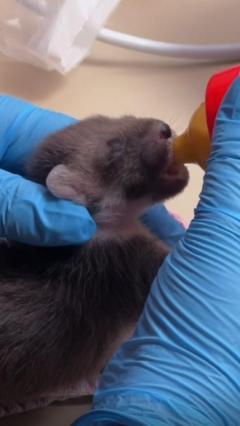
The survival of a lone pine marten (Martes martes) kit following the expiration of its siblings is not a sentimental human-interest story; it is a high-stakes stress test of neonatal wildlife intervention protocols. In the United Kingdom, where the pine marten is a priority species for forest ecosystem restoration, the transition from maternal care to human-led "round-the-clock" intervention represents a massive shift in metabolic and thermal regulation risks. To maximize the probability of recruitment—the point where an individual joins the breeding population—conservationists must navigate a narrow biological corridor defined by three primary variables: thermoregulation stability, nutritional bioavailability, and the mitigation of human-imprinting cognitive defects.
The Triad of Neonatal Vulnerability
When the biological redundancy of a litter is lost, the surviving kit enters a state of acute vulnerability. The "litter effect" provides a thermal buffer and social stimulation that cannot be easily replicated by artificial means. The failure of the siblings suggests a systemic environmental or pathological stressor that must be diagnosed to prevent the final specimen's loss.
1. Thermal Homeostasis and Energy Budgets
Neonatal mustelids are poikilothermic in their earliest stages, meaning they cannot effectively regulate their internal body temperature without external heat sources. The loss of siblings removes "huddling" as a passive energy-saving mechanism.
- The Metabolic Tax: Every degree of ambient temperature drop below the thermoneutral zone forces the kit to divert caloric intake from growth and cellular repair toward thermogenesis.
- The Solution Set: Clinical intervention requires precise, graduated heat gradients. Using static heat pads is insufficient; caregivers must implement a dual-zone environment that allows the kit to move between temperatures, preventing hyperthermia—a frequent cause of secondary organ failure in hand-reared wildlife.
2. Nutritional Bioavailability and Gastrointestinal Stasis
The use of specialized milk replacers is a crude approximation of species-specific maternal milk. Pine marten milk contains a precise ratio of lipids, proteins, and colostrum-derived antibodies that trigger the kit’s immune system.
- The Enzyme Gap: Hand-reared kits often suffer from gastrointestinal (GI) stasis or bloat because their digestive tracts lack the specific enzymes to break down synthetic fats.
- Aspiration Risk: The "round-the-clock" feeding schedule mentioned in standard reporting is a deceptive metric. The frequency of feeding is less critical than the volume-to-weight ratio. Overfeeding leads to gastric distension, while rapid feeding increases the risk of aspiration pneumonia—a leading cause of death in hand-reared mustelids.
3. Ethological Development and the Imprinting Trap
The most significant long-term risk to a lone survivor is not physical, but cognitive. Mustelids are highly intelligent predators that rely on social cues from mothers and siblings to develop "fear responses" and hunting techniques.
- The Anthropomorphic Interference: Constant human contact during the neonatal phase creates a "maladaptive habituation." If the kit associates humans with food and warmth, it becomes biologically unfit for release.
- Mitigation Strategy: Advanced protocols utilize visual barriers, scent masking (using pine needles or marten scat), and the introduction of conspecific vocalization recordings to maintain the kit’s wild identity.
The Cost Function of Round-the-Clock Intervention
Standard media narratives focus on the "heroic" effort of the 24-hour caregiver. From a strategic management perspective, this intensity of labor creates a diminishing return on effort if not managed via a structured shift-rotation. Caregiver fatigue is the primary driver of dosing errors and hygiene lapses.
The biological requirements of the kit dictate a 2-hour or 3-hour feeding cycle. This creates a "circadian fragmentation" for the human operator. To optimize the kit’s survival, a facility must treat the intervention as a medical ICU operation:
- Strict Aseptic Protocols: Every contact point is a potential vector for Pasteurella or Staphylococcus infections, which can turn septic in a neonate within six hours.
- Weight-Gain Velocity Tracking: Growth must be measured in grams per 24-hour period. A plateau in weight for more than two cycles is a clinical "red flag" indicating internal parasitic load or malabsorption.
Measuring Success Beyond Survival
The ultimate metric of this intervention is not the kit reaching adulthood in a cage, but its successful integration into a wild population. This process is governed by the "Soft Release" framework.
The Soft Release Architecture
Unlike a "hard release" where an animal is simply dropped into a forest, a soft release involves an onsite acclimation pen.
- The Pre-Release Audit: Before release, the individual must demonstrate the ability to cache food (a specific pine marten behavior), navigate complex three-dimensional structures (arboreal agility), and show an instinctive avoidance of predators like foxes or larger raptors.
- The Genetic Value: In fragmented habitats, the survival of a single kit can represent a significant percentage of the local gene pool's diversity. This justifies the high resource expenditure required for a single individual.
The Structural Bottlenecks of Wildlife Rehabilitation
The primary limitation in these scenarios is the lack of standardized, data-driven protocols across the various independent charities and centers. Information silos prevent the rapid sharing of "failed states"—cases where a specific formula or heat setting led to a kit's death.
True optimization of pine marten recovery requires a centralized database where every intervention’s variables—ambient humidity, milk replacer brand, probiotic additives, and fecal consistency scores—are logged and analyzed. Without this, every "round-the-clock" effort is an isolated experiment rather than a step forward in conservation science.
The current case of the lone survivor serves as a reminder that wildlife rescue is a discipline of precision, not just compassion. The biological margin for error is non-existent. The intervention must move beyond the "care" phase and into a rigorous "rehabilitation engineering" phase. Success will be defined by the kit’s ability to exist entirely independent of the humans who saved it, a paradox that requires caregivers to be invisible architects of a wild life.
The strategic imperative now is to move the specimen into a phase of "environmental enrichment" as soon as the eyes are fully open and the thermoregulatory system stabilizes. Delaying the transition to a low-contact, high-complexity enclosure will result in a "behavioral sink" where the animal is physically healthy but psychologically incapacitated for the wild. The next 21 days are the critical window; the focus must shift from basic survival to predatory instinct priming. Failure to introduce live-prey cues or complex climbing challenges during this developmental plasticity window will result in a permanent captive, effectively nullifying the conservation value of the initial rescue.