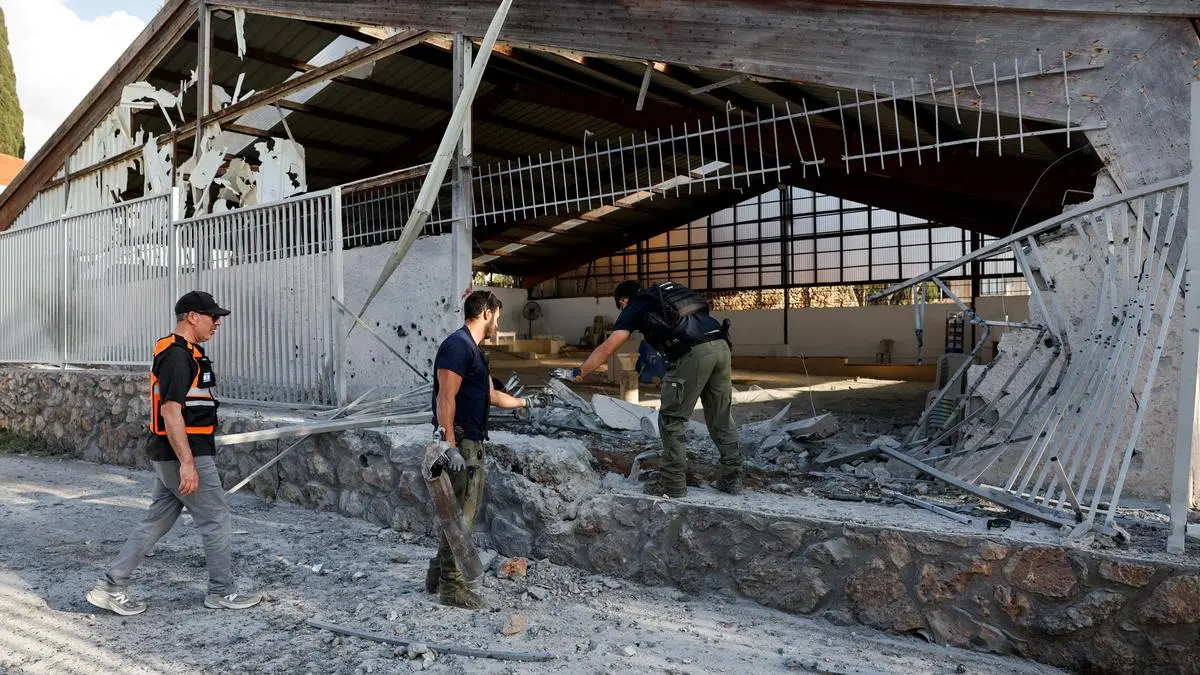
The expansion of IDF ground operations into Bint Jbeil represents a shift from border-line scrubbing to the systematic dismantling of Hezbollah’s "Second Line" of defense. While initial phases of the conflict focused on the neutralization of Radwan Force infrastructure within the immediate visual range of the Blue Line, the engagement in Bint Jbeil targets a symbolic and logistical gravity center. This operation functions on a three-axis pressure model: the isolation of urban hubs, the destruction of sub-surface launch vectors, and the forced displacement of tactical command nodes further north toward the Litani River.
The Bint Jbeil Tactical Significance
Bint Jbeil is not merely a geographic coordinate; it is a psychological and structural anchor for Hezbollah’s southern command. In the 2006 conflict, the town served as the site of significant IDF attrition, establishing a narrative of "impenetrability" that Hezbollah has cultivated for two decades. By launching ground operations here, the IDF is executing a "Shatter-Point Strategy"—targeting the specific node where a defensive failure has the highest probability of triggering a systemic collapse of morale and local command.
The town’s elevation and density provide a natural defensive advantage. Hezbollah’s doctrine relies on "Urban Layering," where civilian infrastructure is converted into a grid of firing positions linked by tunnel networks. The IDF’s approach involves a high-attrition "Pincer Movement," seeking to sever the supply routes from the north before engaging in high-intensity house-to-house clearing. This method aims to prevent the "Ratline" effect—where combatants retreat through tunnels only to reappear in previously cleared sectors.
The Attrition Calculus of Air vs. Ground
The IDF’s continued strikes in Southern Lebanon operate on a distinct cost-benefit function compared to the ground incursion.
- Airborne Kinetic Interdiction: This serves to destroy "Static Assets"—long-range rocket launchers, ammunition depots, and fixed command centers. The goal is the reduction of Hezbollah’s "Volume of Fire" capacity.
- Ground Maneuver: This targets "Persistent Assets"—tunnel entrances, tactical weapon caches, and localized intelligence. These cannot be reliably neutralized from the air due to the depth of the limestone karst terrain and the density of urban cover.
The synergy between these two modes creates a "Dilemma Matrix" for Hezbollah commanders. If they remain in fortified sub-surface positions to avoid air strikes, they risk being bypassed and entombed by ground forces. If they emerge to engage IDF infantry, they expose themselves to the persistent overhead surveillance and precision strike capabilities of the Israeli Air Force (IAF).
The Sub-Surface Warfare Bottleneck
The primary technical challenge in the Bint Jbeil sector is the "Tunnel-Density Ratio." Unlike Gaza, where the soil is sandy and relatively easy to excavate, Southern Lebanon’s geology consists of hard rock. Hezbollah has utilized this to create "Hardened Underground Systems" (HUS) that are significantly more resistant to standard bunker-busters.
These systems are not merely hiding spots; they are integrated combat platforms. A standard HUS unit in Bint Jbeil typically includes:
- Automated Launch Arrays: Pre-aimed rocket tubes that can be fired remotely via wired communication lines, minimizing the electromagnetic signature detectable by IDF signals intelligence (SIGINT).
- Acoustic Sensor Nets: Low-tech listening devices placed on the surface to track the movement of heavy IDF armor (Merkava tanks and Namer APCs) from below.
- Logistical Reservoirs: Stockpiles of food, medical supplies, and anti-tank guided missiles (ATGMs) designed to sustain a 30-to-60-day siege without external resupply.
The IDF’s counter-strategy involves the "Neutralization by Sequestration" method. Rather than entering every tunnel—a high-risk endeavor—engineers use ground-penetrating radar to map the veins and then utilize liquid explosives or rapid-setting high-density foam to render the exits useless, effectively removing the combatants from the theater without a direct fire engagement.
Measuring the Degradation of Command and Control
A critical metric in assessing the effectiveness of the IDF’s Lebanon campaign is the "Reaction Latency." In the early weeks of the escalation, Hezbollah’s response to IDF movements was synchronized and rapid. As operations have deepened into Bint Jbeil, this latency has increased.
The breakdown of centralized command is evidenced by the "Fragmentation of Fire." Instead of coordinated salvos designed to overwhelm the Iron Dome, rocket fire has become more erratic and localized. This suggests that the "Command Chain" has been severed at the brigade level, forcing local cells to operate autonomously. While autonomous cells are harder to eliminate entirely, they lack the "Massing of Force" necessary to launch a meaningful counter-offensive or to stop the territorial encroachment of IDF armored divisions.
The Geopolitical Friction Points
The ground operation in Bint Jbeil introduces three primary variables that complicate the strategic outcome:
- The UNIFIL Buffer Failure: The presence of UNIFIL forces in the combat zone creates "Operational Friction." The IDF must navigate around UN positions, which Hezbollah utilizes as "Tactical Shields." This slows the tempo of the advance and increases the probability of accidental international incidents.
- The Litani Threshold: The IDF’s stated goal is the enforcement of UN Resolution 1701. However, the "Security Zone Paradox" suggests that holding territory up to the Litani River requires a permanent presence, which historically leads to a high-attrition insurgency.
- The Iranian Resupply Variable: The effectiveness of the Bint Jbeil operation is tethered to the "Syrian Land Bridge." If the IDF fails to interdict the flow of advanced ATGMs through the Syrian border, the ground forces in Southern Lebanon will face a continuous "Replenishment of Threat," regardless of how many caches they destroy in Bint Jbeil.
Structural Logic of the IDF’s "Active Defense"
The IDF has moved away from the 2006 "Stagnant Defense" model. The current doctrine is built on "Dynamic Encroachment." In this framework, the ground force does not aim to "hold" Bint Jbeil in a traditional sense. Instead, it aims to "Sanitize" it.
Sanitization involves the systematic destruction of every structure with a military footprint, followed by the installation of high-tech "Persistent Monitoring Nodes." These nodes—automated towers and seismic sensors—are intended to replace human boots on the ground once the initial clearing is complete. This transition from "Man-on-the-Hill" to "Sensor-in-the-Sky" is the IDF’s attempt to avoid the long-term occupation trap that defined the 1982-2000 period.
The ATGM Threat and the Active Protection System (APS) Performance
The battle for Bint Jbeil serves as a real-world stress test for the Trophy Active Protection System (APS) mounted on Israeli armor. Hezbollah utilizes a "Saturation Fire" tactic with Kornet and Almas missiles, attempting to overwhelm the APS by firing multiple projectiles at a single target from different angles simultaneously.
The data indicates a "Diminishing Return on ATGM Volleys" for Hezbollah. As the IDF integrates "Electronic Warfare" (EW) suites that jam the frequency of the missile’s guidance systems, the success rate of Hezbollah’s anti-tank teams has dropped. This technical superiority allows IDF armor to operate with a degree of impunity in urban environments that was previously impossible.
Displacement and the Social Cost Function
The IDF’s operation is also calibrated to produce a "Political Pressure Gradient" within Lebanon. By rendering the border villages uninhabitable for Hezbollah militants, the IDF is also displacing the support base of the organization. The internal migration of hundreds of thousands of Shiite civilians into Christian and Sunni areas of Lebanon creates "Sectarian Friction." The IDF’s strategy assumes that the Lebanese state and its various factions will eventually view Hezbollah’s presence as a greater threat to national stability than the Israeli incursion itself.
This "Societal Attrition" is a slow-acting variable. Its success depends on the IDF’s ability to maintain a "Clean Kinetic Profile"—minimizing civilian casualties while maximizing the destruction of Hezbollah’s military-economic infrastructure. Any significant mass-casualty event in Bint Jbeil would likely reset the "Diplomatic Clock," forcing a premature cessation of operations before the military objectives are fully realized.
Strategic Projection
The IDF’s path forward necessitates a transition from "Clearance" to "Area Denial." Once Bint Jbeil is functionally neutralized, the focus must shift to the "Hermel-Masnaa Axis" to permanently sever the Iranian supply line. Failure to do so will result in a "Sisyphus Loop," where the IDF clears Southern Lebanon only for Hezbollah to re-arm and re-infiltrate within an 18-to-24-month window.
The immediate tactical requirement is the establishment of a "Fire Control Zone" north of Bint Jbeil, utilizing long-range precision artillery and loitering munitions to prevent the re-entry of Radwan units. This will be the true test of the operation’s success: not the capture of the town, but the ability to prevent its re-militarization without maintaining a permanent, vulnerable garrison. The IDF must now prioritize the "Infrastructure of Absence"—ensuring that the border region remains a vacuum of military capability through persistent, automated surveillance and rapid-response strike cells.