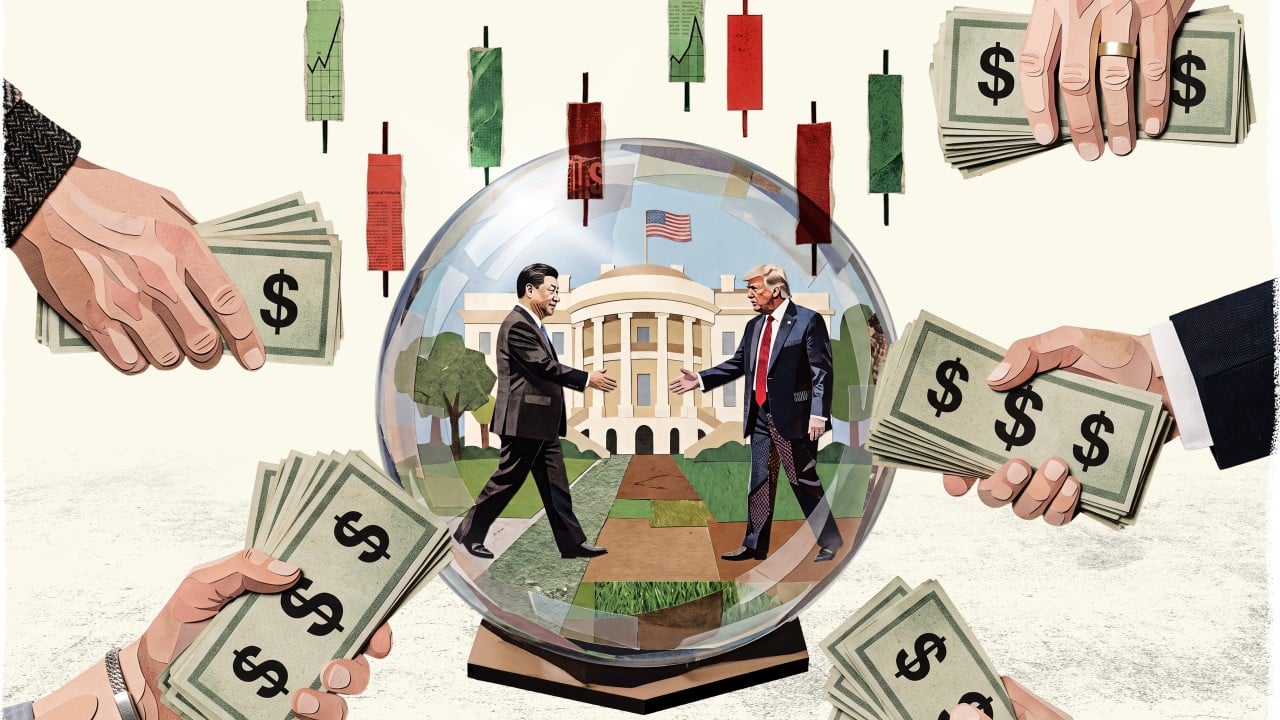
The screen glows in the dark room, casting a cold, blue pulse across a tired face. It is three in the morning in a quiet Chicago apartment, but the market never sleeps. Maya stares at a fluctuating line of pixels. Right now, fifty-eight cents buys a contract predicting that two presidents will shake hands beneath the blinding lights of a summit. Fifty-eight cents. If she is right, she doubles her money. If she is wrong, she loses it all.
She is not a diplomat. She carries no clearance badge, sits in no mahogany-lined Situation Room, and has never set foot inside the halls where global trade pacts are forged. Yet, tonight, Maya and thousands of anonymous digital traders like her are doing something extraordinary. They are pricing the future of global superpowers.
Prediction markets have attached a numeric probability to the Trump-Xi summit. Every tick of the graph represents a collective pulse, a nervous twitch of capital reacting to rumors, leaked cables, history, and raw intuition. But behind the flashing ticker symbols lies a haunting question. Do these bets have any actual value, or are they just expensive horoscopes dressed up in financial jargon?
To understand why this matters, step away from the abstract theory of economics and think about how human beings actually guess what happens next.
Imagine a veteran commodities trader named Arthur, who spent thirty years watching steel shipments stall at Chinese ports because of a whispered political spat. Arthur does not care about political rhetoric. He cares about cargo weights, customs clearance times, and the frantic late-night phone calls of freight forwarders. When Arthur logs onto a decentralized prediction platform and drops ten thousand dollars on a "no" outcome for a breakthrough trade deal, he is not voting. He is betting his livelihood on an information chain that standard news outlets will not touch for another week.
This is the hidden engine of prediction markets. They are not magic. They are aggregation machines. They take the whispers of dockworkers, the private notes of trade lawyers, the cold calculations of quantitative analysts, and the nervous anxieties of retail investors, grinding them all down into a single, merciless percentage.
Skeptics love to dismiss these platforms as glorified casinos. They point to low liquidity, wild emotional swings, and the occasional manipulation by deep-pocketed speculators who want to manufacture a narrative. And they are partially right. Markets can be irrational. Panic is contagious. Greed blinds.
Yet, traditional polling and expert commentary often fare far worse. Pundits on television talk in sweeping generalizations, bound by the need for theatrical certainty. Diplomats speak in opaque language designed to conceal intention rather than reveal it. But money demands accountability. When an expert is wrong on cable news, they keep their job and invite viewers to tune in tomorrow. When a trader is wrong on a prediction market, their bank account shrinks instantly. That stark asymmetry creates a powerful filter for truth.
Consider what happens when a high-stakes summit approaches. The media cycles churn out breathless speculation. Headlines swing wildly from impending trade war to historic detente depending on which anonymous official whispered to a reporter. The general public reads these pieces and feels a sickening swirl of vertigo. Nothing makes sense. Everything feels volatile.
Then you look at the probability curve. It sits stubbornly at forty-two percent, unmoved by the latest screaming headline. Why? Because the underlying mechanics of supply chains, bureaucratic friction, and structural economic leverage have already whispered their verdict to the market makers long before the press release was drafted. The crowd, for all its chaotic flaws, smells the truth beneath the theater.
Does this mean the bets have prophetic value? Not in the mystical sense. A prediction market cannot tell you what a leader will decide in a private, closed-door meeting where emotions run high and fatigue clouds judgment. What it tells you is something much more pragmatic. It measures the weight of probability against the wall of reality.
Think of it as a weather vane. It does not control the wind, nor can it guarantee that the storm will hit precisely at four o'clock. But if every heavy metal slat on the vane is pointing violently to the east, only a fool ignores the impending gale.
Back in the Chicago apartment, the blue light of the monitor reflects in Maya's eyes. She clicks mouse buttons, buying a small block of shares on the negative outcome. Her heart beats a little faster. She has staked grocery money and rent money on the psychological profile of two men who do not even know she exists.
She is not just speculating on a political outcome. She is participating in a vast, global nervous system trying desperately to feel its own pulse in the dark. The summit will come and go. The handshakes will happen or they will not. The cameras will flash, the spin doctors will claim victory, and the world will wake up to another Tuesday. But long before the first microphone is plugged in, the numbers have already told their story. And somewhere in the glowing digital ether, the quiet consensus of the crowd is watching, waiting, and keeping score.