The humidity in the Congo Basin doesn't just sit on your skin. It breathes with you. It is a heavy, verdant weight that smells of damp earth and rotting fruit, a sensory reminder that you are standing in the lungs of the world. But for a tiny, shivering creature named Maman, the forest no longer felt like home. It felt like a graveyard.
Maman is a bonobo. To the casual observer, she might look like a chimpanzee, but the distinction is everything. While chimps solve their problems with power and occasionally war, bonobos are the hippies of the primate world. They are governed by females. They resolve tension with affection. They are, quite literally, our closest living relatives, sharing roughly 99 percent of our DNA.
Yet, when Maman arrived at Lola ya Bonobo, a sanctuary just outside Kinshasa, she wasn't thinking about genetics. She was thinking about the hands that had snatched her away.
The Cost of a Meal
The tragedy of the bonobo isn't a simple story of villains and victims. It is a story of hunger. In the Democratic Republic of Congo, the "bushmeat" trade isn't always about greed; it is often about survival. When a mother bonobo is killed for food, her infant is left behind—a useless byproduct of a desperate hunt.
Poachers don't usually kill the babies. They are too small to eat. Instead, they are sold as status symbols, tethered by wire to market stalls, or left to wither in cardboard boxes. This is the "invisible stake" of the biodiversity crisis. We talk about extinction in terms of numbers and percentages, but the reality is much smaller. It is the size of a five-pound infant with wide, amber eyes who has forgotten how to scream.
Consider the psychological toll on a creature that is as emotionally complex as a human toddler. A bonobo infant remains physically attached to its mother for years. They sleep together, eat together, and travel together. When that bond is severed by a machete or a gunshot, the infant enters a state of shock so profound it often leads to a "failure to thrive." They don't just lose their protector; they lose their will to exist.
The Human Mothers
At Lola ya Bonobo, the cure for this existential grief isn't a cage or a high-tech lab. It is a woman in a green jumpsuit.
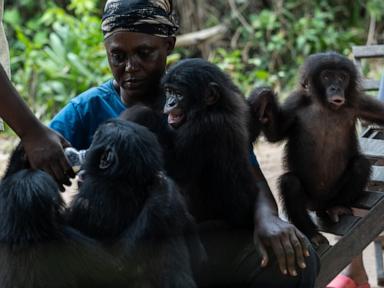
The sanctuary employs "surrogate mothers"—local Congolese women who take on the monumental task of replacing a lost matriarch. These women don't just feed the orphans. They carry them 24 hours a day. They sleep with them. They groom them. They teach them that the world is not a place that only takes; it is a place that can also hold.
Watching a surrogate mother with a baby bonobo is like watching a mirror image of our own evolution. The way the infant clings to her neck, the way she whispers to calm its frantic whimpering—it is a bridge across species. This isn't just "animal rescue." It is a profound act of cross-species empathy that requires the women to sacrifice their own sleep and physical comfort for years at a time.
But there is a tension here. To save a bonobo, you have to make it love a human. To truly free a bonobo, you have to make it forget that love.
The Reintroduction Paradox
The ultimate goal of the sanctuary is something few believed possible: returning these primates to the wild. This isn't as simple as opening a gate. A bonobo raised by humans doesn't know how to navigate the social politics of a wild troop. They don't know which fruits are ripe or how to avoid the leopards that stalk the undergrowth of the Equateur province.
The process is a slow, agonizing transition. The orphans are moved from the nursery to large, forested enclosures where they must learn to integrate with older bonobos. They have to learn the "language" of the forest—the high-pitched squeals that signal a find of honey, the submissive gestures that prevent a fight.
The stakes are impossibly high. Bonobos are found only in the Democratic Republic of Congo. Nowhere else on Earth. If they vanish here, they are gone forever. Estimates suggest there are as few as 15,000 to 20,000 left in the wild. Every orphan that makes it back to the canopy is a literal lifeline for the species.
But the forest they return to is shrinking. Logging, mining, and civil unrest have fractured the landscape. The sanctuary doesn't just protect the animals; it has to protect the dirt they stand on. This involves working with the very communities that might once have seen a bonobo as a meal.
The strategy is simple: make the bonobos worth more alive than dead. By providing jobs, education, and healthcare to the people living near the release sites, the sanctuary turns former hunters into guardians. It is a delicate, human-centric ecosystem where the survival of the ape is tied directly to the prosperity of the village.
The Mirror in the Trees
There is a specific look a bonobo gives you when it's trying to understand your intent. It isn't the blank stare of a dog or the calculating gaze of a cat. It is a look of recognition.
I remember watching a juvenile bonobo named Kikongo play with a piece of discarded fabric. He wasn't just chewing on it. He was trying to wrap it around his shoulders like he had seen a caretaker do with a shawl. He looked up, made eye contact, and for a split second, the "99 percent" felt like an understatement.
We often think of conservation as a chore—a list of things we aren't allowed to do or places we aren't allowed to go. We see it as a scientific necessity rather than an emotional one. But standing in the shade of the Congo, watching an orphan find its footing, you realize that saving them is actually an act of self-preservation.
When we lose a species like the bonobo, we don't just lose a data point in a textbook. We lose a version of ourselves. We lose the only other creature on the planet that has figured out how to live in large, complex societies without resorting to lethal violence. We lose the masters of peace.
The work at Lola ya Bonobo is grueling. It is loud. It is expensive. It is often heartbreaking when an infant, too scarred by its past, simply gives up. But then you see a mother like Maman, who arrived in a box, now leading a troop of her own in a protected forest. She is no longer an orphan. She is a queen.
The jungle doesn't care about our statistics. It doesn't care about our mission statements. It only cares about the heartbeat. And in the quiet corners of a rare sanctuary in the heart of Africa, those heartbeats are getting stronger, one surrogate hug at a time.
The sun begins to dip below the treeline, turning the Congo River into a ribbon of liquid bronze. In the distance, a chorus of high-pitched calls erupts from the canopy. It is a chaotic, beautiful noise. It is the sound of a family being rebuilt from the ruins.
You realize then that the wire around the market stall was never just holding the bonobo. It was holding us, too. Every time we help one of these creatures climb back into the light, we loosen that wire just a little bit more. We prove that we are capable of more than just consumption. We prove we can be the "mothers" a broken world needs.
The forest breathes. And for the first time in a long time, it doesn't sound like a gasp. It sounds like a song.