Forty-five thousand dollars does not buy a dream anymore. In most American zip codes, it barely covers a down payment on a suburban starter box with builder-grade beige carpet, hollow-core doors, and a view of a neighbor’s vinyl siding.
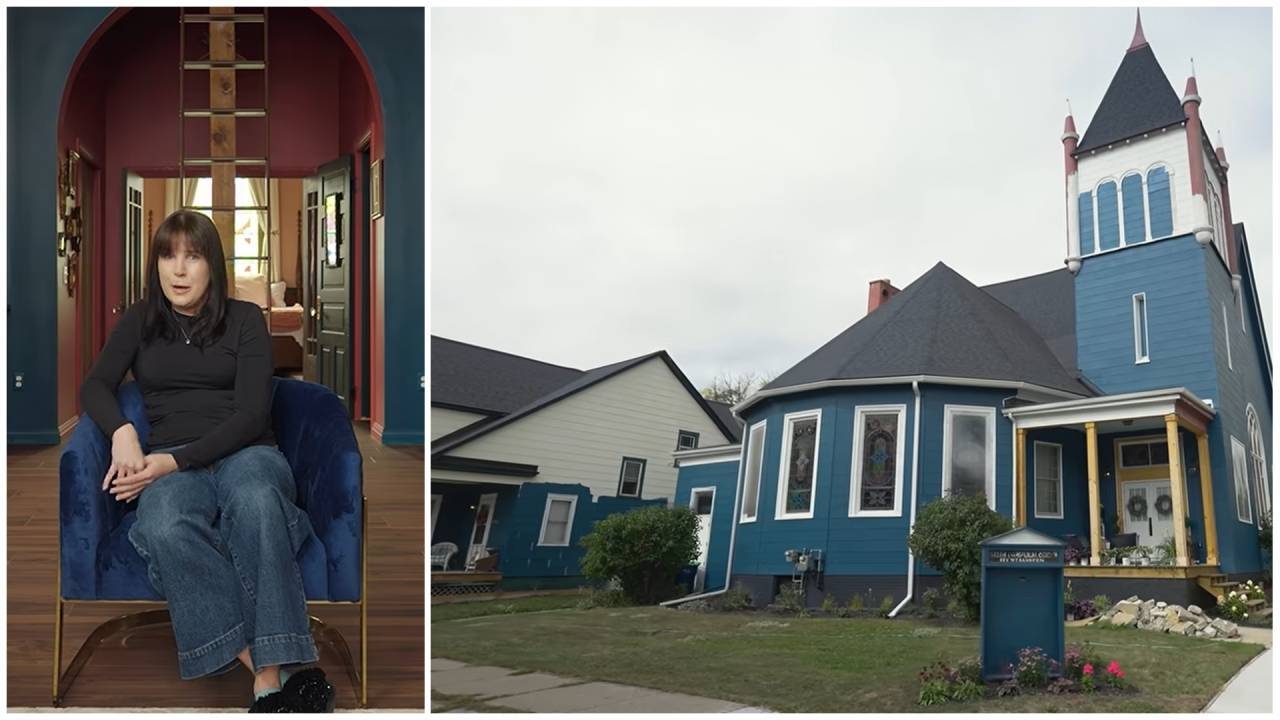
Yet, standing beneath thirty-foot vaulted timber ceilings in rural Michigan, surrounded by arched Gothic windows that filter the afternoon sun into shards of amber and dust, one woman proved that the modern housing crisis is not entirely a lack of inventory. Sometimes, it is a failure of imagination.
When she signed the closing papers on a 128-year-old abandoned church, the neighbors thought she had lost her mind. Real estate agents saw a liability. Contractors saw a money pit. She saw salvation—not the theological kind, though the building had spent over a century dispensing it, but the architectural kind. She saw a chance to rescue a piece of vanishing American craftsmanship before a bulldozer reduced a century of hand-hewn oak to splintered landfill fodder.
To understand why someone trades predictable modern comfort for peeling plaster and a roof that weeps during spring thaws, you have to understand the quiet desperation of the contemporary homebuyer. We are living through an era of residential homogenization. Across the Midwest and beyond, historic structures are left to rot because institutional buyers only care about scalable metrics, while everyday families are priced out of character-rich neighborhoods.
When a 19th-century sanctuary hits the market for the price of a mid-size SUV, it is rarely a bargain. It is a dare.
The Anatomy of a Reckless Rescue
Let us be completely honest about what $45,000 actually buys when you are purchasing a decommissioned house of worship built in the late 1890s. It buys ghosts. It buys eighty years of deferred maintenance, wiring that belongs in a museum of fire hazards, and heating bills capable of inducing mild cardiac arrest every January.
Imagine—as a hypothetical exercise to grasp the sheer physics of the challenge—trying to heat a three-car garage with a hairdryer during a Michigan blizzard. Now multiply that volume by ten, punch twenty-foot single-pane stained glass holes in the walls, and remove all modern insulation. That is the baseline reality of a church conversion.
Anyone who tells you renovating a historic building is romantic has never spent a Tuesday night scraping lead paint off baseboards while wearing a respirator and questioning every financial decision they made since adulthood. There is nothing glamorous about discovering that the bell tower is essentially a five-star hotel for local raccoons, or realizing that "plumbing" in 1898 meant a pump out back and optimism.
Yet, that exact friction is what separates a mere house from a home that possesses a pulse.
In the standard real estate narrative, square footage is king and turnkey convenience is the ultimate luxury. We are conditioned to want sterile perfection. We want quartz countertops that never stain and smart thermostats that anticipate our arrival. By choosing a 128-year-old ruin, she rejected the cultural script that equates living well with living effortlessly. She traded convenience for permanence.
Consider the materials inside a structure raised in the late nineteenth century. Before the era of engineered lumber and drywall, builders felled old-growth Michigan timber—trees that had stood for three hundred years before meeting a saw. The wood inside that sanctuary was denser, tighter-grained, and infinitely stronger than anything stacked on a pallet at a modern big-box hardware store. To tear down a building like that is not just demolition; it is the erasure of a resource that literally cannot be regrown within our lifetimes.
What Happens When Sacred Space Becomes Domestic
Converting a church into a private residence requires solving a fascinating psychological puzzle. How do you make a room designed to make humans feel small feel cozy enough for a Sunday morning cup of coffee?
Cathedrals and country chapels share a specific architectural DNA. They use verticality to draw the eye upward, creating awe, reverence, and a deliberate sense of scale. When you drop a leather sofa and a television into the middle of a nave, the room fights back. Without careful spatial choreography, living in an unconverted sanctuary feels like camping inside a gymnasium.
The trick—a principle seasoned architectural preservationists rely on—is creating zones of intimacy within the expanse. You do not chop up the soaring ceiling with dropped drywall; doing so destroys the very magic you paid to save. Instead, you build low-slung structures inside the shell, like a ship inside a bottle. A kitchen island anchors the ground plane. Lofted bedrooms tuck beneath the rafters, borrowing the dramatic roofline while keeping sleeping quarters warm and enclosed.
Think about the sensory shift of waking up in a space like that.
In a standard suburban home, morning light enters through a four-foot vinyl window, hitting drywall painted eggshell white. In a converted nineteenth-century sanctuary, morning arrives through wavy, hand-blown antique glass. Light bends, fractures, and pools across original heart-pine floorboards that have absorbed the footsteps of four generations of weddings, funerals, and Sunday hymns. You do not just live in the room; you inhabit a timeline.
Of course, the financial math behind such a transformation often confuses onlookers who only see the viral headline. A $45,000 purchase price is merely the ticket to enter the stadium. Once you factor in structural stabilization, modern HVAC systems capable of handling massive cubic footage, septic upgrades, and residential zoning variances, the true cost climbs sharply.
Why do people do it anyway? Because even after pouring sweat, savings, and years of weekends into the project, the math still bends in favor of the bold. For the combined cost of the purchase and a thoughtful, phased renovation, she ended up with thousands of square feet of irreplaceable architecture—a bespoke sanctuary that no developer could replicate today for under seven figures.
The Quiet Epidemic of Abandoned Landmarks
Her story resonates so deeply because it taps into a silent grief spreading across rural and post-industrial America. Drive down any two-lane highway through Michigan, Ohio, Pennsylvania, or New York, and you will pass them. White clapboard chapels with sagging porches. Brick Gothic sanctuaries with plywood nailed over rose windows. Former grange halls, one-room schoolhouses, and Masonic temples slowly surrendering to ivy and gravity.
Demographic shifts and declining congregation numbers have left thousands of historic religious buildings vacant across North America. They sit on prime corner lots in small towns, too expensive for dwindling congregations to heat and too unconventional for traditional buyers who lack the vision—or the stomach—to reimagine them.
When these buildings vanish, small towns lose their visual anchors. They lose the craftsmanship of local stonemasons and carpenters whose names are no longer written on any deed, yet whose labor gave the community its identity.
Rescuing one does not require blind nostalgia. It requires pragmatism blended with grit. Anyone eyeing a historic church, schoolhouse, or barn as an alternative housing path has to navigate hurdles that rarely appear in standard home inspections:
- Zoning and Code Purgatory: Municipalities often struggle to classify a residential church. Switching a property from tax-exempt religious assembly to single-family residential triggers strict building codes regarding egress windows, fire separation, and mechanical ventilation.
- The Thermal Envelope: Historic masonry and timber buildings were built to breathe, not to be sealed tight like a thermos. Trapping modern moisture inside old brick walls without understanding vapor barriers can cause catastrophic spalling and rot within a few winters.
- The Financing Trap: Traditional mortgage lenders hate weird properties. Appraisers struggle to find "comparable sales" when your house has a bell tower and a choir loft, often forcing buyers to rely on cash purchases, renovation loans, or sheer creative financing.
Knowing the pitfalls does not diminish the triumph; it sharpens it. Every obstacle she cleared—every stubbornly rusted bolt, every drafty window frame rebuilt by hand, every skeptical inspector convinced—added another layer of ownership that money alone can never purchase.
A Different Kind of Wealth
We spend an enormous amount of energy chasing security. We buy standardized homes in standardized neighborhoods because we are told that conformity protects resale value. We sand down the edges of our lives until everything looks clean, predictable, and interchangeable.
And yet, scroll through any feed where a woman turns a crumbling $45,000 church into a warm, sunlit home, and you will watch millions of people stop dead in their tracks. They linger on the photos of the exposed trusses. They zoom in on the kitchen tucked beneath the balcony. They leave comments thick with a longing they rarely admit out loud.
They are not envying her budget. They are envying her courage.
They are reacting to the rare sight of someone refusing to accept the cramped, overpriced options handed to them, choosing instead to wrestle beauty out of abandonment. She did not just flip a property or score a clever real estate deal. She took a building that everyone else had written off as dead, opened the heavy wooden doors, let the Michigan sunlight pour back across the floorboards, and proved that sometimes the best way to build a future is to refuse to let the past collapse.
Tonight, while thousands of identical suburban living rooms glow with the pale blue flicker of identical screens, wind will sweep across a quiet Michigan road and press against a hundred-year-old stained glass window—and for the first time in years, the warmth glowing on the other side will belong to someone who refuses to leave.