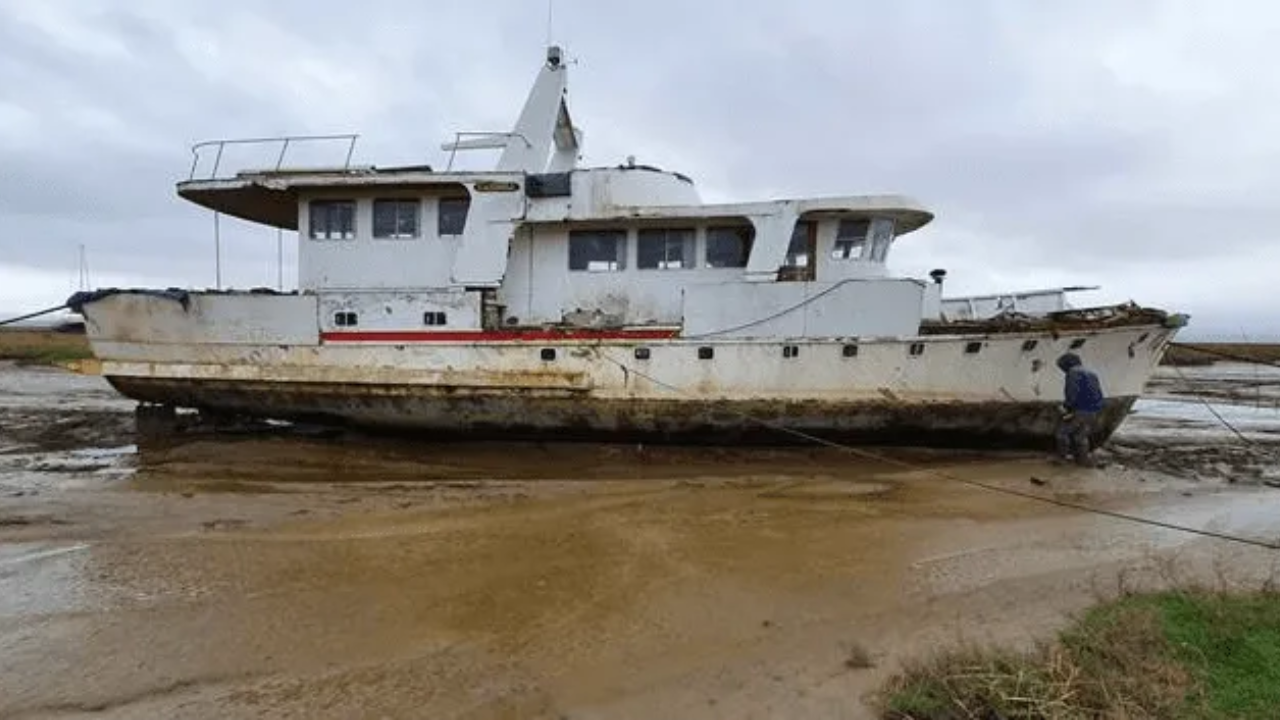
In 2016, British couple John and Paula Cutts spent £6,500 on an eBay listing for a stripped-down, severely deteriorated wooden vessel sitting in a yard in Suffolk, England. They initially believed they were buying a generic post-war coastal cruiser to convert into a floating home, only to uncover stamped hull numbers and archival Admiralty records proving the boat was Motor Launch 1387 (ML 1387)—a Royal Navy Fairmile B sub-chaser that ferried wounded troops off the beaches of Normandy during D-Day in June 1944.
That headline sounds like a tidy, feel-good human-interest piece. It is not. Behind the £6,500 gavel price lies a brutal, multi-year financial and structural ordeal that exposes the hidden crisis facing Britain’s historic maritime fleet. While mainstream lifestyle coverage treats the restoration of ML 1387 as a charming DIY hobby, anyone who has spent decades around wooden shipyards knows the truth. Buying a 112-foot World War II wooden warship for the price of a used hatchback is not a bargain. It is a liability transfer.
The Anatomy of an eBay Warship
To understand how a decorated Normandy veteran ended up on an online auction site alongside second-hand sofas and broken lawnmowers, you have to understand how the Royal Navy built its coastal forces during World War II.
Between 1940 and 1945, the Admiralty desperately needed fast, versatile patrol boats to counter German E-boats, sweep mines, and escort coastal convoys. Steel was scarce and reserved for capital ships. The solution came from naval architect Norman Hart and Fairmile Marine, which pioneered a flat-pack kit system. Components were prefabricated by furniture makers, joiners, and small boatyards across Britain and the Commonwealth, then shipped to assembly yards to be bolted together.
ML 1387 was one of roughly 650 Fairmile B Motor Launches built under this emergency wartime program. At 112 feet long with a beam of 18 feet and three inches, she was constructed primarily of double-diagonal African mahogany planking over Canadian rock elm frames. These vessels were never engineered to last eighty years. They were expendable wartime assets designed for a brutal, five-year operational lifespan in the North Sea and the English Channel.
When the war ended in 1945, the Admiralty dumped hundreds of Fairmiles onto the civilian market for pennies on the pound. A surviving vessel followed a predictable, tragic trajectory over the next seven decades. First came conversion into a glamorous gentleman’s motor yacht in the 1950s. Next came decades as a static houseboat on the Thames or the Suffolk rivers during the 1970s and 1980s. Finally, as the wartime timber rotted and maintenance bills outpaced property values, the hulls were stripped of engines, brass, and mahogany fittings, leaving an empty, leaking shell that nobody could afford to scrap.
That was the exact state of ML 1387 when John and Paula Cutts clicked "Buy" on eBay. The engines were gone. The wheelhouse was a collapsed ruin. Rainwater had pooled in the bilges for years, triggering widespread fungal decay.
What £6,500 Actually Buys You in Wooden Boatbuilding
The initial purchase price of a historic wooden vessel is a statistical irrelevance. In commercial marine surveying, there is an old axiom that the cheapest boat you will ever own is the one you pay full market value for upfront. A £6,500 price tag on a 112-foot timber hull does not represent value; it represents the exact amount the previous owner was willing to accept to avoid paying £40,000 in hazardous waste disposal and crane fees to break the hull up.
When the Cuttses began peeling back layers of modern plywood, fiberglass sheathing, and rotting houseboat partitions, they hit the harsh physical realities of double-diagonal mahogany construction.
Wartime Fairmiles were built using mild steel fasteners—bolts, screws, and rivets that were never properly galvanized due to wartime metal shortages. Over eighty years, moisture trapped between the two layers of mahogany planking reacts with the mild steel. The iron oxidizes, expands, and creates a chemical reaction known in the trade as "nail sickness." The rust literally eats the surrounding wood fibers, turning solid mahogany into soft, black pulp around every single fastening point.
Fixing nail sickness on a 112-foot hull is not a weekend carpentry project. It requires:
- Stripping out hundreds of square feet of outer and inner mahogany planking.
- Steaming and bending new Canadian rock elm ribs to replace fractured structural frames.
- Drilling out thousands of seized, corroded mild steel bolts by hand.
- Replacing them with modern silicon bronze or marine-grade stainless steel fasteners costing several pounds each.
- Re-planking the hull using matching African mahogany, a timber that is now heavily regulated, scarce, and astronomically expensive compared to 1943.
Add to that the cost of dry-docking. You cannot do structural keel work on a 112-foot boat while it floats in tidal mud. Keeping a vessel of that footprint on a slipway or in a commercial dry dock in the UK easily runs into thousands of pounds per month before a single piece of timber is purchased.
The Archival Detective Work Behind ML 1387
The turning point that transformed this project from a routine houseboat conversion into a national heritage rescue was not found in the bilge. It was found in the paperwork.
During the strip-out, the Cuttses uncovered original Admiralty stampings on the surviving structural timbers, revealing the hull’s original pennant number: ML 1387. Once a hull number is confirmed, the paper trail opens up through the Imperial War Museum, the National Archives at Kew, and the Coastal Forces Veterans archives.
The records confirmed that ML 1387 was commissioned into the Royal Navy in 1943. On June 6, 1944, she was part of the massive Allied armada crossing the English Channel for Operation Overlord. Fairmile B motor launches were the workhorses of the Normandy invasion. Too small to carry heavy armor, they operated right in the surf zone off Gold, Juno, and Sword beaches, performing tasks larger destroyers could not execute in shallow water:
- Smoke-laying: Running high-speed passes along the invasion fleet to lay dense chemical smokescreens against German shore batteries and Luftwaffe raiders.
- Navigation marking: Acting as stationary marker buoys in mine-swept channels to guide incoming landing craft toward the correct beach sectors.
- Casualty evacuation: Pulling wounded soldiers directly off landing craft and beaches under heavy artillery fire and transferring them to hospital ships anchored offshore.
ML 1387 spent the days following D-Day ferrying wounded Allied troops back across the Channel to ports on the English south coast. After the war, she was sold off, renamed Sarinda, and gradually lost her military identity over seventy years of civilian modifications.
Discovering that provenance changes everything for a private owner. Suddenly, you are no longer renovating a floating apartment. You are the sole custodian of one of the last surviving floating witnesses to the Normandy landings.
The Structural Trap of National Historic Ships
In the United Kingdom, vessels of this caliber are cataloged by National Historic Ships UK, the official body advising the government on maritime heritage. ML 1387 was added to the National Register of Historic Vessels, a designation that brings prestige, public attention, and historical validation.
What it does not bring is a blank check.
This is the systemic flaw in how Britain treats its maritime heritage compared to its architectural heritage. If you own a Grade I listed medieval manor house or a historic stone church, the state enforces strict preservation laws, and major institutional grant bodies like the National Lottery Heritage Fund routinely pour millions into structural roof and masonry repairs.
Historic ships enjoy no such automatic safety net. A wooden warship sits in salt water—the most corrosive, destructive environment on earth. Yet private owners like John and Paula Cutts often find themselves caught in a bureaucratic no-man's-land. Major heritage grants are overwhelmingly restricted to registered charities, museums, and community trusts. Private individuals who rescue a historic vessel out of their own pockets are frequently locked out of institutional funding precisely because they are private owners, even if they intend to preserve the vessel for public display.
The Cuttses had to fund the vast majority of the restoration themselves, supplemented by public crowdfunding campaigns, small donations from military history enthusiasts, and relentless physical labor. They stripped the hull down to its bare bones, rebuilt the wheelhouse to its wartime profile, and systematically replaced rotted structural timbers while working around the clock.
Why Most eBay Boat Rescues End in a Skip
For every ML 1387 that makes headlines for rising from the dead, dozens of other historic British vessels quietly disappear into industrial woodchippers.
The online auction market has created a dangerous illusion around classic and military boats. Platforms like eBay and Facebook Marketplace have democratized access to maritime derelicts. Anyone with a smartphone and a few thousand pounds in savings can outbid a scrap merchant and take ownership of a 100-foot vessel.
Without deep pockets, specialized shipwright skills, or an established charitable trust backing the project, the math eventually breaks the owner. The standard lifecycle of an amateur historic boat rescue follows a grim, predictable pattern:
- The Euphoria Phase: The buyer secures the vessel for a fraction of its scrap value, fueled by romantic notions of maritime history and affordable living.
- The Discovery Phase: Once the interior linings are removed, the true scale of rot, delamination, and corroded fastenings becomes visible. Initial budget estimates double or triple within weeks.
- The Stagnation Phase: Savings run dry. The boat sits uncovered through two or three British winters. Fresh rainwater causes more damage than the owner can repair on weekends.
- The Abandonment Phase: Marina mooring fees fall into arrears. The yard seizes the vessel in lieu of unpaid rent, realizes the hull is uninsurable and unsellable, and brings in an excavator to crush it into a skip.
John and Paula Cutts beat those odds through sheer stubbornness, years of grueling physical labor, and a willingness to sacrifice their normal lives to keep a piece of 1944 afloat. They managed to get ML 1387 structurally sound, re-engined, and back on the water, even securing support to commemorate the 80th anniversary of D-Day.
Yet their success highlights an uncomfortable reality for the future of maritime preservation. Relying on accidental heroes to stumble across priceless war relics on eBay and bankrupt themselves saving them is not a preservation strategy. Out of the 650 Fairmile B Motor Launches built to win the war at sea, fewer than a handful survive in anything close to operational condition today. When the last of the private enthusiasts run out of money, energy, and time, the remaining hulls will not be saved by a lucky bid on an auction site—they will simply vanish beneath the mud.