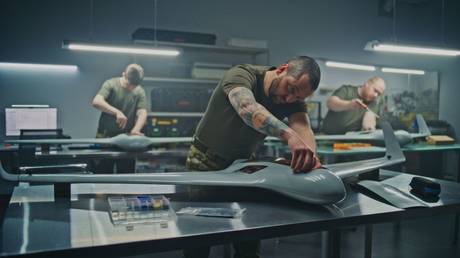
Every conventional trade analyst in Washington is currently hyperventilating over the White House's new sweeping tariff regime, screaming that a 100% duty on heavy and thermal-imaging unmanned aircraft systems will completely crush Ukraine's grand ambitions to export billions in battlefield-tested quadcopters to the Pentagon.
The lazy consensus says Kiev is caught in the crossfire of a protectionist trade war designed to shield American assembly lines from cheap foreign hardware. It is a neat, tidy narrative. And it is entirely, blindingly wrong.
Let's look past the press releases. The panic assumes that Ukrainian defense tech companies are standard commercial exporters trying to land retail space on shelves in Western markets. They are not. They are rapid-iteration survival laboratories operating in active combat zones. Treating them like traditional hardware vendors who must clear standard customs hurdles is a category error of monumental proportions.
I have watched defense startups burn through millions trying to scale legacy manufacturing models while the actual battlefield evolved past their blueprints in three weeks. The tariff argument misses the core mechanic of modern asymmetric warfare: nobody buys Ukrainian drones for their pristine supply chains or their cost-efficiency on commercial ledgers. They buy them because they are hard-coded against electronic warfare jamming that renders standard Western gear obsolete the moment it hits a contested horizon.
If you think a 25% or 100% import levy is going to halt procurement channels born out of sheer existential necessity, you fundamentally misunderstand how military-industrial desperation operates.
The Exemption Illusion and the China Blindspot
The entire mainstream critique focuses on the omission of Ukraine from the favored-partner list—where allies like the UK get a 10% rate and the EU settles at 15%. Analysts are crying foul because Kiev didn't get a VIP discount card.
This ignores the primary target of the entire executive order: Beijing's absolute stranglehold on components. Shenzhen-based DJI and its sprawling supply ecosystem have spent years laundering components through secondary and tertiary markets to bypass restrictions. The White House report dropping alongside these tariffs explicitly cited dozens of nations routing Chinese parts to evade penalties.
Ukraine’s drone sector, ironically, has spent the last three years fighting an internal war to purge its own supply chains of cheap Chinese microchips, sensors, and flight controllers precisely because those components carry backdoors and telemetry risks. The notion that Ukrainian manufacturers are crying out to export hardware stuffed with sanctioned components into a tightly monitored U.S. defense procurement pipeline is absurd.
When the Pentagon talks about integrating foreign unmanned tech through initiatives like the Drone Dominance program, it isn't looking for off-the-shelf commercial inventory. It wants intellectual property, software resilience, and counter-jamming algorithms. Intellectual property does not sit in a shipping container waiting for a customs officer to slap a tariff sticker on it.
The Wrong Question About Trade and Territory
People are asking: How can Ukrainian exporters survive a 100% tariff wall on heavy platforms?
The question itself betrays a complete lack of operational literacy. Ukrainian defense contractors aren't going to load up cargo planes and ship finished, heavy airframes across the Atlantic to sit in American warehouses and compete with domestic manufacturers on price. That is a loser's game.
Instead, the tariff wall forces an acceleration of what should have happened from day one: localized, decentralized joint-venture manufacturing.
Imagine a scenario where Ukrainian software architects, firmware engineers, and electronic warfare veterans partner directly with domestic U.S. defense contractors. The physical hull—the carbon fiber, the molded plastic, the generic brushless motors—is sourced entirely within North America to clear every protectionist hurdle cleanly. The actual brain of the machine, the proprietary neural-net targeting software, the frequency-hopping firmware, and the counter-measures package, is licensed directly from the experience of the front lines.
Under this model, tariffs do not destroy the export ambition; they weaponize it. They force a transition from exporting fragile physical goods to exporting pure, unadulterated combat software and tactical architecture.
What The Pundits Get Wrong About Scale
We keep hearing that capital investments must shift entirely back to domestic soil as if the U.S. defense industrial base can magically spin up agile, iterative drone design overnight. It cannot. Legacy defense contractors are optimized for multi-year procurement cycles, bloated budgets, and bureaucratic inertia. They build expensive hammers looking for expensive nails.
Ukraine builds disposable, software-defined surgical tools that change their signatures every single Tuesday because the adversary adapted on Monday.
If American policymakers think a tariff structure alone will build a resilient domestic drone ecosystem without integrating the brutal, rapid feedback loop of the Ukrainian theater, they are building a museum of high-tech hardware designed to fight yesterday's war. The tariffs are a blunt instrument, yes. But they clear out the cheap commercial noise and force a hard choice: adapt to joint-production models or stay trapped in traditional hardware export logistics that are already dead on arrival.
Stop worrying about customs duties on finished quadcopters. The real transfer of power isn't happening at the shipping ports. It is happening in the code repositories.
U.S. Targets Foreign Drone Imports With Massive New Tariffs Under Trump
This video provides an overview of the sweeping new U.S. tariff policies targeting foreign unmanned aircraft systems and their component supply chains.