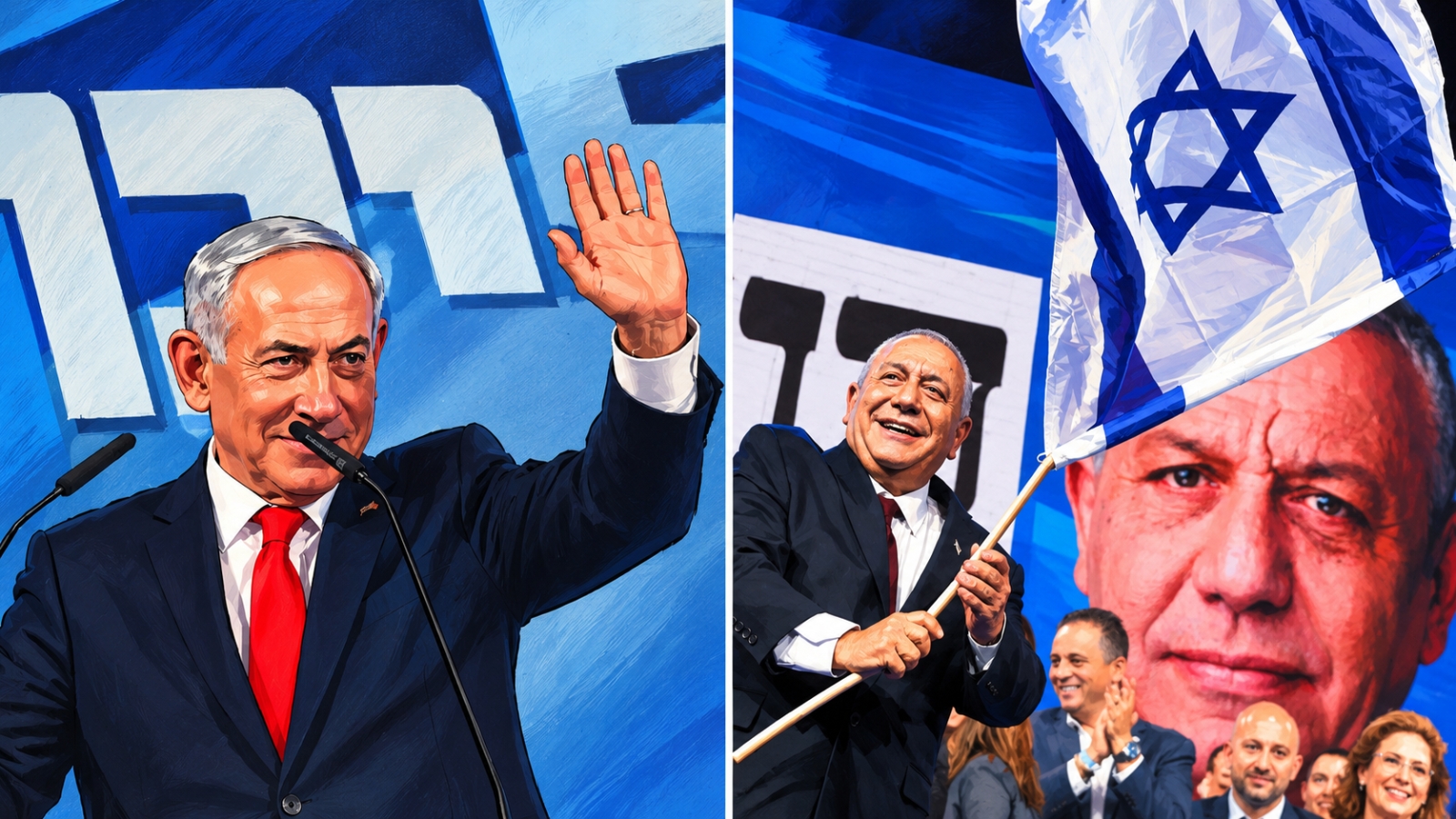
In a proportional representation system with a low electoral threshold, power does not belong to the faction with the largest plurality; it belongs to the smallest bloc capable of denying a majority to its rivals. When Israeli voters return an indecisive Knesset where neither the pro-Netanyahu right-wing religious bloc nor the anti-Netanyahu center-left opposition secures the mandatory 61-seat majority out of 120, Benjamin Netanyahu retains the premiership by default under Israel’s Basic Law: The Government, while Arab-majority parties—historically excluded from governing coalitions—capture decisive leverage as negative kingmakers. Understanding this outcome requires examining the structural asymmetry of Israeli coalition math, the legal mechanics of caretaker governments, and the strategic utility of external parliamentary support.
The Structural Asymmetry of the 120-Seat Grid
Israeli legislative politics operates under a pure proportional representation model with a single nationwide district and a 3.25% electoral threshold. This design maximizes ideological representation while penalizing executive stability. Because nearly every social, religious, and ideological cleavage translates into a distinct party list, no single party has ever won an outright majority in the Knesset. Coalition building is therefore an exercise in multi-variable optimization under strict ideological constraints.
In cycles characterized by deadlock—such as the repeated elections between 2019 and 2021—the Knesset fractures into three functional clusters rather than two competing ideological camps:
- The Core Right-Religious Bloc: Anchored by Likud alongside ultra-Orthodox (Haredi) parties (Shas and United Torah Judaism) and religious-Zionist factions. This cluster exhibits high discipline because its constituent parties share overlapping patronage interests and face high switching costs if they defect to a secular center-left coalition.
- The Anti-Netanyahu Opposition Bloc: A heterogeneous collection spanning center-right secular nationalists, centrist technocrats, and left-wing social democrats. Their sole unifying variable is the removal of the incumbent Prime Minister, creating severe internal friction over economic policy, judicial authority, and territorial governance.
- The Arab-Majority Lists: Primarily represented through the Joint List alliance or independent factions such as Ra'am (the United Arab List). Historically, mainstream Zionist parties across both major blocs treated Arab factions as outside the legitimate pool of coalition partners.
When the Core Right-Religious Bloc secures between 55 and 60 seats, it falls short of the 61-seat affirmative majority required to swear in a new government. Yet the opposition cannot assemble an alternative 61-seat coalition without including the Arab-majority parties. Because the Arab parties control roughly 10 to 15 seats, their refusal to back either side—or the refusal of right-wing anti-Netanyahu factions to sit with them—locks the legislature in a mathematical stalemate.
Caretaker Continuity and the Legal Default
Media narratives frequently misinterpret a failure to form a coalition as an immediate transfer of power or a vacuum of executive authority. Under Israeli constitutional law, the opposite occurs. Section 30 of Basic Law: The Government establishes the principle of governmental continuity. A sitting Prime Minister and cabinet do not vacate office upon the dissolution of the Knesset or the certification of inconclusive election results. They remain in place as a transitional or caretaker government until a new cabinet wins a formal vote of confidence in the parliament.
This legal architecture creates a profound incumbency advantage during periods of parliamentary gridlock:
- Asymmetric Burden of Proof: The challenger does not merely need to defeat the incumbent in seat count; the challenger must assemble an affirmative majority of 61 members willing to vote for a specific alternative cabinet. The incumbent only needs to prevent the challenger from reaching 61.
- Executive Inertia: While legal precedent from the Supreme Court imposes restraint on caretaker governments regarding major irreversible appointments or sweeping policy shifts, the incumbent retains control over the state budget execution, security cabinet agendas, and diplomatic representation.
- Time as a Weapon: Every failed coalition negotiation deadline triggers either the transfer of the mandate to another Knesset member or the automatic dissolution of the parliament for another election cycle. Throughout this multi-month sequence, the incumbent remains the sitting Prime Minister.
Netanyahu’s retention of power during inconclusive elections is therefore not an anomaly; it is the predictable output of a system where blocking a rival majority is significantly cheaper than constructing an affirmative one.
The Kingmaker Paradox: Veto Power Without Cabinet Seats
In standard coalition theory, a "kingmaker" is a pivotal party—such as the Free Democratic Party in post-war Germany or Shas in earlier Israeli eras—that trades its parliamentary votes for ministerial portfolios, budget allocations, and policy concessions. Arab parties in Israel have historically operated under a different mechanism: negative kingmaking.
Because ideological red lines regarding the Israeli-Palestinian conflict, military service, and the definition of the state as Jewish and democratic prevent Arab factions from joining Zionist cabinets—and deter Zionist parties from inviting them—Arab parties rarely convert their seats into cabinet ministries. Instead, they exercise decisive influence through three distinct parliamentary mechanisms:
1. President’s Consultation Recommendations
Following an election, the President of Israel consults with all incoming parliamentary factions to determine which Knesset member holds the highest probability of forming a coalition. When Arab parties decline to recommend any candidate, they lower the denominator of active recommendations without granting an outright majority to the opposition. Conversely, if a faction recommends the opposition leader—as occurred when elements of the Joint List recommended Benny Gantz in 2019—it forces the President to grant the initial coalition-building mandate to the challenger, temporarily stripping the incumbent of the procedural first move.
2. Outside Support (The Blocking Obstruction)
A minority government can survive in a parliamentary system if a non-governing party agrees to vote against motions of no confidence or abstain during the initial investiture vote. This model, famously utilized by Yitzhak Rabin’s government in the early 1990s via the Oslo Accords era agreements with Arab parties, allows a center-left coalition to govern with fewer than 61 internal seats. When Arab parties withhold this outside support, any center-left coalition mathematically collapses before it can be sworn in.
3. Pragmatic Issue-Based Leverage
The divergence between ideological anti-Zionist factions (such as Balad) and pragmatic Islamist or municipal-focused factions (such as Ra'am) alters the negotiating calculus. When an Arab party signals willingness to cooperate with either the right-wing bloc or the anti-Netanyahu bloc in exchange for concrete material deliverables—such as policing budgets to combat organized crime in Arab municipalities, zoning permits, and infrastructure funding—it breaks the binary deadlock. By refusing to pledge automatic allegiance to the center-left, a pragmatic Arab faction forces both Netanyahu and his rivals to bid for its abstention or external backing.
Strategic Fragility and the Limits of Incumbency
Relying on parliamentary deadlock and opposition fragmentation to retain the premiership carries severe operational limitations. A caretaker government cannot pass a new state budget, forcing the state to operate on a monthly pro-rated continuation of the previous year’s spending baseline (one-twelfth per month). Over extended periods, this starves ministries of capital expenditure, freezes public sector reforms, and degrades long-term fiscal planning.
Furthermore, the kingmaker status of Arab parties introduces acute instability into any coalition that relies on them. Right-wing defectors within an anti-Netanyahu bloc face relentless electoral pressure from their base if their government depends on Arab votes for survival. Simultaneously, Arab lawmakers face backlash from their own constituents if they prop up a government executing military operations in Gaza or expanding West Bank settlements. Consequently, external support arrangements suffer from an inherently short half-life; any security escalation immediately threatens to collapse the parliamentary arithmetic.
The Strategic Play for Coalition Architects
In a fractured proportional system where ideological vetoes block standard majority formation, political survival depends on decoupling parliamentary survival from formal cabinet membership. Future coalition architects seeking to break the Israeli deadlock must abandon attempts to forge broad ideological consensus and instead execute a transactional minority-government strategy: secure a core executive cabinet of 55 to 58 seats, isolate a single pragmatic pivot faction outside the coalition, and lock in an explicit, written confidence-and-supply agreement focused exclusively on municipal budgets and civil infrastructure while shelving all constitutional and territorial disputes for the duration of the legislative term.


