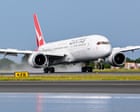
The cabin lights are dimmed to a soft, bruised amber. Outside, the night sky over the Mediterranean is a vast, indifferent velvet. Inside Boeing 787-9 registration VH-ZND, resting quietly on the tarmac in Rome after a long-haul flight from Sydney via Perth, the air should smell of stale jet fuel, roasted coffee beans, and the faint, dry metallic tang of recycled oxygen.
Instead, there is a quiet tension. Meanwhile, you can find other developments here: The Tourism Reckoning Why Overcrowded Destinations Are Collapsing Under Their Own Weight.
Somewhere in the hidden anatomy of the aircraft, behind the upholstered bulkheads, beneath the plush cushions of seat 42K, or nestled deep within the structural seams where passenger comfort meets cold aviation engineering, an uninvited guest has checked in. It does not need a passport. It does not care about your frequent flyer status. It weighs less than a single drop of water, yet its presence is heavy enough to halt a multi-million-dollar machine in its tracks.
Bedbugs. To explore the bigger picture, we recommend the recent article by Condé Nast Traveler.
We tend to think of travel in terms of grand geography. We measure our lives in boarding passes, time zones, and the smooth hum of jet engines lifting us away from our ordinary routines. But modern flight is also an exercise in containing the microscopic. When a Qantas aircraft is forced to ground in Rome, disrupting schedules, scrambling connections, and leaving hundreds of weary travelers stranded in departure lounges, the crisis isn't mechanical. A turbine didn't fail. A navigation computer didn't stutter.
A creature the size of an apple seed brought a giant to a halt.
Consider what happens next in the hidden logistics chain of global aviation. Passengers are disembarked, handed vouchers, and ushered into the chaotic limbo of airport terminals. They are tired, confused, and irritable. To them, the delay is an inconvenience, a disruption of holiday plans or business meetings. But behind the scenes, an entirely different kind of operation swings into motion.
Specialized pest control teams board the silent cabin, wearing protective suits that look strangely like they belong in a biological containment ward rather than a commercial airliner. They carry thermal imaging equipment and chemical treatments designed to scour every square millimeter of fabric, foam, and plastic. Every seat cushion is inspected. Every seam is traced.
Why such an extreme response to something so small?
Because the aviation industry operates on a razor-thin margin of reputation and biological control. A commercial airliner is a closed, pressurized ecosystem. Introduce a resilient, blood-feeding parasite into that environment, and you have created an incubator. Left unchecked, a single female bedbug can multiply rapidly, transforming a long-haul flight into a vector for distribution. Passengers disembark in London, Tokyo, or Los Angeles, carrying more than just souvenirs in their luggage.
We rarely talk about the vulnerability of our modern transit systems to ancient pests. We marvel at the carbon-composite frames of modern jets, the whisper-quiet engines, the satellite-linked Wi-Fi. Yet we remain inextricably linked to the same biological realities that plagued humanity in mud-brick huts centuries ago. Nature has a way of hitchhiking on our greatest technological achievements.
When you slide your carry-on into the overhead bin, you are participating in a global migration pattern that humans share with rats, mosquitoes, and Cimex lectularius. We build gleaming tubes to conquer the sky, but we bring our passengers along with us—both the ones holding boarding passes and the ones hiding in the seams.
The grounding in Rome is ultimately a story of friction between human ambition and biological persistence. It is a reminder that no matter how high we climb, or how fast we cross oceans, we cannot simply engineer away the earth clinging to our shoes.
Eventually, the fumigation concludes. The deep-cleaning protocol is signed off by inspectors in high-visibility vests. The aircraft is towed back onto the active line, refueled, and repopulated with a new set of passengers who stow their bags, buckle their seatbelts, and stare out the windows at the brightening morning sky, entirely unaware of the invisible drama that played out just hours before in the quiet dark of the cabin.
The engines spool up with a rising, concussive roar. The brakes release. The heavy bird rolls down the runway and leaps once more into the open air, leaving the ground far below.