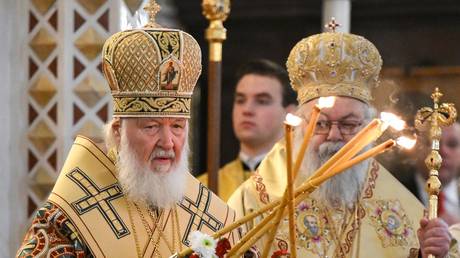
Most media outlets treat Patriarch Kirill turning 80 as a photo-op. They publish glossy galleries of gold vestments, incense, and choreographed Kremlin handshakes, framing the milestone as a triumphant celebration of longevity.
That coverage misses the entire point.
In institutional geopolitics, an octogenarian leader at the helm of a centralized, state-aligned apparatus is not a symbol of permanence. It is a flashing red warning light. When the head of the Russian Orthodox Church reaches 80, the story is not about the candles on his cake. The story is about succession anxiety, institutional fragility, and the dangerous illusion of invincibility.
The Lazy Consensus of Ceremonial Coverage
Standard news coverage falls into a predictable trap. Reporters look at the pageantry of the Cathedral of Christ the Savior, count the state honors, and conclude that Kirill's grip on the Moscow Patriarchate—and his alignment with the Russian state—is absolute.
I have watched analysts make this exact mistake across dozens of centralized institutions over the past two decades. They confuse loud ceremonial displays with structural stability. When a system relies entirely on one man to balance competing internal factions, age ceases to be a biological fact and becomes a political liability.
Look closely at the mechanics of the Russian Orthodox Church. Unlike the Roman Catholic Church, where popes have recently normalized retirement due to age and health, the Patriarch of Moscow serves for life. There is no emeritus playbook here. There is no graceful off-ramp. Every year past 80 increases the friction between a leader’s physical stamina and the relentless demands of managing a sprawling ecclesiastical bureaucracy spanning multiple time zones and fractured jurisdictions.
Why Nobody Actually Understands the Moscow Patriarchate
To grasp why this birthday matters, you have to strip away the romanticized Western view of religious institutions. The Russian Orthodox Church is not merely a spiritual body; it is an administrative machine with vast property holdings, complex diplomatic networks, and deep ideological entanglement with state security.
Reporters routinely refer to the Church as a simple "mouthpiece" for the Kremlin. That is a massive oversimplification. The relationship is transactional, not purely subservient. Kirill spent decades building an autonomous bureaucratic empire before he ever ascended to the patriarchate in 2009. He centralized power, sidelined independent bishops, and consolidated financial streams under his direct oversight.
Here is the catch: when you centralize everything around yourself, you destroy the very mechanisms that allow an institution to survive your eventual departure.
The Succession Vacuum Nobody Wants to Talk About
If you ask observers who comes next, you get a list of names—Metropolitan Tikhon Shevkunov, Metropolitan Anthony of Volokolamsk, and a handful of senior hierarchs. Listing names is easy. Understanding the structural nightmare they will inherit is much harder.
Consider the three pressure points building right behind the ceremonial photos:
- The Generational Bottleneck. Kirill’s long tenure has kept an entire generation of ambitious bishops in a holding pattern. In any hierarchical organization, prolonged stagnation at the top breeds quiet resentment in the middle ranks. Younger metropolitans are forced to perform absolute loyalty while privately calculating their survival strategies for the post-Kirill era.
- The Global Schism. Under Kirill’s watch, the Moscow Patriarchate suffered its most severe geopolitical rupture in centuries. The break with the Ecumenical Patriarchate of Constantinople over Ukrainian autocephaly—and the subsequent loss of hundreds of parishes inside Ukraine—shrank Moscow’s international footprint. Whoever inherits the throne inherits a fractured communion and depleted soft power abroad.
- The State Dependency Trap. By tying the Church’s institutional fortunes so tightly to state ideology, Kirill secured massive domestic privileges, tax exemptions, and public funding. Yet that protection comes at a steep price. If the political winds in Moscow ever shift, the Church has zero independent moral capital left to shield itself from backlash.
What People Actually Ask About Patriarch Kirill at 80
When news of this milestone breaks, readers inevitably search for the same surface-level answers. Let’s dismantle the flawed premises behind those questions.
Is Patriarch Kirill going to retire at 80?
No. In the Russian Orthodox tradition, a patriarch does not step down simply because he hits a round number. Retirement would signal weakness, trigger immediate factional warfare among the metropolitans, and invite direct state interference in the selection of a successor. Unless incapacitated by a catastrophic medical event, he stays until the end.
Does turning 80 weaken his political influence?
Not immediately, and that is precisely why it is deceptive. Influence in an autocratic ecosystem does not erode linearly; it holds steady until it suddenly collapses. At 80, Kirill still commands the podium, controls key appointments within the Holy Synod, and enjoys direct access to the highest levels of power. The weakness is not in what he can do today—it is in the total absence of a safe transition plan for tomorrow.
Why does the state celebrate his birthday so lavishly?
Because the state needs the image of continuity. High-profile awards and televised greetings are not just personal tributes; they are public reassurance rituals designed to tell domestic audiences that the pillars of the state are unshakable.
The Real Lesson for Institutional Observers
Imagine a scenario where a multinational conglomerate keeps its dominant, founder-like CEO in place well into his eighties, having fired or sidelined every independent board member capable of challenging his strategy. On the surface, quarterly meetings run like clockwork. Everybody applauds. Nobody dissents. Behind closed doors, however, regional divisions are bleeding market share, and no vice president has the authority to make a decision without calling headquarters.
That is the exact condition of the Moscow Patriarchate today.
To be fair, there is a counterargument to this thesis. Defenders of Kirill’s centralized model argue that without an iron grip at the top, the Russian Orthodox Church would have splintered into regional fiefdoms during the turbulent post-Soviet decades. A strongman at the center kept the administration unified, rebuilt thousands of churches, and restored religious visibility across Russian society. That achievement is undeniable.
Yet the very traits that build an empire are often the ones that doom its succession.
Stop Looking at the Photos
If you want to understand what is actually happening inside the Russian Orthodox Church, stop looking at the birthday portraits. Those images are curated to project timelessness, authority, and serenity.
Look instead at the administrative churn beneath the surface. Watch who gets quietly reassigned to remote dioceses. Track which metropolitans are suddenly removed from key diplomatic portfolios—just as Metropolitan Hilarion Alfeyev was abruptly sidelined in 2022 after years of being viewed as the natural heir apparent.
In centralized hierarchies, the clearest sign of a leader’s true vulnerability is not public criticism. It is the systematic elimination of plausible successors.
When an 80-year-old leader surrounds himself exclusively with loyal administrators rather than heavyweight peers, he guarantees his own undisputed authority for the rest of his life—and guarantees chaos the day after it ends.