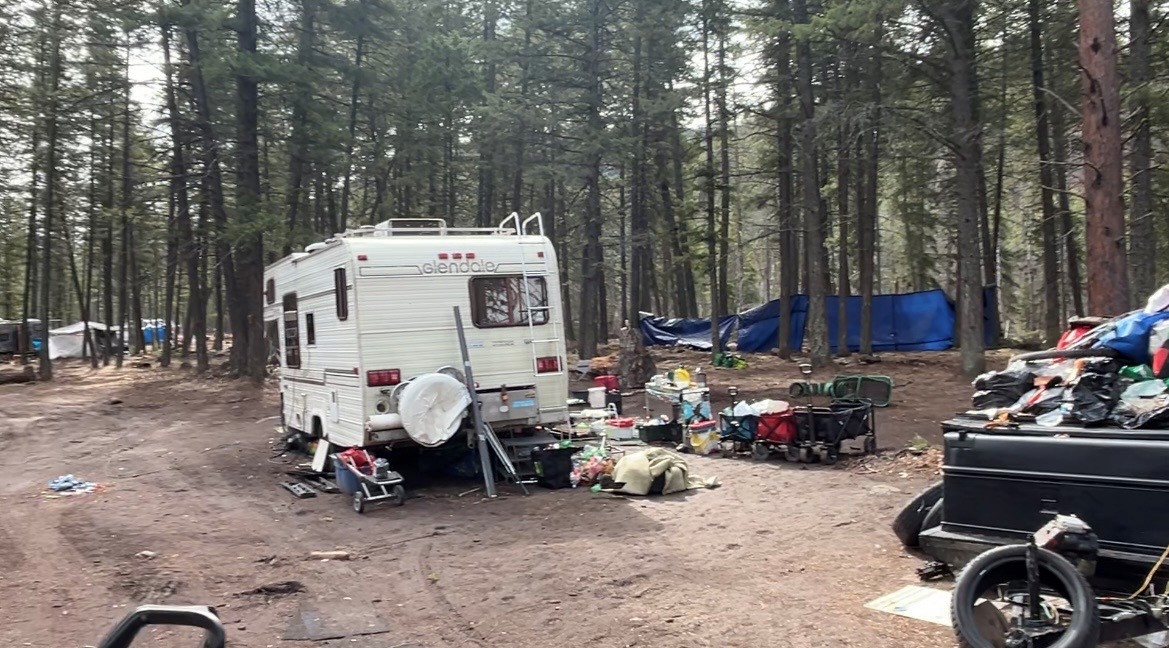
The Ministry of Forests has officially moved to clear unauthorized encampments along the Okanagan Lake shoreline near Peachland. While the government frames this as a necessary step to mitigate immediate wildfire risks and environmental damage, the reality on the ground reveals a much more complex breakdown of social policy and land management. These eviction notices are not just about clearing brush or preventing a stray spark. They represent a collision between a shrinking supply of accessible public land and a population that has nowhere else to go.
The notices recently served to individuals living in makeshift structures and campers along the Princeton Avenue corridor and nearby forest service roads signal a hardening of the province’s stance on "squatting." For years, these areas have served as a pressure valve for the Central Okanagan’s housing crisis. Now, with the memory of the McDougall Creek wildfire still fresh in the minds of residents, that valve is being welded shut.
The Fire Risk as a Policy Lever
Wildfire prevention is the ultimate trump card in British Columbia. When the province cites the risk of human-caused fires in the wildland-urban interface, public opposition to evictions tends to evaporate. It is a logical argument. The geography of Peachland, with its steep slopes and dense fuel loads, makes it a tinderbox during the summer months. An unattended campfire or a poorly discarded cigarette in these informal camps could theoretically ignite a blaze that threatens millions of dollars in property and countless lives.
However, using the Ministry of Forests to solve what is essentially a housing and mental health issue creates a cycle of displacement rather than a solution. By removing these individuals from the forest, the province is not "fixing" the risk; it is merely moving the risk to a different jurisdiction. When people are pushed out of the woods, they often migrate toward urban centers where shelters are already at capacity, or they simply move deeper into the wilderness where they are harder to monitor and even further from emergency services.
The Ministry’s enforcement officers are tasked with protecting the land, not the people. This distinction is vital to understanding why these operations feel so clinical and, to those being evicted, so cruel. The focus is on the "unauthorized use of Crown land," a legalistic framing that ignores the lack of viable alternatives for the occupants.
The Shrinking Map of Public Access
The Peachland situation highlights a broader trend across the province where public land is becoming increasingly restricted. For decades, the "bush" was seen as a frontier where one could disappear if the traditional world became too expensive or too suffocating. That frontier is closing. Between increased industrial activity, private development, and stricter environmental protections, the areas where a person can legally park a rig or pitch a tent for more than 14 days are vanishing.
What we are seeing in Peachland is the enforcement of the Land Act and the Forest and Range Practices Act used as a blunt instrument. While these laws are intended to prevent environmental degradation—and there is no denying that some camps leave behind significant trash and human waste—the enforcement is often reactive. It happens when the presence of the "unhidden" poor becomes an eyesore for the local tax base or a perceived threat to tourism.
The Environmental Cost of Displacement
Critics of the squatters often point to the "mess" left behind. They talk about abandoned vehicles, plastic tarps, and the contamination of local watersheds. These are legitimate concerns. The Okanagan watershed is a delicate system, and informal camps lack the infrastructure to handle waste.
But there is a counter-argument that is rarely heard in the halls of the Victoria legislature. When the province conducts a "clean-up" and eviction, the process itself can be disruptive. More importantly, it fails to address the root cause of the environmental impact. If the province provided designated, managed sites with basic sanitation for those who choose or are forced to live off-grid, the environmental footprint would be drastically reduced. Instead, the policy remains one of total prohibition, which leads to a "scorched earth" approach to enforcement.
The Housing Crisis by Another Name
Peachland is an affluent community. Its real estate market has seen explosive growth, driven by its proximity to Kelowna and its stunning lake views. This wealth creates a vacuum. The service workers, the seasonal laborers, and the retirees on fixed incomes who once called this area home are being priced out.
The camps along the Princeton Avenue corridor are a physical manifestation of this economic displacement. Some of the people being evicted are not "transients" in the traditional sense; they are former residents who have been pushed to the margins. When the Ministry of Forests issues an eviction notice, they are essentially telling these people that their presence on public land is an illegal encumbrance.
The math of the Okanagan doesn't add up for the vulnerable.
- Average rent for a one-bedroom apartment exceeds $1,800.
- Vacancy rates hover near zero percent.
- Social housing waitlists are measured in years, not months.
In this environment, the forest becomes the only landlord that doesn't check a credit score. By clearing these camps without providing a dedicated space for these individuals to relocate, the province is effectively participating in a game of geographic shell-shuffling.
The Logistics of the Eviction
The actual process of serving these notices involves a coordinated effort between the Ministry of Forests, the RCMP, and sometimes local bylaws. It is a high-tension environment. For the occupants, their entire world is contained within a 20-foot radius. For the officers, it is a matter of checking a box on a work order and ensuring that the land is "restored" to its natural state.
There is a significant logistical hurdle in these evictions. Many of the vehicles in these camps are non-operational. Towing a rusted-out motorhome from a steep, gravel forest service road is a dangerous and expensive undertaking. The province often ends up footing the bill for the disposal of these vehicles, a cost that far exceeds what it would take to provide basic social support services on the front end.
The residents are usually given a window—often 72 hours to a week—to vacate. During this time, the tension in the community spikes. Local social media groups fill with a mix of relief and vitriol, while advocacy groups scramble to find space in overstretched shelters.
A Failed Strategy of Deterrence
The provincial government seems to believe that through consistent enforcement, they can deter people from living on Crown land. This is a fundamental misunderstanding of the situation. People do not live in a tent in the middle of a Peachland winter because they haven't been warned about the legal consequences. They do it because the alternative is a sidewalk or a jail cell.
The "deterrence" model only works if there is a legal path available. Currently, there is no legal path for long-term residency on Crown land, and there is no adequate path for low-income housing in the region. This creates a permanent class of "illegal" citizens who are constantly in motion, moving from one forest service road to the next, always one step ahead of the next eviction notice.
The Missing Middle of Land Management
There is a glaring lack of "transitional land" in British Columbia. We have parks for recreation and we have industrial land for resource extraction, but we have no category for "survival habitation."
In other jurisdictions, "safe parking" programs or managed backcountry sites have been used to centralize informal populations, making it easier to provide fire safety education, waste management, and social services. By refusing to acknowledge the need for this kind of space, the Ministry of Forests ensures that they will be back in Peachland next year, and the year after that, serving the same notices to the same people.
The irony is that the very fire risk the province is trying to avoid is exacerbated by the secrecy that displacement causes. When people are "squatting" illegally, they are less likely to report small fires or hazards for fear of drawing attention to their location. A managed site would allow for fire-safe infrastructure, like communal fire pits and cleared defensible space, which would actually meet the Ministry's stated goals more effectively than a forced eviction.
The Burden on Municipalities
While the Ministry of Forests handles the land, the town of Peachland bears the social brunt of these actions. Small municipalities are ill-equipped to handle the sudden influx of displaced people that follows a provincial clearing. The local food banks, the small RCMP detachment, and the local health clinic see a surge in demand that they are not funded to meet.
This creates a rift between the provincial government and local leaders. Victoria can claim they are "cleaning up the woods," but the residents of Peachland see the fallout on their street corners and in their parks. It is a classic case of jurisdictional buck-passing where the most vulnerable are used as the currency.
The Long Road to Nowhere
The eviction notices in Peachland are a symptom of a systemic failure that spans housing, health, and land-use policy. Simply clearing the brush and hauling away the trailers will not change the reality that more people are being pushed out of the traditional economy and into the trees.
The forest is no longer a silent backdrop to the Okanagan lifestyle; it has become a contested space where the province’s inability to house its citizens meets the urgent reality of a changing climate. As the summer heat begins to bake the valley, the Ministry may clear the camps, but the underlying heat of the social crisis remains untouched.
Moving a person five miles down the road does not solve a wildfire risk. It just changes the coordinates of the eventual smoke. Until the province integrates land management with actual social infrastructure, these "hard-hitting" enforcement actions are nothing more than a temporary, expensive, and ultimately futile performance. The people will return, or others will take their place, because the forest is the only place left that hasn't put a "No Vacancy" sign on the door.