The open road does not care about your intentions. It stretches out under a blinding sun or a freezing rain, indifferent to human sorrow, deaf to the quiet pleas of a heart breaking for a distant land. Asphalt offers no mercy. It only offers distance.
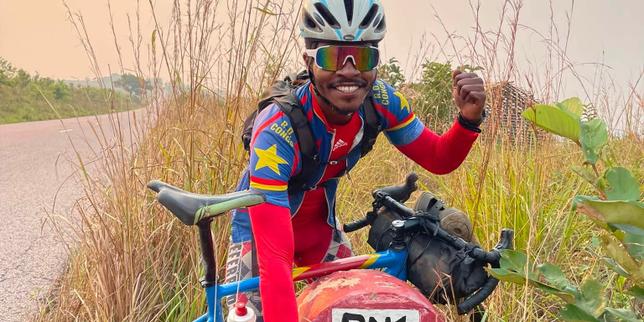
For months, Miguel Masaisai chose that distance.
He did not pedal across Africa for glory. He did not chase medals, sponsorships, or the hollow echo of viral fame. He rode because silence was heavier than the load on his bicycle frame. Back home, in the Democratic Republic of Congo, communities were fracturing under the weight of an unrelenting conflict. Families scattered. Futures evaporated. While politicians argued in guarded rooms and diplomats issued tired statements, the daily reality of war chewed up ordinary lives.
So, Miguel got on a bike.
He packed what he could carry, pointed his handlebars forward, and set out on a continent-spanning journey with a singular, radical message: stop the fighting. Peace, he believed, was not merely the absence of gunfire; it was the presence of justice, listening, and shared humanity. Every rotation of the pedals was a heartbeat dedicated to those whose voices had been choked out by violence.
People watched him pass through their towns. Some cheered. Some stared in quiet bewilderment. Who was this lone rider carrying the grief of a nation on two wheels? They saw a man braving dust storms, broken roads, and physical exhaustion. But what they really witnessed was endurance born of love. He was translating geopolitical catastrophe into a human scale—one mile, one conversation, one drop of sweat at a time.
He wanted the world to look at the DRC not as a distant headline of tragedy, but as a home filled with people who simply wanted to sleep without fear. He carried their stories in his head, turning the rhythmic clicking of his bicycle chain into a metronome for hope.
Then came the highway.
Tragedy rarely arrives with dramatic cinematic flair. It often looks entirely ordinary until it is too late. A stretch of road. A heavy vehicle. A split second where momentum and mass collided.
Miguel Masaisai was struck by a truck.
In an instant, the journey stopped. The bicycle crumpled. The pedaling peacemaker was gone.
The news rippled outward, hitting those who followed his journey like a physical blow. How could a mission so pure, so desperately needed, end in the dust of a random highway? It feels bitterly unfair. It makes you question the architecture of the universe, where cynicism often outlives idealism, and a reckless machine can extinguish a light that was trying to warm a continent.
Yet, death can silence a voice, but it cannot swallow a movement.
The truck ended Miguel's ride, but it could not erase the tracks he left behind. Across villages, cities, and digital borders, people are talking about him. They are remembering why he started riding in the first place. The war in the DRC has not magically vanished because a cyclist lost his life, but the spotlight Miguel forced onto the darkness has not gone out either.
Consider what happens next. When a symbol of peace is struck down, the responsibility shifts. The burden of carrying the message falls from his shoulders onto ours. We are left to grapple with the unfinished road.
Miguel’s journey teaches us something uncomfortable about courage. True conviction does not wait for guaranteed safety. It steps into the wind anyway, knowing full well the risks, choosing meaning over comfort. He understood that peace is built by people willing to make themselves vulnerable.
The road stretches on. The horizon is still hazy, blurred by the dust of ongoing struggles and human stubbornness. But somewhere out there, on the asphalt of memory, the quiet hum of a bicycle chain continues to echo.