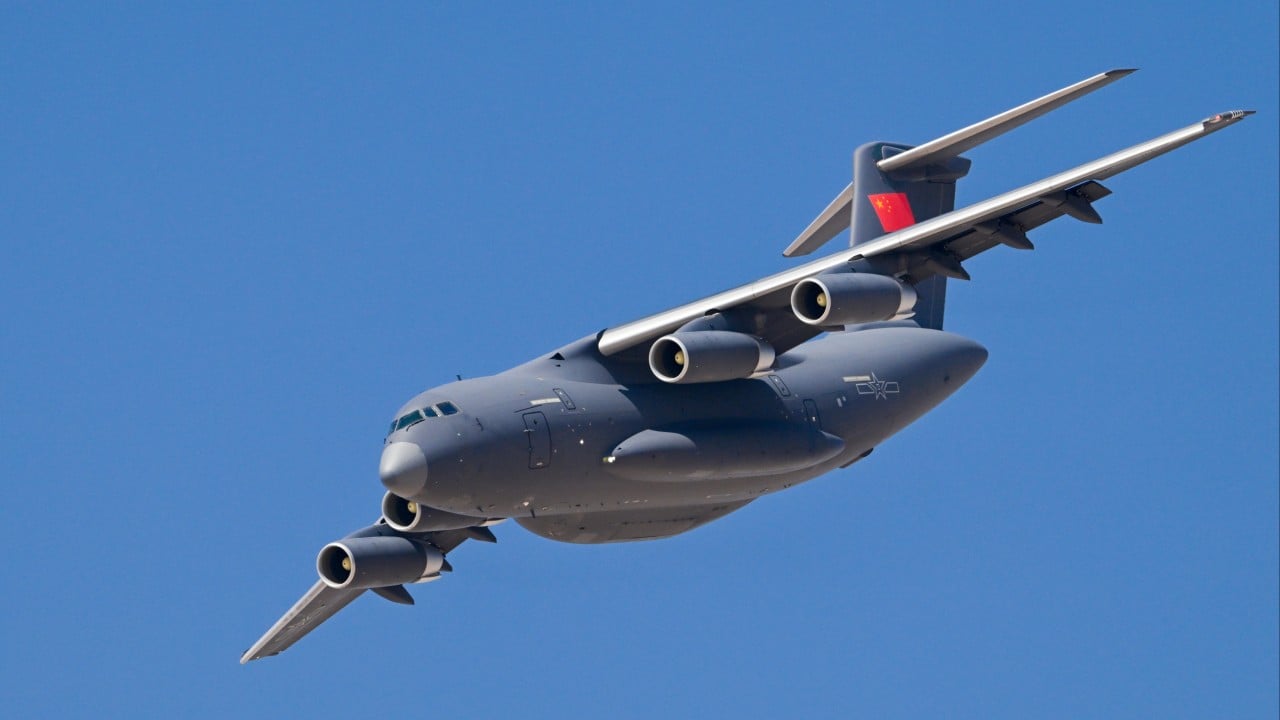
When the Xi'an Y-20 heavy airlifter first took to the skies, western analysts wrote it off as a bulky clone cobbled together from imported Russian parts. They missed the bigger picture. Fast forward a decade, and that single cargo platform has evolved into an expansive family of strategic assets reshaping Beijing's power projection across the Pacific and beyond.
You aren't just looking at a heavy transporter anymore. You're looking at a multi-role ecosystem comprising the baseline Y-20A, the upgraded WS-20-powered Y-20B, the YY-20 aerial refueling tanker, and emerging electronic warfare or airborne early warning variants like the KJ-3000. The strategy here isn't about matching western fleets cargo-for-cargo. It's about turning a single airframe into a Swiss Army knife for the People's Liberation Army Air Force (PLAAF).
Breaking Down the Y-20B and Modular Flexibility
The real shift happened when engineers swapped out legacy Russian D-30 engines for domestically produced WS-20 high-bypass turbofans. That upgrade solved a chronic performance bottleneck, giving the Y-20B the thrust and fuel efficiency required for long-endurance missions.
Military planners didn't stop at hauling tanks. Recent state-backed media reveals and documentary footage highlight a heavy push toward modular adaptability. Instead of locking an aircraft into a single factory-hardened role, the airframe accepts mission-specific pods.
- The Transporter: Capable of swallowing up to 66 metric tons, moving heavy armor like Type 99A tanks or Type 15 light tanks across continental distances.
- The Tanker (YY-20): Extended fuel storage and wing-mounted pods that stretch the combat radius of stealth fighters like the J-20 deep into contested Pacific zones.
- The Command Post: Emerging configurations acting as airborne early warning and control nodes or electronic warfare platforms.
This modular swap capability changes logistics entirely. During peacetime, an airframe runs routine transport sorties. In a crisis, maintenance crews can reconfigure internal systems or slap on external pods to pivot the asset into a frontline force multiplier.
Why the Pacific Reach Matters Now
For years, China's blue-water and long-range air ambitions hit a hard ceiling due to a lack of aerial refueling capacity and airborne early warning endurance. Relying on a small, aging fleet of modified H-6 bombers restricted fighters to shorter tethers near the mainland.
The YY-20 tanker changes that math completely. By routinely operating alongside J-20 fighters during distant exercises, these heavy platforms stretch operational reach past the first and second island chains. You're seeing sustained air patrols and power projection that stretch thousands of miles from domestic airbases.
Critics often argue that rapid manufacturing scales can't replace decades of operational combat experience. That's true. Beijing's aircrews lack the continuous wartime logistics background of western air arms. But ignoring the sheer hardware velocity is dangerous. The production lines at Xi'an are turning out heavy frames at a pace western defense budgets struggle to match.
Moving Past the Copycat Myth
The old narrative claimed China simply reverse-engineered Russian concepts without genuine innovation. The development timeline of the Y-20 family completely shatters that view. Engineers utilized Model-Based Definition (MBD) design techniques and extensive 3D printing for structural components, slashing assembly times drastically compared to older domestic aircraft programs.
By mastering the underlying digital blueprints, flight controls, and composite manufacturing locally, Beijing insulated the program from foreign supply chain disruptions. When you control every nut, bolt, and software line, rolling out specialized mission variants becomes an internal engineering choice rather than a diplomatic negotiation.
Keep a close eye on how these modular airframes deploy over the next few years. The story isn't just about how many transport planes roll off the assembly line. It's about how quickly a cargo plane can turn into a command center when nobody is looking.