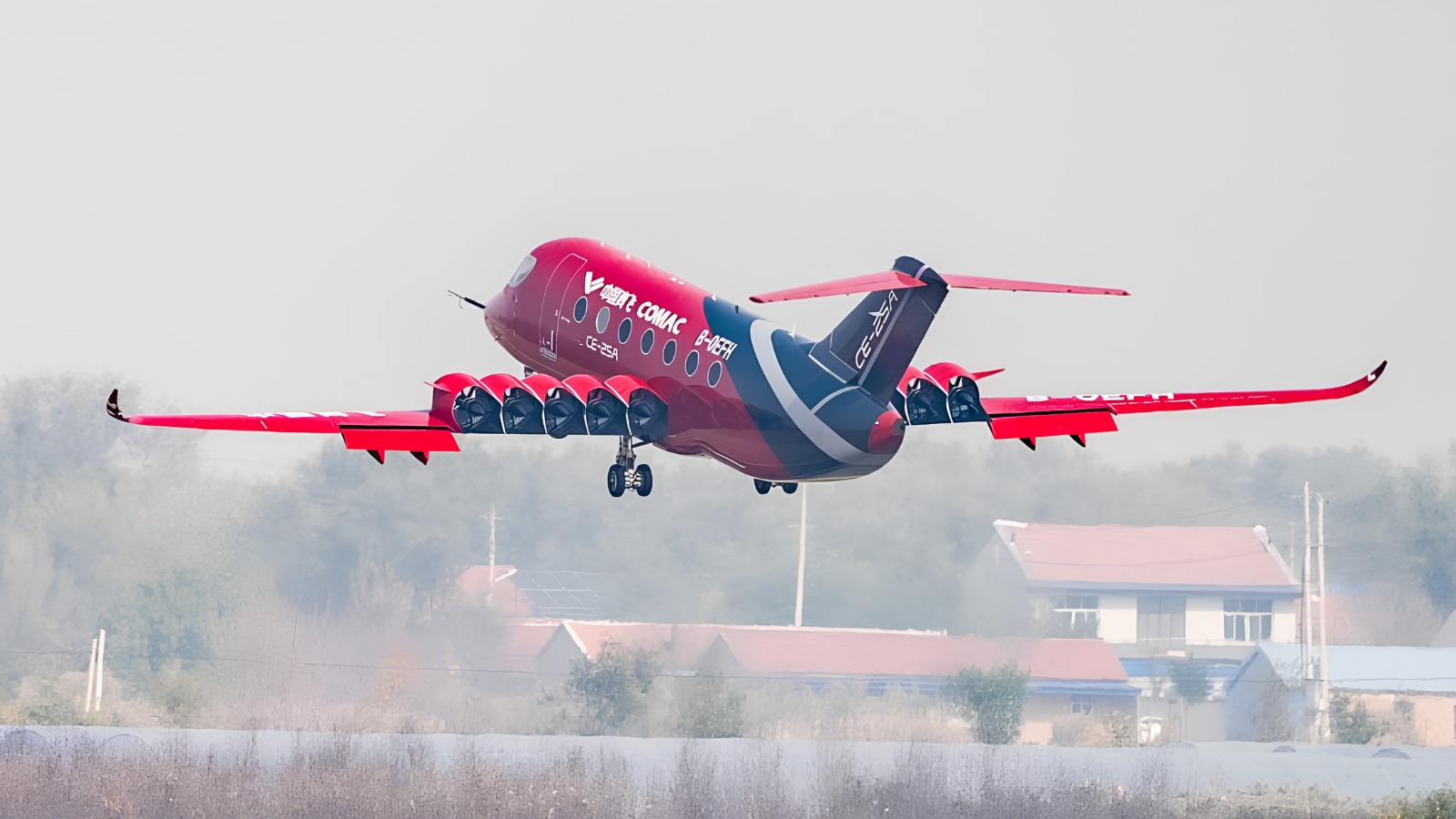
China just flew a 10-tonne, 19-passenger electric airliner with three people on board, and half the headlines already treat it like jet fuel is dead. Hold on.
When the Commercial Aircraft Corporation of China (COMAC) sent its CE-25A into the sky over Binzhou, Shandong province on November 14, 2026, it marked a genuine aviation milestone. Two pilots and a flight-test engineer sat inside a battery-powered commuter aircraft sporting ten ducted fans mounted along the top of its wings. COMAC lists the plane's specs at a 300 km/h cruising speed, a 2,400-meter cruising altitude, and a 400-kilometer range.
Those numbers look great on a press release. Look closer at the flight logs and the basic physics of batteries, though, and a completely different picture emerges.
What Actually Happened Over Binzhou on November 14
If you only skimmed the viral clips, you might think the CE-25A loaded up 19 passengers and cruised 400 kilometers between cities. It didn't.
During its maiden piloted run, the aircraft stayed airborne for 16 minutes and 38 seconds and covered 60.4 kilometers. The entire test sequence—including taxiing and ground checks—took 57 minutes and 46 seconds. Only three crew members were aboard, not a full cabin of travelers with luggage.
That doesn't diminish the engineering feat. Putting human test pilots into a 10-tonne prototype powered entirely by lithium batteries takes serious confidence. Before anyone stepped inside, COMAC spent nine months running 19 uncrewed autonomous test flights, starting back on February 2, 2026. You don't skip straight to long-haul endurance runs on day one of crewed testing.
Still, confusing a 16-minute validation hop with a ready-to-book commuter route is the first trap people fall into.
Why Ten Ducted Fans Beat Two Big Propellers
Walk out onto any regional tarmac today and you'll see twin-engine turboprops like the Beechcraft 1900D or the De Havilland Twin Otter. The CE-25A looks nothing like them. Instead of two massive spinning blades hanging off the front of the wings, COMAC mounted ten electric ducted fans—five on each wing—positioned near the trailing edge.
According to the Institute of Electrical Engineering at the Chinese Academy of Sciences, each motor unit delivers 200 kilowatts, giving the aircraft a combined propulsion output of 2 megawatts.
Why bother with ten smaller fans instead of two large ones? Aerodynamics and redundancy.
- Blown-wing lift: Placing ducted fans along the upper surface of the wing accelerates airflow over the airfoil and deployable flaps. That generates extra lift at slower speeds, allowing the plane to take off and land on shorter regional runways.
- Built-in safety margins: Lose one engine on a twin-engine plane and your pilot immediately has a high-workload emergency dealing with asymmetrical thrust. Lose one out of ten electric fans, and the flight computer simply bumps power slightly to the remaining nine.
- Noise reduction: Shrouding the blades inside ducts contains acoustic energy and eliminates supersonic tip speeds, making the aircraft dramatically quieter over populated suburbs than a traditional turboprop.
This setup is called distributed electric propulsion, and it only works because electric motors scale down without losing efficiency. Try putting ten miniature jet turbines on a regional wing and your fuel burn and maintenance bills would bankrupt an airline in a month.
The Battery Math Behind That 400-Kilometer Range Claim
Here is where aerospace engineers start raising their eyebrows. COMAC partnered with battery giant CATL and researchers at Shanghai Jiao Tong University to build the CE-25A, yet neither company has disclosed the exact weight or chemistry of the battery pack inside the demonstrator.
Let's look at the physics. Unlike a jet or turboprop, an electric airplane doesn't get lighter as it flies. A 10-tonne battery plane takes off at 10 tonnes and lands at 10 tonnes.
Independent engineering analyses from battery specialists at Battery Design and EVsays break down what it actually takes to push a 10-tonne airframe through the air at 300 km/h:
- Cruise power demand: Maintaining 300 km/h at 2,400 meters requires roughly 680 to 980 kilowatts of continuous power depending on the airframe's lift-to-drag ratio. That burns around 2.7 kilowatt-hours per kilometer.
- Climb and reserve penalties: Lifting 10 tonnes to 2,400 meters eats roughly 100 to 120 kilowatt-hours right out of the gate. Aviation regulators also mandate a 30-to-45-minute energy reserve in case bad weather forces a diversion.
- The weight budget: Carrying 19 passengers plus three crew members at standard aviation weights eats up nearly 1.9 tonnes. After accounting for the fuselage, wings, landing gear, and ten motors, engineers have roughly 2 to 3 tonnes of weight left for batteries.
Do the arithmetic. If the pack holds around 800 to 950 kilowatt-hours inside a two-tonne structure, CATL has to achieve a pack-level specific energy of roughly 400 to 450 watt-hours per kilogram.
While CATL has showcased condensed-matter cells hitting 500 Wh/kg in lab settings, turning raw cells into an aviation-certified pack requires heavy cooling plates, structural crash cages, and fire-containment barriers that prevent thermal runaway mid-flight. Even with an ultra-light 350 Wh/kg pack, holding back a mandatory 30-minute safety reserve drops the practical, real-world route distance from 400 kilometers down to somewhere between 105 and 215 kilometers.
That doesn't make the plane useless. Plenty of island hops and intercity shuttles across China's Yangtze River Delta or Pearl River Delta sit right inside that 150-kilometer sweet spot. Just don't expect a 400-kilometer flight with a full cabin and a headwind anytime soon.
Why the "25" in CE-25A Matters More Than the Flight
Most casual observers gloss over aircraft model numbers. In aviation, those letters tell you everything about the regulatory mountain ahead.
The "C" stands for China and COMAC, "E" stands for electric, and "A" marks the first variant in a planned family. The crucial part is 25.
COMAC isn't certifying this plane under light-sport or small commuter rules. The Civil Aviation Administration of China (CAAC) accepted COMAC's type-certificate application under CCAR-25—China's transport-category airworthiness standard. That is the exact same regulatory rulebook used to certify massive commercial airliners like the COMAC C919, Boeing 737, and Airbus A320.
Earlier electric planes took much easier paths:
- Pipistrel Velis Electro: Certified by European regulators in 2020, it carries just two people and serves almost exclusively as a flight-school trainer.
- RX4E: Certified in China by Shenyang Aerospace University in late 2024, this four-seater falls under lighter Part 23 general aviation rules.
By aiming for CCAR-25 on a 19-seat aircraft, COMAC is forcing regulators to write the rulebook for commercial battery-electric airliners from scratch. Regulators have to verify what happens if a battery cell shorts out at 2,400 meters, how fast high-voltage wiring degrades over thousands of cycles, and how ground crews safely recharge a megawatt-scale pack during a 30-minute airport turnaround.
Accepting an application simply opens the file. Earning the actual certificate typically takes years of grueling structural tests, lightning-strike simulations, and thousands of flight hours. Neither COMAC nor the CAAC has announced a target date for commercial passenger service.
How China's Approach Compares to Western Rivals
China isn't building electric airliners in a vacuum, though its strategy differs sharply from startups in the United States and Europe.
Look at Heart Aerospace, which moved its headquarters from Sweden to Los Angeles. Heart originally designed a pure-electric 19-seater called the ES-19 before realizing battery weight limits made commercial airline economics too tight. The company pivoted to the 36-seat ES-36, a hybrid-electric regional plane that pairs batteries with conventional turbine generators to hit longer routes, aiming for service entry around 2031.
Meanwhile, Eviation's Alice—a sleek 9-seat all-electric commuter—flew in 2022, only to see its projected range slashed from 440 nautical miles down to 250 nautical miles once real-world battery and structural weights were factored in.
COMAC enjoys a massive structural advantage that Western startups lack: state-backed industrial scale and direct integration with the world's largest EV battery supply chain. Because CATL already manufactures high-density cells at gigawatt scale for electric cars and grid storage, COMAC doesn't have to beg venture capitalists for bridge funding every eighteen months. They can iterate on full-scale flying prototypes like the CE-25A while regulators slowly hammer out certification standards.
How to Spot Real Progress vs PR Hype in Electric Aviation
If you follow clean aviation or invest in aerospace tech, the CE-25A gives you a great benchmark for separating genuine breakthroughs from flashy press releases. Whenever a manufacturer announces a new electric plane milestone, run it through four quick filters:
- Check the flight duration against the claimed range: A 16-minute hop proves the plane flies safely, not that the battery holds enough energy for a 400-kilometer route. Wait for endurance flights that actually cover 75% or more of the advertised distance.
- Look for full-payload testing: Empty cabins make range numbers look artificially high. Real commercial viability only starts when test crews load water ballast equal to 19 passengers and their bags.
- Separate cell energy from pack energy: Anyone quoting "500 Wh/kg" is talking about an individual battery cell sitting on a lab bench. Always ask for the installed pack-level energy density once cooling systems and fire shields are bolted on.
- Watch the certification category: Application acceptance is paperwork. Look for "Type Inspection Authorization" and final transport-category certification before believing any airline launch timeline.
Watch for COMAC's next flight-test bulletins out of Shandong over the coming months. Until the CE-25A flies a multi-hour mission carrying full ballast and lands with a 30-minute reserve intact, treat that 400-kilometer range as an engineering target rather than a timetable you can buy a ticket on.