You don't need a degree in international diplomacy to smell a contradiction when politicians talk tough on foreign adversaries while energy tankers quietly cross the Atlantic. When headlines started swirling about Donald Trump’s diesel deal with Vladimir Putin, most pundits split into two predictable camps. One side screamed treason. The other brushed it off as standard free-market pragmatism. Both missed the actual mechanics of how global refined fuel markets operate, why Russian diesel ended up entangled with American energy policy, and what that means for your wallet at the pump.
I've spent years tracking maritime shipping manifests, refinery crack spreads, and energy sanctions regimes. The reality behind refined petroleum flows between Moscow and Washington isn't a neat partisan talking point. It's messy. Money talks louder than press releases, and middlemen always find a crack in the legal wall.
The Mechanics Behind the Trump Putin Diesel Controversy
To understand why anyone is even talking about a diesel arrangement involving Trump and Putin, you have to look at two distinct timelines and how refined fuel actually moves around the planet. First, during Trump's first administration—specifically around 2019 and 2020—U.S. imports of Russian petroleum products didn't drop. They surged.
Data from the U.S. Energy Information Administration (EIA) confirms this hard truth. While Washington slapped sanctions on Venezuela’s state oil company PDVSA in early 2019, Gulf Coast refineries suddenly lost access to the heavy, sour crude they were built to process. What happened next? American refiners and fuel traders turned straight to Moscow. By 2020 and 2021, Russia became one of the top foreign suppliers of petroleum products—including fuel oil and unfinished diesel components—to the United States.
There wasn't a single secret handshake in a smoky room where Trump and Putin signed a personal fuel contract. That's not how commodity markets work. Instead, policy choices created a massive vacuum, and Russian state-backed giants like Rosneft and Lukoil gladly stepped in to fill it.
Fast forward to the post-2022 sanctions era and Trump's return to the political spotlight, and the phrase "dodgy diesel deal" took on a second life. Critics began scrutinizing both past trade spikes and potential backdoor negotiations over easing Russian energy restrictions in exchange for geopolitical concessions in Eastern Europe. Whether you look at the physical barrels imported during his presidency or the policy proposals floated by his allies regarding sanctions relief, the core issue remains identical. American energy independence rhetoric rarely matches the physical reality of global shipping lanes.
Why American Refineries Needed Russian Barrels in the First Place
Most people assume that because the United States produces more crude oil than any other nation on earth, we don't need foreign fuel. That assumption is completely wrong.
Crude oil isn't a single uniform liquid. Texas and North Dakota pump mostly light, sweet crude. Many massive refineries along the Texas and Louisiana coasts were engineered decades ago to process heavy, sulfur-rich crude from places like Venezuela, Mexico, and Russia. Retrofitting a multi-billion-dollar refinery takes years and absurd amounts of capital.
When the Trump administration choked off Venezuelan oil in 2019 to pressure Nicolás Maduro, those Gulf Coast facilities faced an immediate feedstock crisis. They needed heavy barrels and semi-refined distillates fast. Russia had plenty of Urals crude and straight-run fuel oil sitting in Baltic and Black Sea ports.
Traders at firms like Vitol, Trafigura, and major oil conglomerates did what traders always do. They bought the cheapest compliant molecules available on the water and routed them to Houston, Corpus Christi, and New York Harbor. The administration didn't stop them because stopping them would have spiked domestic diesel and gasoline prices right before an election cycle.
Political survival beats ideological consistency every single time.
How Sanctions Loopholes Keep Russian Diesel Flowing
Even after the United States and the European Union imposed strict bans and price caps on Russian crude and refined products following the 2022 invasion of Ukraine, Russian diesel never actually vanished from Western supply chains. It just changed passports.
If you track Automatic Identification System (AIS) transponders on product tankers—something independent analysts at organizations like the Centre for Research on Energy and Clean Air (CREA) do daily—you see the exact playbook. It relies on three primary mechanisms:
- The Laundromat Refinery Route: Russian crude ships legally to massive refining hubs in India (like Jamnagar) and Turkey. Once those refineries crack the crude into ultra-low-sulfur diesel, the fuel legally transforms into "Indian" or "Turkish" product under international rules-of-origin laws. Tankers then haul that exact diesel straight to ports in New York, New Jersey, and Rotterdam.
- Ship-to-Ship Transfers: Tankers turn off their transponders in international waters off the coast of Greece, Morocco, or Malaysia, pump diesel from a Russian-linked vessel into a clean-flagged tanker, and blend the cargo with non-Russian fuel to obscure its chemical fingerprint.
- Shadow Fleet Financing: Hundreds of aging tankers operating outside Western insurance and maritime registries keep moving discounted barrels to buyers willing to look the other way.
When critics attack Trump over a potential or historical diesel arrangement with Putin, they're often pointing at the political willingness to formalize or widen these existing backdoors. Dropping sanctions or relaxing enforcement doesn't invent a new trade route from scratch. It simply removes the middleman markup that India, Turkey, and shadow-fleet operators currently pocket.
What Critics Get Wrong About Geopolitics and Fuel Prices
If you listen to cable news commentators, you'd think a U.S. president can simply flip a switch to punish Moscow without hurting American truckers, farmers, and consumers. Honestly, that's pure fantasy.
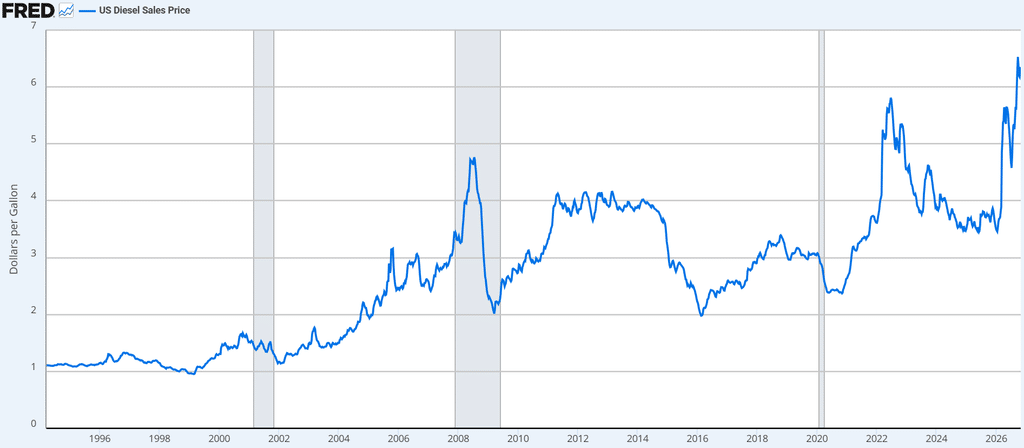
Diesel is the lifeblood of the physical economy. Every loaf of bread at your grocery store, every Amazon package on your porch, and every ton of concrete poured at a construction site relies on diesel engines. Unlike gasoline, which mostly powers commuter cars, diesel demand is stubbornly inelastic. When global distillate inventories tighten, freight costs explode, and inflation hits every single sector within weeks.
Russia happens to be one of the largest diesel exporters in the world. Removing millions of barrels per day of Russian distillate from the global pool doesn't make those barrels disappear. It forces Europe and Latin America to bid aggressively for American Gulf Coast diesel instead.
Think about what happens when European buyers outbid East Coast distributors for fuel refined in Texas. Because of the Jones Act—a 1920 maritime law requiring goods shipped between U.S. ports to travel on American-built, American-crewed vessels—it's often cheaper to ship diesel from Houston to Rotterdam on a foreign tanker than to ship it from Houston to Boston. As a result, New England regularly imports refined fuel from overseas to keep trucks running and homes heated in winter.
When politicians talk about cutting deals or easing pressure on Russian energy, they aren't always acting out of affection for the Kremlin. Often, they're staring at terrifyingly low distillate inventory numbers on the U.S. East Coast and realizing that high diesel prices lose elections faster than bad headlines.
The Moral Hazard of Quiet Compromises
Still, recognizing economic reality doesn't excuse political doublespeak. The real problem with the Trump-Putin diesel dynamic isn't just the barrels moving across the ocean. It's the gap between public posture and private policy.
You can't claim to be enforcing "maximum pressure" or achieving total "American energy dominance" while simultaneously relying on Russian feedstock to keep domestic pump prices from boiling over. Furthermore, when sanctions enforcement becomes selective or transactional, it teaches authoritarian regimes a dangerous lesson. It signals that Western red lines are always negotiable if the domestic political cost of holding the line gets too high.
For Putin, energy exports remain the single most vital revenue stream funding state operations and military expenditures. Every dollar saved on shipping discounts or shadow-fleet friction goes directly back into Moscow's treasury. When Washington signals openness to normalizing energy trade without securing concrete, verifiable geopolitical concessions first, Moscow pockets the leverage before a single contract is even signed.
How to Spot Energy Spin Before It Fools You
Politicians across the entire spectrum manipulate energy data to tell whatever story suits their campaign. Once you know how the physical barrel market works, you stop falling for lazy headlines.
Next time a story breaks about a controversial oil or diesel deal between Washington and Moscow, run it through three quick filters before taking the bait:
- Check the EIA Import Logs: Don't trust pundits quoting anonymous sources when public customs data exists. The U.S. Energy Information Administration publishes monthly country-level import figures for crude oil, distillate fuel oil, and unfinished oils. If barrels actually landed at a U.S. port, the volume shows up in black and white within sixty days.
- Separate Crude From Refined Products: A country can ban Russian crude oil while still importing millions of barrels of semi-refined vacuum gasoil or blended diesel through third-party hubs. Watch the specific product codes, not just the broad "oil" label.
- Follow the Crack Spread: Watch the price difference between raw crude oil and finished diesel (known as the heating oil or ULSD crack spread). When that spread blows out past $40 or $50 a barrel, refiners are making massive profits and governments are panicking behind closed doors. That's almost always the exact moment quiet policy waivers and diplomatic backchannels open up.
Understanding fuel markets strips away the theater. Presidents don't control global commodity prices by decree, and geopolitical rivals rarely stop trading completely when money is on the table. Keep your eye on the tanker manifests and the refinery margins—that's where the real policy gets written.