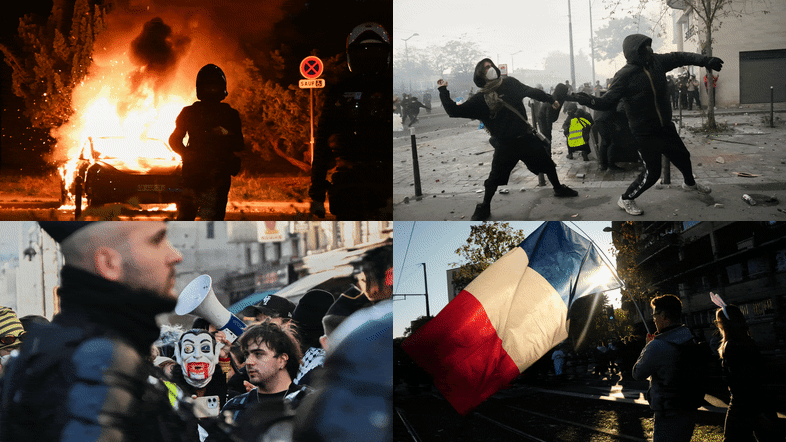
Burned cars in Paris. Smashed storefronts in Dublin. Riot police clashing with angry crowds in Brussels and Rotterdam.
When you turn on the news and see another European city erupting into chaos, the standard media explanation is almost always the same. Politicians blame far-right agitators, radicalized youth, or isolated policing failures. They treat these outbursts like sudden summer storms that blow through, break a few windows, and disappear once the streets get swept clean.
They're completely missing the point.
The wave of civil unrest shaking Europe isn't a series of random law-and-order glitches. It's the violent symptom of a deep, structural rot—a toxic mix of prolonged economic stagnation, vanishing social mobility, and a widening gulf between Europe's governing elite and the people paying the bills. If you want to understand the real risks facing Europe right now, you have to look past the tear gas and examine the quiet despair fueling it.
The Myth of the Isolated Incident
Whenever riots break out, governments reach for the exact same playbook. They condemn the violence, promise swift arrests, and deploy thousands of extra officers to restore calm. It works for a few weeks. Then another spark flies somewhere else, and the whole cycle repeats.
Take the summer of 2023 in France, triggered by the fatal police shooting of 17-year-old Nahel Merzouk in Nanterre. Within days, protests morphed into widespread looting and arson across dozens of French municipalities, causing over €650 million in insured property damage according to France Assureurs. Or look at the November 2023 riots in Dublin, where a knife attack outside a school sparked hours of anti-immigrant violence, burning buses and LUAS trams in the heart of the Irish capital. In 2024, the United Kingdom saw similar scenes erupt across towns like Southport, Rotherham, and Belfast following a tragic stabbing attack and viral misinformation online.
Different countries. Different triggers. Different political flashpoints.
Yet the underlying fuel is eerily identical. Whether the anger comes from marginalized suburban youth in the French banlieues or disenfranchised working-class communities in post-industrial British towns, the root emotion is the same: a crushing sense that the system is rigged, the future is closed off, and nobody in power actually cares. When people feel they have nothing left to lose, they stop respecting the rules that hold a society together.
Europe's Slow-Motion Economic Squeeze
You can't separate street violence from kitchen-table economics. For over a decade, much of Western Europe has been trapped in a pattern of sluggish growth that economists sometimes call "secular stagnation." While the United States powered ahead after the 2008 financial crisis and again after the COVID-19 pandemic, the Eurozone barely treaded water.
Look at the numbers. Between 2008 and 2023, per capita GDP growth in the Eurozone lagged dramatically behind the US. Then came the 2022 energy shock following Russia's invasion of Ukraine, which sent European natural gas and electricity prices skyrocketing. Inflation peaked above 10% in the Eurozone in late 2022, gutting real wages overnight. Even as headline inflation cooled through 2024 and 2025, the prices of groceries, rent, and utilities never went back down. They just stayed permanently higher.
When I speak with small business owners and factory workers across Germany, France, and the UK, the frustration isn't about abstract macroeconomic charts. It's about basic dignity. A full-time paycheck no longer buys a home in cities like Dublin, Amsterdam, or Paris. Young adults live with their parents well into their thirties because rents eat up half their net income. Meanwhile, public services—from Britain's National Health Service to German rail networks and French public schools—are visibly crumbling after years of underinvestment and austerity.
Economic despair doesn't automatically turn people into rioters. Most struggling citizens just put their heads down and grind harder. What turns quiet frustration into explosive anger is the feeling that your sacrifice is pointless while a protected class keeps winning.
Why Integration and Housing Policies Failed
Pretending that immigration and urban planning haven't played a role in Europe's unrest is dishonest, and voters know it. For decades, European governments treated immigration primarily as a labor-market fix—a quick way to fill low-wage jobs and offset aging populations—without building the housing, schools, or community infrastructure needed to absorb millions of newcomers.
The result? Hyper-segregated neighborhoods on the fringes of major cities.
In France, the post-war banlieues were built as concrete high-rise dormitories physically cut off from city centers by highways and rail lines. Decades later, youth unemployment in many of these districts still runs two to three times higher than the national average. In Sweden, a country once held up as the gold standard of European social harmony, failed integration policies and segregated suburbs in cities like Malmö and Stockholm helped fuel an unprecedented surge in gang violence and bombings that shocked the continent.
At the same time, rapid population growth colliding with chronic housing shortages created fierce competition for scarce public resources in places like Ireland and the Netherlands. When local families wait years for social housing while hotels fill up with asylum seekers, resentment boils over. Opportunistic extremists on both the far right and far left love this environment. They don't create the anger; they simply step in, hand it a megaphone, and point it at a convenient target.
The Erosion of Institutional Trust
A healthy democracy can survive economic downturns and social friction if citizens trust their institutions to handle problems fairly. That trust is evaporating across Europe.
According to regular Eurobarometer surveys, public trust in national governments and parliaments hovers near historic lows in several major EU member states. People watch politicians promise border control, economic reform, or lower taxes during election campaigns, only to deliver bureaucratic gridlock once in office. They see energy giants and luxury conglomerates post record profits while ordinary households ration heating during the winter.
Social media acts like gasoline on this dry timber. Algorithms reward outrage, tribalism, and viral clips of chaos over boring policy nuances. A single unverified rumor on Telegram or X can mobilize hundreds of angry young men onto a street corner in less than an hour—faster than police intelligence can even track the chatter. Traditional community anchors that once absorbed social tension, like trade unions, local churches, and neighborhood civic clubs, have hollowed out. What replaces them is raw, unmediated mob energy.
The Real Risks Behind the Riots
If you think the biggest danger of these riots is broken glass and burned police cruisers, you're looking in the wrong direction. Property can be rebuilt. Insurance claims get paid. The real risks to Europe are slower, quieter, and far more destructive over the next decade.
1. Capital Flight and Stalled Investment
Global investors hate unpredictability. When international companies see recurring civil unrest, frequent general strikes, and political paralysis in major European economies, they quietly move their capital elsewhere. Why build a new manufacturing plant or tech hub in a region plagued by high energy costs, rigid labor laws, and periodic street violence when North America or parts of Asia offer higher growth and greater stability? Every billion euros that flows out of Europe means fewer good jobs, smaller tax revenues, and even less money to fix the social problems driving the unrest in the first place. It's a classic doom loop.
2. The Radicalization of Mainstream Politics
When centrist governments fail to deliver security and prosperity, voters don't just give up—they reach for political wrecking balls. Across Europe, established center-left and center-right parties are bleeding support to populist movements that promise simple, radical answers to complex problems. Whether it's the rise of the National Rally in France, the Alternative for Germany (AfD), or hardline coalitions in Italy and the Netherlands, the political center is collapsing.
The danger isn't just that populist parties win elections. It's that fractured parliaments become virtually ungovernable. Minority governments spend all their energy surviving no-confidence votes instead of passing difficult structural reforms on pensions, energy, and housing. Paralysis breeds more anger, which feeds even more radicalism at the ballot box.
3. The Militarization of Everyday Policing
Every major riot pushes European democracies a little closer to permanent security states. Governments pass sweeping surveillance laws, expand facial recognition networks, restrict public protests, and equip local police like paramilitary units. While tough policing stops immediate looting, relying on force to manage deep social decay destroys the fragile consent between citizens and the state. Once young people view police officers as an occupying army rather than public servants, peaceful civic life becomes nearly impossible to maintain.
What Actually Needs to Change
You can't arrest your way out of structural decline, and you can't solve housing and wage crises with press conferences. If European leaders want to pull the continent back from this spiral, they have to stop treating symptoms and confront the root causes head-on.
First, Europe needs a serious growth and deregulation agenda—not another wave of bureaucratic red tape. Governments must slash permitting delays for housing construction, invest aggressively in reliable baseline energy (including nuclear power alongside renewables), and lower the crushing tax burden on working-class wages. People need to feel that hard work actually leads to upward mobility again.
Second, immigration and integration policies need honesty and competence. Countries must enforce clear, predictable border rules while pouring real resources into language training, job placement, and de-segregating urban housing so newcomers actually become part of the economic fabric rather than trapped in parallel societies.
Finally, local governance has to matter again. Distant bureaucrats in Brussels or national capitals can't micromanage neighborhood decay. Empowering mayors and local councils with real budgets to rebuild vocational schools, youth sports programs, and community policing gives frustrated citizens a tangible stake in their own streets.
Until Europe's leaders address the economic stagnation and institutional alienation driving the despair, the quiet periods between riots won't be peace. They'll just be intermissions.