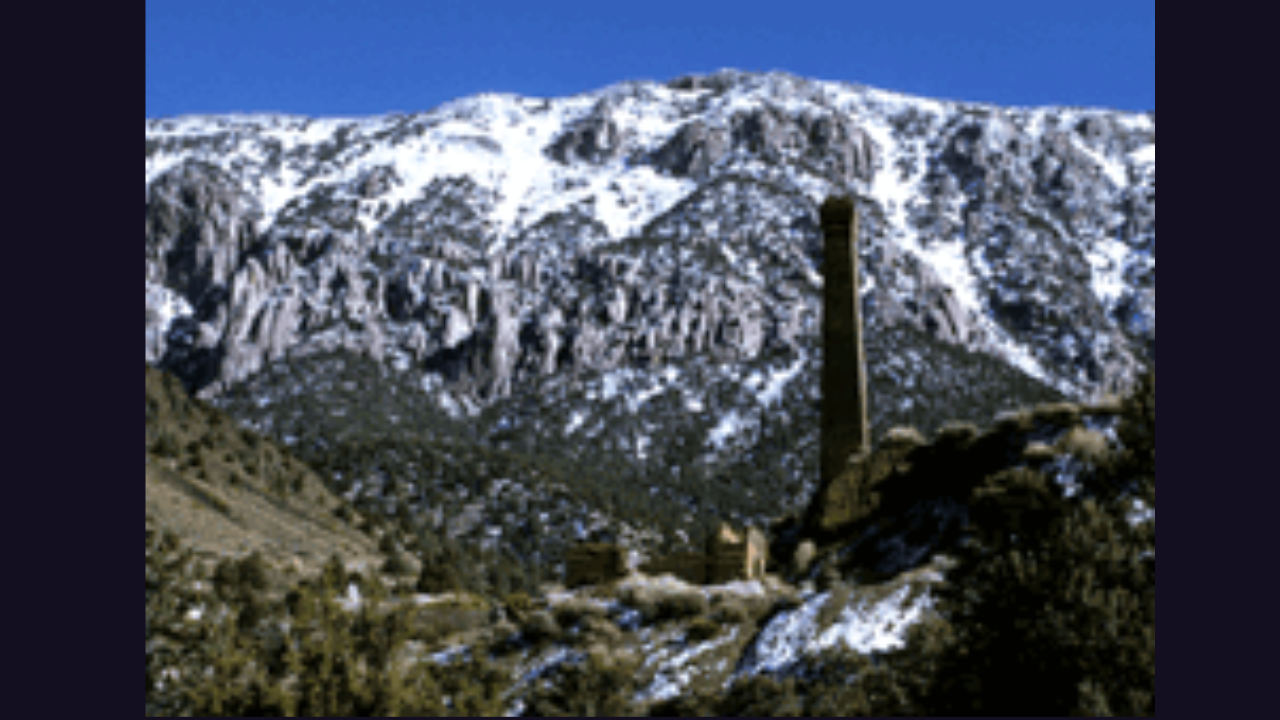
Most ghost towns leave behind a few rusted tin cans, maybe a sagging wooden saloon, and a romantic story about grit and hard work. Greenwater, California, didn't even leave the wood.
If you drive into the Black Mountains on the eastern edge of Death Valley National Park today, you'll find almost nothing. Just wind, creosote scrub, and scattered depressions in the desert floor where tents used to sit. Yet between 1906 and 1907, roughly 2,000 people packed into this waterless canyon chasing what promoters promised would be the richest copper district on Earth. By 1909, the entire operation was dead.
People love to frame the Greenwater copper boom as a tragic tale of unlucky miners defeated by a harsh desert. That's completely backwards. Greenwater wasn't a mining failure at all—it was one of the most aggressive stock-promotion schemes in American history, dressed up in canvas tents and dynamite.
How Greenwater Went From Desert Scrub to Wall Street Obsession
To understand why 2,000 people scrambled into an area with zero surface water and brutal summer heat, you have to look at what happened in Nevada just a couple of years earlier. Strikes at Tonopah and Goldfield had turned broke prospectors into overnight millionaires. Investors across the country were desperate not to miss the next big desert payout, and promoters knew it.
Copper staining had been spotted in the Black Mountains as early as 1884 by Arthur Kunze, a prospector who staked claims in the area long before anyone cared about the red metal. For twenty years, nobody bit. There was no railroad nearby, no timber for mine shafts, and no water to run milling equipment.
Then came 1905 and 1906. Electrification was booming across American cities, driving copper prices through the roof. Suddenly, those green-stained rocks on the rim of Death Valley looked like an easy fortune. Promoters flooded newspapers in Los Angeles, San Francisco, and New York with breathless advertisements comparing Greenwater to the legendary copper mines of Butte, Montana, and Bisbee, Arizona.
They didn't wait to see if deep ore veins actually existed. They incorporated dozens of mining companies, printed millions of shares of stock, and started selling dreams to East Coast clerks and West Coast speculators who had never set foot in Inyo County.
The Heavy Hitters Who Pumped the Bubble
This wasn't just small-time swindlers operating out of back alleys. Some of the biggest names in western mining threw their weight—and their marketing budgets—behind the district.
Charles Schwab, the steel magnate who had run Carnegie Steel and U.S. Steel, bought heavily into the Greenwater and Death Valley Copper Company. Patsy Clark, a prominent Spokane mining millionaire, backed the Furnace Creek Copper Company. Even Arthur Kunze teamed up with promoters to launch the Kunze-Consolidated Copper Company.
When names like Schwab hit the financial pages, skepticism evaporated. Why would a steel titan pour money into Death Valley unless the copper was really there? Shares traded furiously on exchanges from Goldfield to New York, pushing the combined paper capitalization of Greenwater mining companies past $100 million—an astronomical sum in 1906.
What Life Actually Looked Like Inside the Camp
If you've ever hiked the trails around Dante's View in Death Valley, you know how punishing that terrain is. Now imagine living there without air conditioning, paved roads, or a reliable well.
By the autumn of 1906, three separate townsites—Greenwater, Kunze, and Furnace—had merged into a single sprawling tent city stretching across the high desert basin. Roughly 2,000 residents called it home. At its peak, the camp boasted two banks, a post office, several saloons, general stores, a boarding house, and not one but two weekly newspapers: the Greenwater Times and the Death Valley Chuck-Walla.
The Chuck-Walla, published by Carl Glasscock and Earle Clemens, was a masterpiece of desert boosterism. Every issue hyped minor assay reports as world-shaking discoveries while poking fun at the daily miseries of camp life.
And those miseries were very real.
- Water cost more than whiskey. Because the local springs couldn't support a crowd of 2,000, teamsters had to haul water in barrels from miles away—including from Furnace Creek and springs across the Nevada line. A single barrel sold for anywhere from $5 to $15. People bathed rarely, washed dishes in used bathwater, and watered mules only when absolutely necessary.
- Lumber was practically nonexistent. Almost every structure in town was built from canvas stretched over light wooden frames, supplemented by flattened kerosene tins and stone dugouts. Building a proper timber-framed saloon meant freighting every single plank across miles of sand and rock from the nearest railheads at Ludlow or Tonopah.
- Summer heat was lethal. Sitting at roughly 4,000 feet of elevation gave Greenwater slightly cooler nights than the valley floor below, but daytime temperatures still routinely pushed past 110 degrees Fahrenheit. Heatstroke, dysentery, and pneumonia were constant threats.
Despite all this, the mood in late 1906 was euphoric. Miners blasted exploratory shafts down into the rock, confident that once they broke through the surface cap, they would hit massive sulfide copper deposits.
Why the Greenwater Copper Boom Collapsed So Fast
Geology doesn't care about stock prices. That simple reality killed Greenwater faster than the desert heat ever could.
Throughout 1906 and into 1907, crews sank shafts hundreds of feet deep across the district. The Greenwater and Death Valley Copper Company pushed its main shaft down past 1,000 feet. Miners kept waiting for the rich surface copper carbonates and oxides to transition into the massive, profitable sulfide ore bodies that made Butte and Bisbee famous.
It never happened.
Instead of widening into rich veins, the copper mineralization pinched out completely as the shafts went deeper. What looked like the top of a massive deposit was actually just thin, scattered surface staining leached through fractured volcanic rock. There was no deep ore body. Not a single ton of commercial copper ore was ever shipped out of Greenwater for smelting.
The Panic of 1907 Pulled the Plug
Even without the geological bust, macroeconomic reality caught up with the district in October 1907. The Panic of 1907 triggered a severe financial crisis across the United States. Banks failed, credit froze, and copper prices plunged by nearly half in a matter of months.
Speculative mining stocks were the first thing investors dumped. Overnight, the capital that kept Greenwater's payrolls running dried up. Without outside investor money paying miners to dig empty holes in the rock, the camp had zero economic reason to exist.
The exodus was immediate. Saloonkeepers packed up their bars, printers hauled away their presses, and miners walked out leaving their tents behind. By early 1908, only a few hundred diehards remained. The post office shut its doors for good in 1909, and by 1910, census takers found almost nobody left to count.
What Most History Books Miss About Greenwater
When people talk about the Greenwater copper boom today, they usually treat it as an isolated footnote in Death Valley history. Honestly, that misses the bigger picture of how western mining actually worked at the turn of the twentieth century.
First, Greenwater proved how completely detached stock promotion had become from physical reality. Promoters realized they didn't need to find ore to make a fortune—they only needed to sell the story of ore. By the time deep shafts proved the ground was barren, the early insiders had already cashed out their shares to retail investors thousands of miles away.
Second, the camp directly accelerated infrastructure development around Death Valley. To service Greenwater and nearby borax operations, Francis Marion "Borax" Smith pushed forward construction of the Tonopah and Tidewater Railroad along the eastern edge of the valley. Even though the railroad arrived too late to save Greenwater's mines, it opened up the region to freight, prospectors, and eventually early desert tourism.
Finally, Greenwater serves as a textbook warning about confirmation bias. Everyone in camp wanted to believe the copper was there. Newspaper editors spun disappointing core samples as "promising indicators," mining engineers downplayed geological red flags to keep their consulting fees flowing, and workers ignored the lack of real production because the wages kept clearing every Saturday.
How to Visit the Greenwater Site Today
If you want to see where 2,000 people once traded million-dollar mining stocks in the middle of nowhere, you can still visit the site—just don't expect a restored tourist village with gift shops and wooden sidewalks.
Greenwater sits inside the boundaries of Death Valley National Park, off Furnace Creek Wash Road (also known as Greenwater Valley Road) east of Dante's View. Because the area was thoroughly scavenged for lumber, metal, and canvas immediately after the bust, almost no standing structures survived.
If you plan to make the trip out there, keep a few practical realities in mind:
- Bring a high-clearance vehicle. Greenwater Valley Road is an unpaved backcountry track. Standard rental sedans frequently puncture tires on sharp volcanic rocks out here, and tow trucks from Pahrump or Furnace Creek will easily cost you upwards of $1,000.
- Pack way more water than you think you need. Just like in 1906, there is zero potable water anywhere near the site. Carry at least one gallon per person per day in your vehicle, even during winter months.
- Know what to look for on the ground. Because no buildings remain, look for subtle human footprints: flat, cleared rectangles ringed with stones where canvas tents once stood, rusted tin cans scattered in washes, stone foundations, and fenced-off vertical mine shafts.
- Leave every artifact untouched. Greenwater is protected federal land under the Antiquities Act and Archaeological Resources Protection Act. Picking up a square nail, a shard of purple sun-baked glass, or a rusted pickaxe head isn't just bad etiquette—it's a federal crime.
Stop by the Death Valley Visitor Center at Furnace Creek before heading into the backcountry to check current road conditions and pick up a topographic map. Take plenty of water, watch your step around open mine shafts, and see firsthand how fast a hundred-million-dollar dream can vanish back into the desert floor.