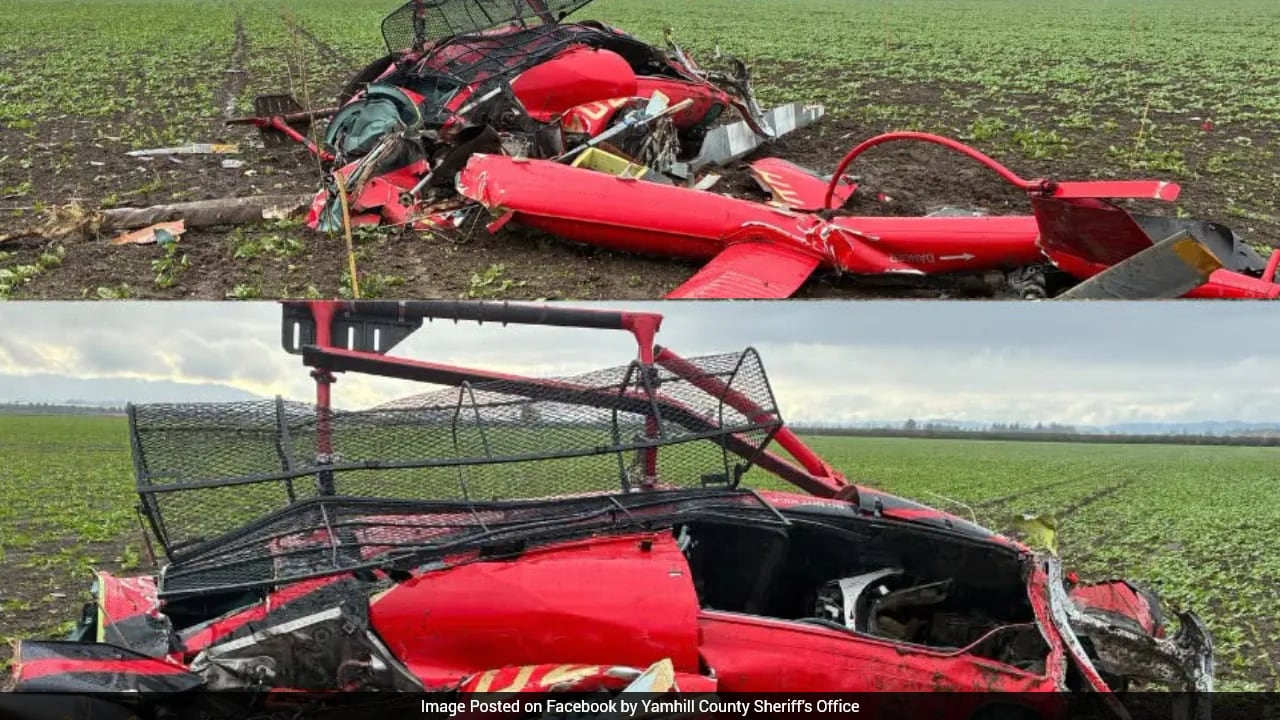
Two helicopters don't just accidentally bump into each other in an empty sky. When a mid-air collision near an Oregon airport claims three lives, the immediate public reaction is always disbelief. People assume modern aircraft are packed with radar screens that beep loudly whenever another pilot gets too close.
That assumption is flat-out wrong.
If you've ever spent time in a civilian cockpit or listened to frequency chatter around regional airfields, you know the reality is much more analog than Hollywood makes it look. Most light helicopters operating around non-towered or regional airports rely on a system called "see and avoid." It sounds simple. In practice, it's terrifyingly fragile.
Let's break down what actually happens in the airspace around regional Oregon airports, why mid-air collisions occur during routine operations, and how federal investigators piece together the final seconds before impact.
Why Airspace Near Regional Airports Gets So Crowded
Most people picture commercial airliners when they think of airport traffic. They imagine miles-long runways, massive air traffic control towers, and strict flight corridors. Regional airports in Oregon—like those in McMinnville, Aurora, Hillsboro, or Bend—operate very differently.
These hubs are magnets for flight training, agricultural spraying, logging support, and private charter hops. Helicopters love them because rotorcraft don't need long runways to operate. Pilots can hover-taxi to a side pad, lift straight out, and transition quickly into low-altitude routes.
Here's the catch.
Many regional airports either lack a full-time control tower or operate under Class E and Class G airspace rules during off-peak hours. Even at towered fields, helicopters frequently operate in dedicated training areas or low-level corridors just outside the immediate control zone. Pilots are legally required to announce their positions on a Common Traffic Advisory Frequency (CTAF).
The Blind Spot Problem in Rotorcraft
Ask any veteran helicopter pilot about their biggest anxiety during flight training, and they won't say engine failure. They'll say traffic separation.
Helicopters have massive structural blind spots. While the front bubble offers great forward visibility, the area directly above, behind, and beneath the cabin is completely blocked by the transmission, rotor mast, and floor structure. If one helicopter is descending onto an approach path while another is climbing out beneath it, neither pilot may see the other until the rotor blades are already intersecting.
To make matters worse, human eyes are terrible at spotting stationary targets on a collision course.
If two aircraft are converging at a constant angle, the approaching helicopter doesn't move across your windshield. It stays in the exact same spot, growing larger at an exponential rate in the final two seconds before impact. By the time your brain registers the silhouette, you don't have enough cyclic authority to yank the aircraft out of the way.
How Federal Investigators Reconstruct a Mid-Air Collision
Whenever a fatal crash occurs in the United States, two agencies immediately mobilize: the Federal Aviation Administration (FAA) and the National Transportation Safety Board (NTSB). Their jobs are completely distinct, though the public often lumps them together.
The FAA shows up first to check pilot certifications, aircraft maintenance logs, and airspace compliance. The NTSB takes the lead on determining the probable cause.
Investigators don't guess. They treat the debris field like a three-dimensional physics puzzle.
- Radar and ADS-B Forensics: Even if an airport doesn't have an active tower, FAA radar facilities and ground-based Automatic Dependent Surveillance-Broadcast (ADS-B) receivers record transponder pings. Investigators pull raw data packets to map altitude, groundspeed, and heading second by second.
- Wreckage Trajectory Mapping: Where the pieces land tells the story of how they met. If rotor blades shatter at 800 feet, the heavier engine blocks fall nearly straight down, while lightweight tail boom skin drifts with the prevailing wind.
- Cockpit Avionics Extraction: Modern helicopters often carry Garmin GPS units or engine monitoring systems that store non-volatile memory chips. Even after a severe post-crash fire, NTSB lab technicians in Washington, D.C. can often extract flight tracks from charred circuit boards.
- Radio Audio Synchronization: LiveATC archives and FAA facility recordings get synced to the exact millisecond of the ADS-B data. Investigators listen to hear whether both pilots were even on the same radio frequency.
That fourth point happens more often than anyone likes to admit. A pilot transitioning from a nearby regional field might still have their radio tuned to an approach frequency while entering the traffic pattern of a non-towered strip. Both pilots think they're making every required safety call. Neither hears a word the other is saying.
The Role of ADS-B and Cockpit Technology
Since January 2020, the FAA has mandated ADS-B Out equipment for aircraft flying in most controlled airspace. The system broadcasts a plane's GPS position, altitude, and velocity once every second.
It's a huge leap forward. Still, it has glaring holes.
First, ADS-B Out only transmits your location. Unless the pilot also has ADS-B In installed and displayed on a cockpit screen or tablet, they don't see incoming traffic. Second, helicopters operating low to the ground—say, 400 to 600 feet above the Willamette Valley—frequently drop below ground-station line-of-sight coverage. When an aircraft drops below radar and ADS-B receiver coverage, traffic alerts inside the cockpit can go quiet right when the aircraft enters the busy airport pattern.
Why Flight Training Multiplies the Risk
Oregon is a major hub for helicopter flight instruction. The mix of Pacific Northwest weather, mountainous terrain, and accessible regional airports makes it ideal for turning student pilots into commercial aviators.
Instructional flights introduce a very specific human factor into the cockpit.
During a training flight, an instructor and a student are heavily focused on maneuvers—autorotations, steep approaches, or hover transitions. Heads go inside the cockpit to check airspeed indicators, manifold pressure, and rotor RPM. In a helicopter, letting your rotor RPM drop too low is fatal, so pilots are trained to monitor gauges religiously.
Every second spent staring at a gauge is a second nobody is scanning the horizon.
What Actually Happens After a Fatal Crash Announcement
When local authorities and the FAA confirm fatalities following a collision near an Oregon airfield, the timeline of official information follows a strict, slow protocol. Families have to be notified before the county sheriff's office or medical examiner releases names.
Within 10 to 14 days, the NTSB publishes a Preliminary Report. Don't expect answers in that document. The preliminary report only states verified facts—weather conditions, tail numbers, flight paths, and basic witness statements.
The real answers take anywhere from 12 to 24 months.
That's how long it takes for the NTSB to publish its Final Report and Probable Cause determination. In aviation, rushing to blame a pilot before analyzing toxicology reports, mechanical teardown results, and sun-glare angles leads to bad safety policy. Investigators will actually calculate the exact azimuth and elevation of the sun at the minute of the crash to determine if one pilot was staring directly into blinding glare.
How You Can Track Official Updates Accurately
Breaking news headlines about aviation accidents are notoriously inaccurate during the first 48 hours. Early reports routinely confuse fixed-wing planes with helicopters, misstate passenger counts, or misidentify the nearest airport.
If you want verified facts rather than speculation, go straight to the primary aviation databases:
- The NTSB CAROL Query Tool: Once an investigation opens, the NTSB assigns an accident number (usually starting with WPR for the Western Pacific Region, which covers Oregon). You can search the Case Analysis and Reporting Online database directly by date and state.
- FAA Preliminary Accident and Incident Notices: The FAA updates its public aviation safety portal every morning with raw overnight incident summaries logged by regional operations centers.
- County Sheriff Press Releases: Local search and rescue teams secure the crash site first. The county sheriff's office—not the FAA—handles victim identification and ground perimeter updates.
Skip the social media rumor mills and unverified flight-tracker screenshots. Wait for the raw ADS-B tracks and the official NTSB docket to open, because in aviation safety, the actual chain of events is always far more specific than the initial headlines suggest.


