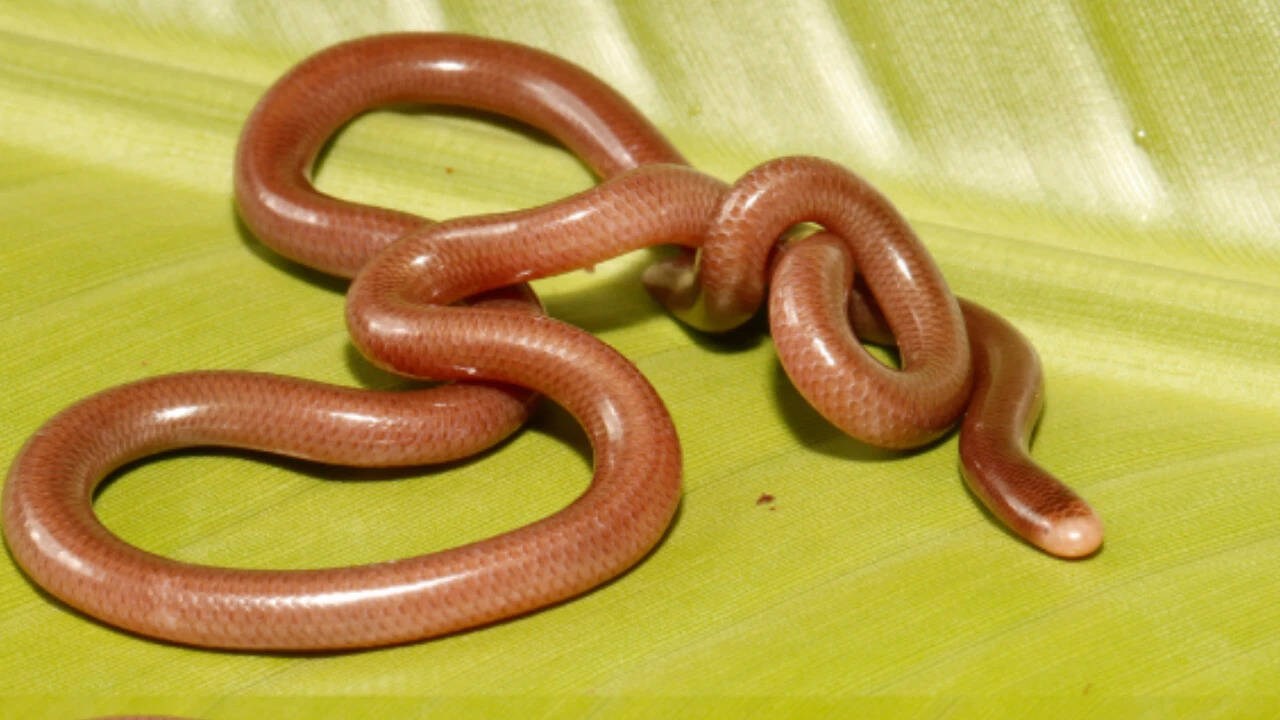
Look closely at the soil in the high-altitude valleys of Tibet, and you might spot something squirming that makes your skin crawl. Most hikers would glance down, assume it's a thick earthworm, and keep walking. They'd be wrong. Herpetologists working near the China-Nepal border recently identified a brand-new species of snake that looks remarkably like a common garden worm—and it turns out we've been misunderstanding how reptiles survive in the Himalayas for decades.
This isn't just another obscure taxonomy update buried in a dusty academic journal. The discovery of Thermophis relatives and burrowing species in the Tibetan Plateau—specifically the newly described blind and fossorial snakes from Gyirong Valley—shatters the old assumption that reptiles can't handle extreme elevation and freezing soil. If you've ever wondered how cold-blooded animals survive where human lungs struggle for oxygen, this tiny, worm-shaped reptile holds the answer.
Why This Snake Looks Like a Worm
Evolution doesn't care about aesthetics. It cares about survival. When you spend ninety percent of your life pushing through packed dirt, loose gravel, and rotting vegetation at 9,000 feet above sea level, legs are useless. Even normal snake features—like wide heads, big eyes, and bright warning colors—become massive liabilities.
Scientists studying the biodiversity of the Sino-Nepalese border in Tibet's Gyirong County documented this creature's bizarre anatomy. It's tiny, cylindrical, and lacks the distinct neck you'd see on a viper or a python. Its head is blunt and reinforced, acting like a living shovel to bore through mountain soil.
Here is what actually separates this reptile from the earthworms it mimics:
- Microscopic scales that cover its entire body, reducing friction as it tunnels underground.
- Vestigial eyes tucked beneath protective translucent scales, allowing it to sense light and dark without getting dirt scratched into its corneas.
- A forked tongue that flicks out to sample chemical trails left by ants and termites.
- A rigid skull fused together to withstand the mechanical pressure of digging through rocky Himalayan topsoil.
People often confuse these reptiles—typically belonging to blind snake families like Typhlopidae or specialized burrowing colubrids—with invertebrates. Honestly, you can't blame them. Unless you're holding a magnifying glass and counting ventral scales, the resemblance is uncanny.
The China-Nepal Border Is a Biological Blind Spot
You'd think by now we'd have mapped every vertebrate on Earth. We haven't. Not even close.
The border region between China and Nepal, particularly the deep valleys cutting through the Himalayas like Gyirong and Yadong, acts as a massive evolutionary funnel. Warm, moist air from the Indian Ocean pushes up through these narrow gorges, colliding with the freezing, arid climate of the Tibetan Plateau. That collision creates bizarre microclimates stacked vertically on top of one another. You can walk ten miles uphill and pass through five distinct ecosystems.
Because this terrain is brutally difficult to navigate—and heavily restricted due to international border politics—research teams from the Chinese Academy of Sciences and Nepalese wildlife institutes have only recently gained consistent access to sample the soil fauna. When they finally started turning over rocks and sifting through leaf litter, they realized the region wasn't a biological wasteland. It was a vault of endemic species that evolved in total isolation.
How Cold-Blooded Reptiles Survive Freezing Elevations
Reptiles are ectotherms. They rely on external heat to regulate their body temperature, which is why you don't see cobras slithering across glaciers. So how does a worm-like snake thrive near the roof of the world?
It cheats. Instead of basking in the sun like a desert lizard, this snake uses geothermal warmth and subterranean insulation. Soil temperatures a few feet underground stay remarkably stable even when blizzards hammer the mountain peaks above. By staying fossorial—living almost exclusively underground—the snake avoids the lethal temperature swings of the Himalayan air.
Its metabolism also runs in extreme slow motion. While a tropical tree snake needs to eat every few days to fuel its active hunting style, a high-altitude burrowing snake can survive on a handful of ant larvae and soft-bodied insects for months. It doesn't waste energy chasing prey. It simply tunnels straight into an underground insect nest and eats until the colony moves.
Stop Assuming Small Means Insignificant
Whenever a tiny, cryptic species makes the news, the public reaction is usually the same. Who cares? It's basically a worm.
That mindset misses the entire point of ecological health. Burrowing snakes are biological indicators. They sit right in the middle of the subterranean food web, keeping ant and termite populations in check while aerating mountain soil. Because they breathe through lungs yet spend their lives trapped in the dirt, they absorb environmental toxins and suffer immediately from soil degradation.
If these snakes start disappearing from the China-Nepal borderlands, it means the alpine soil ecosystem is collapsing long before you'd notice trees dying or snow leopards vanishing.
What You Can Do With This Information
You probably aren't booking a flight to Tibet next week to dig through mountain mud. Still, there are practical ways to apply what herpetologists are learning in the Himalayas to how you view wildlife in your own backyard:
- Look twice before reaching for garden pesticides. Most worm-like creatures you uncover while digging in flowerbeds or turning compost—including blind snakes, threadsnakes, and legless lizards—are harmless insectivores eating the exact pests destroying your plants.
- Support borderland conservation groups. Organizations like the International Centre for Integrated Mountain Development (ICIMOD) work directly across the China-Nepal frontier to protect fragile mountain corridors from unregulated road construction.
- Follow primary taxonomic databases. If you want real wildlife news without sensationalized headlines, check the Reptile Database or open-access journals like ZooKeys and Zootaxa, where researchers publish the actual field notes and DNA sequencing behind new discoveries.
The next time you see something squirming in the dirt after a heavy rain, pause before you step over it. Nature loves recycling successful body plans, and what looks like a simple garden worm might actually be a specialized vertebrate survivor millions of years in the making.


