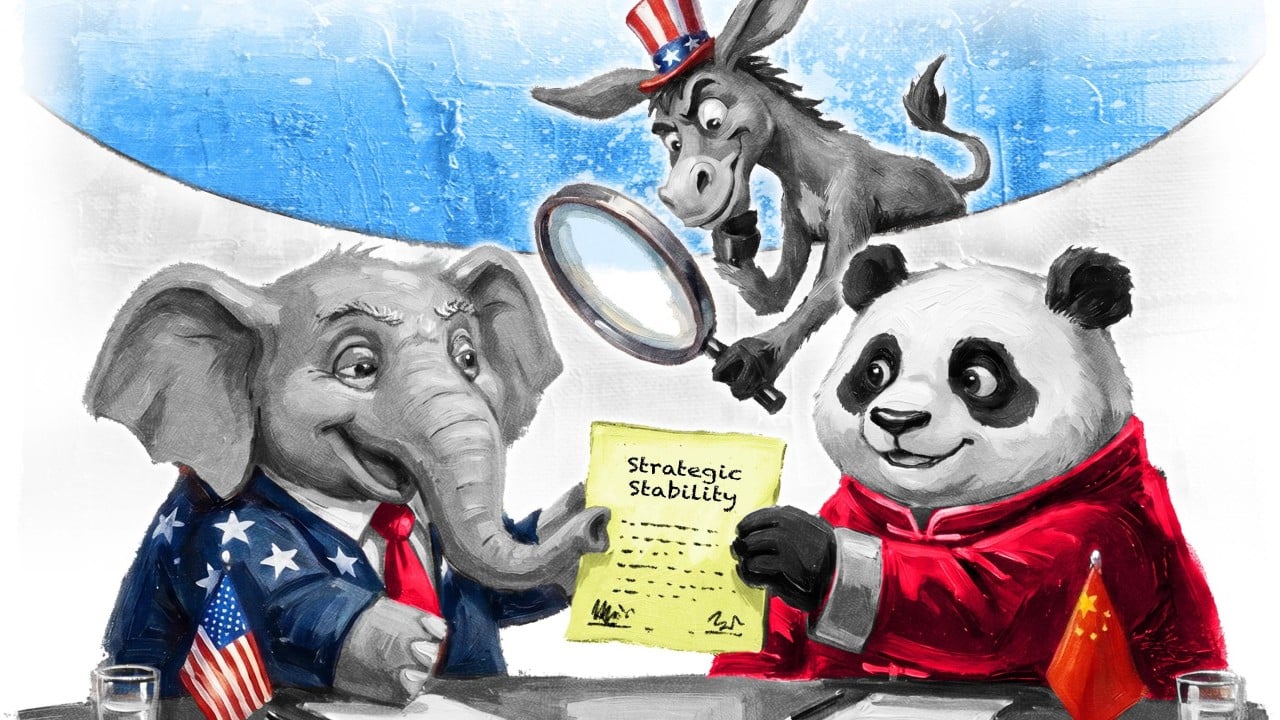
Everyone in Washington loves a dramatic foreign policy headline, especially during a midterm cycle. Right now, the favorite talking point among cable news pundits is that if Donald Trump and the Republicans take a beating at the ballot box, any hope for US-China strategic stability goes straight out the window.
It's a neat narrative. It's also mostly wrong.
If you actually spend time reading Congressional markups or watching how Beijing operates during American election cycles, you realize that domestic midterm shifts don't suddenly erase the guardrails between the world's two largest economies. Honestly, the real threat to stability isn't a flipped House or Senate. It's the structural reality that neither Washington nor Beijing actually agrees on what "strategic stability" means in the first place.
Let's break down what actually happens to the bilateral relationship when the political winds shift on Capitol Hill, why the current panic misses the mark, and where the real friction points are hiding.
Why US-China Strategic Stability Survives Midterm Swings
To understand why a midterm loss doesn't automatically trigger a geopolitical meltdown, you have to look at how American foreign policy is actually made. The president holds massive constitutional authority over diplomacy, military posture, and executive agreements. Congress holds the purse strings and controls statutory sanctions, sure, but the day-to-day management of crises—the hotlines, the military-to-military talks, the quiet diplomatic backchannels—lives entirely inside the executive branch.
Even when a president loses congressional majorities, their ability to manage great power competition rarely shrinks. In fact, history shows the exact opposite happens.
When presidents hit legislative gridlock at home, they almost always pivot harder toward foreign policy because it's the one arena where they can still get things done without asking Congress for permission. Think back to how past administrations operated during divided government. Whether it was Barack Obama after 2010 or Trump himself during his first term after the 2018 blue wave, the White House didn't suddenly surrender its diplomatic playbook to Capitol Hill.
The Rare Bipartisan Consensus on Beijing
There's another reason the "midterms will ruin everything" argument falls apart. On China, Democrats and Republicans aren't living on different planets anymore.
Ten years ago, a shift in congressional power meant a massive ideological swing between free-trade engagement and hawkish containment. Today? Both sides of the aisle are competing to see who can look tougher on Beijing. The House Select Committee on the Chinese Communist Party proved that point over and over, passing major policy recommendations with overwhelming bipartisan majorities.
Because both parties already agree on the broad strokes—export controls on advanced semiconductors, outbound investment screening, and supply chain reshoring—a midterm shakeup doesn't flip the table. It just changes who gets to hold the gavel while pushing largely similar bills.
What Beijing Actually Watches When Americans Vote
If you talk to analysts who track Chinese state media and diplomatic cables, you quickly notice that Beijing views American midterms with a mix of cynicism and cold calculation. Chinese leadership doesn't sit around hoping one American party wins so they can suddenly become best friends. They view the entire US political system as structurally hostile to China's rise, regardless of who controls the Senate.
What Beijing does watch for is predictability.
Xi Jinping and the Politburo hate surprises. When a US administration looks politically wounded after a bad midterm election, Beijing worries about two specific behaviors. First, they worry that a weakened president might manufacture an external crisis or take an aggressive stance over Taiwan to look strong domestically. Second, they worry that a lame-duck executive won't be able to deliver on whatever promises they make during bilateral summits.
Why negotiate a complex tariff reduction or a fentanyl enforcement framework with a White House if a newly empowered opposition Congress is just going to pass legislation six months later that blows up the deal? That's the real diplomatic headache. It's not that stability vanishes overnight; it's that Beijing becomes far more reluctant to spend political capital on agreements that might not survive congressional pushback.
The Real Problem With Strategic Stability Nobody Talks About
Here is the massive blind spot in almost every mainstream analysis of this topic. Pundits throw around the phrase "strategic stability" as if Washington and Beijing are reading from the same dictionary.
They aren't. Not even close.
When American defense officials from the Pentagon or the State Department talk about strategic stability, they are usually borrowing Cold War terminology. To Washington, stability means crisis management. It means having working military hotlines, clear rules of engagement in the South China Sea, nuclear risk reduction talks, and guardrails that prevent an accidental collision between a US destroyer and a Chinese coast guard vessel from spiraling into a shooting war.
Beijing hates that definition.
From China's perspective, American-style "guardrails" are just a sneaky way for the US to keep encircling China while ensuring Beijing doesn't lash out. When Chinese diplomats use the phrase strategic stability, they mean mutual respect for "core interests"—which is diplomatic code for the US stopping arms sales to Taiwan, rolling back semiconductor sanctions, and accepting China's dominant role in the Indo-Pacific.
You can see why this creates a permanent stalemate. Washington wants safety mechanisms so it can compete safely. Beijing wants concessions on its core territorial and technological claims before it agrees to turn on the safety mechanisms. A midterm election doesn't create this disconnect, and no congressional vote is going to fix it.
How Divided Government Actually Changes the Game
While a midterm loss won't blow up the entire relationship, it does change the specific levers that get pulled. If the opposition takes control of one or both chambers, the dynamic shifts from executive-led diplomacy to congressional disruption.
The Sanctions and Tariff Escalation Trap
Presidents like using tariffs and export controls as bargaining chips. You put a 60 percent tariff on the table, then you offer to pause or lower it if Beijing buys more American agricultural products or cracks down on precursor chemicals. It's transactional. It gives the White House room to maneuver.
Congress doesn't do transactional. Congress passes laws.
When an opposition Congress wants to box in a president, one of the easiest ways to do it is by passing mandatory sanctions or revoking Permanent Normal Trade Relations status. Once those measures are written into federal law, the president loses the flexibility to waive them during high-stakes negotiations. If you're watching the relationship closely, this is the exact mechanism to keep your eye on—not dramatic speeches on the House floor, but quiet legislative riders attached to the annual National Defense Authorization Act (NDAA) that tie the White House's hands.
Taiwan and Symbolic Diplomacy
Another area where a midterm shift creates immediate friction is symbolic diplomacy around Taiwan. We already saw how a high-profile congressional visit to Taipei can freeze military-to-military communications for months.
In a divided government, congressional leaders have zero incentive to coordinate their travel plans or legislative initiatives with the White House. In fact, irritating the administration's diplomatic timetable is often seen as a political bonus. If a newly empowered Speaker or Senate committee chair decides to push aggressive Taiwan defense legislation or lead a delegation to Taipei right before a scheduled presidential summit, the White House has almost no way to stop it. Beijing, meanwhile, rarely distinguishes between the legislative and executive branches—they blame the entire US government and respond with military drills around the island.
Separating Political Theater From Real Policy Shifts
If you're trying to figure out whether US-China relations are actually deteriorating or if you're just watching routine political theater, you need to ignore the cable news chyrons and look at three concrete indicators.
First, watch the working-level diplomatic calendar. Are the Treasury Department's economic working groups still meeting with their counterparts in Beijing? Are the climate envoys, counternarcotics officials, and defense policy coordinators still holding scheduled talks? As long as those mid-level bureaucrats are sitting across the table from each other, the floor of the relationship is holding, no matter how loud the rhetoric gets in Washington.
Second, pay attention to military-to-military crisis channels. The real test of strategic stability happens at sea and in the air. Keep track of the Military Maritime Consultative Agreement (MMCA) talks and communications between the US Indo-Pacific Command and China's Southern Theater Command. When those lines stay open, both sides are actively trying to prevent a local incident from becoming a global crisis.
Third, look at supply chain and capital flow data, not press releases. Politicians love talking about "decoupling," while economists and diplomats talk about "de-risking." Check the actual numbers from the Bureau of Economic Analysis or the Rhodium Group. If American institutional investors are still navigating complex joint ventures and trade volumes are simply rerouting through Vietnam and Mexico rather than collapsing entirely, the economic interdependence that anchors stability is still very much intact.
What You Should Actually Watch Over the Next Six Months
Don't let midterm election night headlines dictate how you read the geopolitical chessboard. Whether the political map in Washington shifts red, blue, or stays purple, the fundamental drivers of the US-China rivalry remain locked in place.
If you want a clear read on where strategic stability is actually heading, skip the partisan commentary and track the actual mechanics of the relationship:
- Read the NDAA conference report. When Congress finalizes its annual defense bill, look at the specific provisions targeting Chinese biotech, drone manufacturers, and maritime logistics. That's where real, permanent policy changes happen.
- Track the Treasury and Commerce Department Federal Register notices. Executive branch rulemaking on outbound investment and AI chip restrictions tells you far more about the administration's true posture than any campaign speech ever will.
- Watch Beijing's response to congressional delegations. Notice whether Chinese pushback stays limited to angry Ministry of Foreign Affairs press briefings or escalates into canceled bilateral summits and suspended military hotlines.
Strategic stability with China was never a fragile glass ornament resting solely on the outcome of a single American midterm election. It's a messy, ongoing tug-of-war between two superpowers trying to manage a structural rivalry without stumbling into a war neither side can afford. Keep your eyes on the institutional guardrails, ignore the partisan noise, and you'll see the real picture long before the pundits catch up.